


Chapter I. General Principles
Description
This section is from the book "Improved Plumbing Appliances", by J. Pickering Putnam. Also available from Amazon: Improved Plumbing Appliances.
Chapter I. General Principles
VERY great advances in Sanitary Plumbing have been made within the last few years. (a) In the endeavor to attain a practical realization of the leading principle of sanitary drainage, that waste matters should be completely removed from the dwelling automatically the instant they are formed, we find cess-pools and filth retainers of every kind rapidly disappearing from good plumbing work. The pan closet, with its huge and foul container, is now universally condemned by sanitarians, and the simplest hopper closet, with the easiest, smoothest, most direct and most restricted passage for the escape of the waste matters, is substituted for it. The old-fashioned D-trap (Fig. 1) has, for the same reason, almost entirely disappeared, and the few examples of it that still exist are becoming valuable as relics of plumbing barbarism, to be exhibited, decayed and crumbled, in museums of hygiene, to illustrate the errors of the plumbers' dark ages, or to be used on the desk of the lecturer as warnings against the storage of putrefying matter in any part of the plumbing system. The common round or pot trap (Fig. 2), near kindred of the discarded D, is still used to a considerable extent, only because until lately no better device had been discovered to do its work.
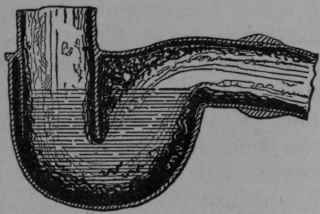
Fig. 1. - Old-fashioned D-Trap.
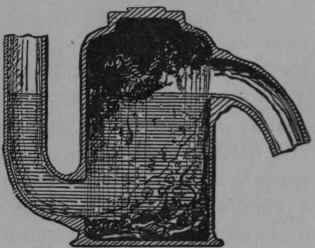
Fig. 2. - Pot-trap, after short usage under a kitchen or pantry sink.
(b) In order to purify, as far as possible, the air of the drains, and to prevent the dangerous accumulation of corrosive gases within them, thorough ventilation of all the main sewers and soil-pipes is now considered a necessity, and is always carried out in good plumbing practice. So important a change and improvement as this necessarily involves a corresponding modification and simplification of the plumbing system in other directions; but this has not always been kept in view, and much that was useful in an unventilated system of sewers has been retained through habit, after its utility has disappeared.
(c) As a further means of purification of the drainage system, the importance of thorough flushing is now beginning to be understood, and how to produce this flushing without expense or waste of water becomes one of the leading considerations in modern plumbing work.
(d) The importance of having every part of the work visible and accessible is becoming evident, and is very rapidly finding favor with the public. Until within a very few years great pains were taken to conceal, by every possible device, and at considerable expense and inconvenience, all parts of the waste-pipes and receptacles.
The result was that dangerous leakages of gas or water occurred, which could not be traced and repaired without great expense, and often not until irreparable injury had been done. Now equal ingenuity and skill is exerted to have every inch of plumbing visible and accessible, and to render it as ornamental as a combination of good workman, ship and sound, handsome material can make it.
It is the same in the construction of plumbing work as it has always been in the other branches of architecture. The decorative treatment of any purely useful part of a building is certain to follow in a higher development of the art, and a thing which, in an early stage, was treated with contempt, has often formed one of the most graceful and important features of the design.
Thus, the funnels destined to carry off the foul air and products of combustion in the house were originally concealed from view, and considered unworthy of the attention of the artist. But they afterwards became the leading ornaments of the building. So the channels designed to carry away the foul water and products of decomposition, which of late have been scrupulously concealed, are now beginning to receive the attention of the decorator, and occupy the place they deserve in the ornamental architecture of the house.
(e) To ensure greater durability and reliability, the materials and jointing of our pipe systems have been improved. Iron has been substituted for lead in the main drains, and better methods of connecting the pipes than were formerly in vogue have been devised.
(/) An especial ground for satisfaction may be found in the increasing interest taken by the public at large in sanitary matters, though this interest has not yet gone so far as to familiarize them with the details of plumbing work.
One of the principal reasons for this lack of information is the extreme complication which has crept into this department of building. In the effort to raise the standard of security, the very important principle of simplicity has frequently been lost sight of, and the error of using a complexity of machinery, when a simple means would have produced the same or a better result, has been frequently committed.
Branch-pipe ventilation has been carried to an excess; valves and other mechanical devices have been introduced, when a simple water-seal would have been preferable; disinfectants and germicides have been adopted to remove evils which have themselves no need of existing; and finally, expensive and laborious methods, particularly in pipe-jointing, are often employed, where simpler and more scientific processes are capable of producing better results.
In spite of the general progress, these errors have had the effect of lowering the confidence of the public in plumbers and plumbing work. The increasing complication and cost have given rise to a very widespread feeling of insecurity and desire to forego, as far as possible, the conveniences of set plumbing fixtures in the house.
This anxiety on the part of the public has, however, not been without its beneficial result. A favorable reaction has set in, and the simpler appliances and methods are rapidly taking place of the more elaborate and complicated ones, wherever their principles have been made known.
Let us examine more in detail the considerations briefly outlined above, with a view to guiding us in the choice of our plumbing appliances.
It is evident that (a) there should be no unnecessary obstruction to the rapid removal of the sewage from its point of generation; that the waste-pipe system should be freed as far as possible from the gaseous products of decomposition through judicious (b) ventilation and (c) flushing; that (d) every part of the plumbing should be, where possible, visible and accessible; that (e) all parts should be of sound material tightly put together; that (f) the whole should be as simple as is possible, consistent with security, effectiveness and convenience; and that, moreover (g), the appliances should be as far as possible automatic, noiseless and eco. nomical. These are self-evident desiderata - plumbing axioms, as it were - and those appliances which conform to them in the highest degree may be accepted as the best.
(a) Rapid removal of the wastes.
Under this requirement the soil and waste pipes should contain no chamber for the accumulation and retention of sewage, where putrefaction can take place, and foul and corrosive gases arise to disperse themselves throughout the pipe system, impregnating the water-seals of the traps, corroding the metal of the pipes, and lying in wait to press into the house at the first unguarded entrance.
The common cess-pool is the most familiar and dangerous illustration of the violation of this rule, and enough has been written of late years by sanitarians to show its evils. The old-fashioned large brick cellar-drain formerly used as a horizontal continuation of the soil-pipe, soaked and smeared in its unscoured corners with filth, is another illustration of a fast-disappearing analogous error in construction. The main horizontal drain as well as the soil-pipe are now made of smoothly-coated heavy iron pipes no larger than is absolutely necessary to carry off the wastes without stoppages. The internal diameter should seldom be more than four inches.
The old-fashioned D and the modern round or pot traps are other familiar examples, on a smaller scale, of the objectionable cess-pool.
The ordinary slow-wasting lavatory, discharging a stream not over a tenth as large as the capacity of the waste-pipes which serve them, converts these waste-pipes into small elongated cess-pools, which thus form still another and almost universal illustration of a violation of this principle.
Finally, the pan, valve and plunger closets are recognized by sanitarians as defective, largely on account of the container or receiver which forms a necessary part of their construction.
Let us now examine the various plumbing appliances in use, and see how far they conform to the requirement under consideration. Afterwards we will review them from the standpoint of the other desiderata or axioms enumerated above in their order, and we shall then be in a position to decide intelligently and independently as to their relative merits.
We shall confine our attention to Lavatories (including Wash-Basins, Bath-Tubs, Kitchen and Pantry Sinks), Water-Closets (including Urinals and Slop-Hoppers), Traps and Waste-Pipes.
Continue to:


My Books

