


Good Material And Construction
Description
This section is from the book "Improved Plumbing Appliances", by J. Pickering Putnam. Also available from Amazon: Improved Plumbing Appliances.
Good Material And Construction
The construction of all lavatories which have lead overflow-pipes connected with the earthenware by means of putty is evidently very faulty. Those which, like the waste-cock outlet basin of Fig. 3, are of complicated construction, requiring the coupling together of very many separate pieces, are still more faulty. The ordinary "Boston Waste" Basin (Fig. 18) requires twelve joints to adjust its waste fittings and trap below the slab, namely; six wiped solder joints, one putty and five threaded joints. Fig. 19 shows this complication carried to an extreme. It has lately been patented in the United States, and serves to illustrate construction faulty in a great many ways.
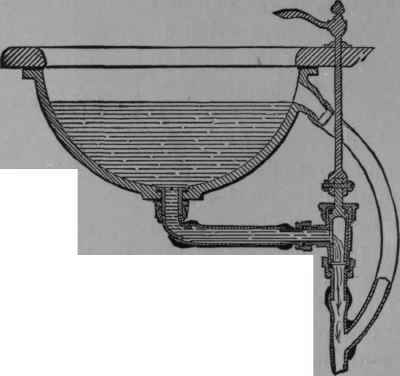
Fig. 18. - Boston Waste.
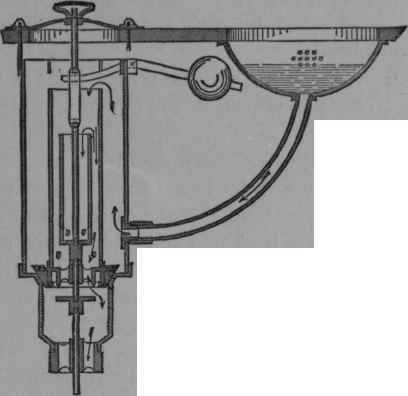
Fig. 19. - Complicated Lavatory Fittings.
The first mistake made in developing this apparatus is the supposition that a mechanical seal was necessary for safety. The outlet is closed by a large valve, which must be lifted by hand to discharge the water. The overflow outlet is closed by a smaller valve, within the first, and opened by the weight of the water accumulating in the cylinder above it.
It is easy to see that this complicated device affords abso lutely no security beyond that which a good water-seal would give, and that the principle of the overflow mechanism is entirely faulty, inasmuch as its valve would remain constantly partly open under a very slight accumulation of sediment either under its seat or in the small outlet holes above. The second mistake is in supposing that the working parts of so complicated a machine could be maintained in good order; and the third is in imagining that anyone could be found willing to purchase so elaborate and costly a plumbing appliance.
Exactly the same faults exist in the common pan, valve and plunger closets. The mechanical seals add absolutely nothing to their security. They are constantly getting out of order, and there is a constant tendency to reduce the strength and quality of their machinery, in order to enable them to compete in price with the simpler and more effective hopper water-closets.
The construction of the ordinary pipe-joint is unquestionably as defective as anything in the entire domain of modern building.
The gasket of jute or other similar fibre used to retain the lead frequently allows it to run to waste and obstruct the bore of the pipe. The lead shrinks as it cools, and requires the use of the calking tool to expand it again and drive it into the cavities of the iron. Even the most skillful and conscientious operator can never be sure that his work has been properly done until the hydraulic test is applied, and the work at best is tedious and expensive, and is liable to crack the pipe in some place where the injury may escape detection for some time. Even if, after much labor, a joint has 'been made to stand the hydraulic test, its tightness is very soon destroyed by the expansion and contraction of the pipes caused by the passage through them of hot water or steam. The expansion of the spigot is in such cases greater than that of the hub or bell, on account of its position relatively to the hot fluids. Hence, the lead is temporarily compressed between the spigot and bell, and being inelastic, does not resume its original bulk when the pipes cool again. A minute opening is thus formed all around the spigot, and the joint leaks gas.
The longitudinal expansion and contraction of the pipe, as well as any settling or jarring of the building, also affects often still more seriously the bell and spigot joint, for the spigot is easily drawn away from the bell, having nothing but the friction of the packing to resist the separating force.
Another serious objection to this form of joint is the difficulty of taking the pipes apart for repairs or alterations after they have once been put together. The usual way is to break to pieces one or more of the lengths to be separated, and then remove them by degrees. There is, in fact, no practical alternative. Melting would be dangerous and expensive, and involve the disjointing of several pipes to enable one to be lifted two inches out of the bell of another.
The necessity of using fire in a house strewed with carpen-ters's litter to melt the lead, is another serious difficulty.
The temptation to fraud, already referred to, is another objection.
The liability to obstruction caused by careless use of the jute, by which it is driven too far into the bore of the pipe when packing in it for lead pouring, is again an objection.
Finally, one of the most serious defects of the joint is usually overlooked altogether. Its form is such as to enable it to destroy the signs of its own defectiveness. The spigot descending into the bell prevents the timely warning which a leakage of water would give, and allows the rising gases of decomposition to enter the house where the falling water would be warded off. The constant gas leakage may be too minute in quantity for detection by the senses, and yet be sufficient to engender disease in the house.
We cannot comfort ourselves by the thought that rust will ultimately close up any small crevices that may originally exist between the bell and the spigot, because these two members are too far apart to be united by such an agent, and, moreover, the filling materials between them interpose an effective barrier to any such beneficent action.
Thus, the ordinary pipe-joint is totally unreliable, incapable of resisting the effects of expansion and contraction or heavy strains, difficult to connect and impossible to disconnect, conducive to fraud, treacherous and expensive of time and material.
Continue to:


My Books

