


Accessibility And Visibility
Description
This section is from the book "Improved Plumbing Appliances", by J. Pickering Putnam. Also available from Amazon: Improved Plumbing Appliances.
Accessibility And Visibility
All plumbing fixtures having hidden overflow, supply or waste passages should be avoided, because a leak or defect in them may escape detection until serious injury is done, and because after the defect has been discovered it is expensive and sometimes altogether impossible to repair it.
The lead overflow passage of the ordinary plug and chain lavatory, for instance (Fig. 15), is usually connected by a putty joint. The putty becomes exceedingly dry and brittle after a short time, and frequently cracks and causes leakage. The joint, being high up under the slab and at the rear, is difficult of access and awkward to repair.
With water-closets this principle is still more important than with lavatories. Every part should be easily accessible from the outside. Especially should the trap be both visible and accessible, in order that it may always be known if the water-seal be intact and that no decomposing filth be left in it to pollute the atmosphere of the house. It is, moreover, necessary frequently to remove the water entirely from the trap and overflow passage of the closet in closing up houses which are to be left unoccupied during the winter. It should be possible to do this, and to plug up the outlet against the entrance of soil-pipe air, without difficulty or the necessity of taking the apparatus apart.
We see how this principle is violated in the pan, valve and plunger closets (Figs. 7, 8 and 9). The same may be said of most forms of the "Wash-out" closet, shown in Fig. 16. Should the trap seal of this closet be broken at any time through any cause, such as faulty setting, evaporation, siphonage, leakage, capillary attraction, or other cause, the trouble could not be seen from the outside, and serious damage might be done before the defect was discovered. The same serious defect exists in all those forms of water-closets which have double traps one under the other.
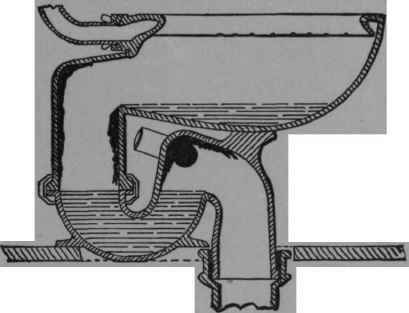
Fig. 16. - Wash-out Closet.
The principle is applicable equally to valves and cisterns, particularly for water-closet service. All the working parts should be exposed to view and readily accessible without expert aid or special tools. In short, every part of the plumbing of the house should be exposed, so that there will not be an inch of surface which cannot be readily reached by the owner, and wherever it is possible, every inch should be in open view.
We rarely see this rule carried out in regard to the piping. An entirely groundless impression prevails that an exposure of the piping throughout would be unsightly and objectionable in some way. A practical trial, however, shows this to be erroneous. The pipes neatly arranged and jointed, lacquered and painted, form ornaments rather than the reverse. Brass and lead pipes should be lacquered, and iron pipes should be bronzed, silvered, gilded or painted like steam pipes. Wherever possible, toilet rooms should be planned to come over each other in the several stories of a building, so that the waste and supply pipes and bath-tub traps of one should appear on the ceiling of the toilet room or china closet below. The china closet waste-pipes will be laid on the cellar ceiling below. It will rarely be found necessary in a properly planned house to run the pipes on the ceilings or walls of important ornamental rooms. If, however, in exceptional cases this becomes necessary, panelled casings with hinged doors extending the whole length of the panels, whether they run horizontal or perpendicular, may be built around the pipes, and a little ingenuity will render these panellings ornamental features in the architecture of the room. Or if, by any exceptional chance, it is necessary in some places to run pipes between the floor joists, the floor above them must be arranged in the form of a hinged trapdoor to lift and expose the entire length of the piping. As a rule, however, piping, whether supply or waste, should never under any circumstances be placed between floor joists, because the jointing and general workmanship on concealed pipes is as a rule inferior; imperfections and leakages are more difficult to detect; properly constructed floor panels are expensive to make and troublesome to handle on account of tiling, hardwood flooring or carpeting; and defects are so much more difficult to repair in these contracted spaces that the work must often of necessity be improperly done.
A house owner who has once experienced the comfort of having every pipe laid in a skillful and ornamental manner in full view, will never return to the foolish custom of having them concealed.
The main drain-pipe in the cellar should never be laid beneath the concrete, but should be secured to the main walls or hung to the joists or rest on the concrete, always in some easily accessible position. Sometimes it may be necessary to make a trough in the concrete with a gentle pitch toward the sewer. Where the main drain passes through the foundation wall, it should have ample space. The hole through the masonry should be twice as large as the diameter of the drain, to allow for settlement, and the drain should pass through the centre of the hole.
Piping should never be laid in slots in the masonry, unless the slots are at least three times as wide as the diameter of the pipes at their flanges, and of depth no greater than the diameter of the pipe. Architects make the great mistake of planning deep and narrow slots for plumbing pipes. The result is that the pipes are improperly jointed; and, worse still, repairs are rendered next to impossible in these places. No line of piping should ever, under any circumstances, be run up in front of another in such a manner as to render easy access to the first impossible. This is a very common fault among plumbers. To repair the covered pipe is next to impossible, and sometimes involves tearing down both stacks to get at a few defects in the covered one. A space, equal at least to the diameter of the pipe, should always be left between each line.
A very important point, usually entirely overlooked in plumbing, is that every part of the material used in jointing pipes should be visible from the outside. With lead and brass pipe this principle is observed; but with iron pipes it is not. The common joint for iron pipes is the bell and spigot joint, shown in section in Fig. 17. The joint in this kind of pipe is supposed to be made of good lead, run in between the spigot and bell, and afterwards calked by hand to make it tight. A properly made joint of this kind should consume a pound of lead to every inch in the diameter of the pipe. Hence a four-inch pipe should have four pounds of lead in each joint, allowing for waste. Now, one of the most discouraging things the honest plumber has to encounter is competition with unscrupulous members of his craft, who are able to conceal behind the shelter of the bell fraudulent substances like sand and paper, instead of solid lead, with little risk of detection. A small quantity of lead poured over the worthless stuffing below gives to the joint an honest appearance, and the "skin" plumber is thus able to take contracts away from his more worthy competitors. In short, the ordinary bell and spigot joint offers a premium on dishonesty. The concealment it affords is a powerful incentive to fraud. These false fillings are well known to be very common. Indeed, it is seldom that the full weight of lead possible, and the thorough calking necessary to insure absolute tightness, is found.
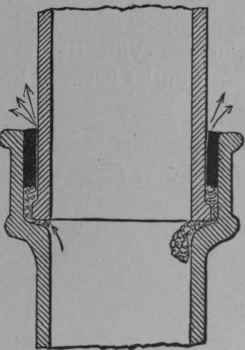
Fig. 17. - Bell and Spigot Joint.
A perfect pipe-joint should have such a form that all the packing material used should be distinctly visible from the outside, and where this packing consists of lead, it should be left without covering of paint or putty, in order that its presence all round may be detected at a glance.
Continue to:


My Books

