


Chapter V. Simplicity And Economy
Description
This section is from the book "Improved Plumbing Appliances", by J. Pickering Putnam. Also available from Amazon: Improved Plumbing Appliances.
Chapter V. Simplicity And Economy
IT might seem superfluous to argue that the greater the simplicity and economy of our plumbing, consistent with security, convenience and effectiveness, the better. But we find even those who are generally regarded as authorities in sanitary science fall into the error of writing that "good plumbing is always more costly than bad plumbing." In fact, this mistake is at the present time a very general one, and it is often thought that the plumber profits by an unavoidably increasing complication at the expense of the public.
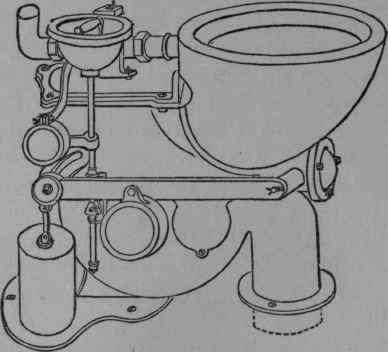
Fig. 20. - Complication in Water-closets.
Now, it is in no respect less true with plumbing than it is with every other purely useful art, that, other things being equal, the simplest and most economical is the best.
The cost of constructing a complicated water-closet, like that shown in Fig. 20 (until lately one of the most popular forms in England), is very much greater than that of a simple hopper water-closet; yet the latter, if properly designed, is immeasurably superior to it. The great cost and complication of basins like that in Figs. 18 and 19 of the preceding chapter do not render them superior to the simpler forms; and the elaborate and expensive mechanical and mercury seal traps are not so serviceable as a simple water-seal trap of proper form.
It is the same with systems of piping. The less we can have of it to accomplish our purpose the better. Every unnecessary joint adds to the danger of leakage and to the difficulty of maintaining it in good repair.
Fig. 21 represents the piping of a slop-sink in a house lately built on Fifth avenue, New York. The sink forms one of four built over each other in successive stories, and all the pipes shown in the drawing are built for their service. Each sink is vented just below its strainer into a large galvanized iron ventilating flue. The trap is separately vented into a 3-inch cast-iron flue. A lead safe is used under the sink at the floor, and this drains through a strainer into a 1 1/4-inch galvanized iron waste-pipe leading to the cellar. The rest of the piping shown consists of a double set of hot and cold water brass supply pipes, one for street and the other for tank pressure. So much for a slop sink! No expense has been spared to render the mechanical part of this job perfect, and it is, in fact, a very beautiful piece of workmanship. Yet it is not good plumbing. In the first place, no proper means of flushing the apparatus has been provided. In the second place, the outlet and trap-vent pipes, which both enter cold flues, are worse than useless. In the third place the safe and its waste-pipe are superfluous; and in the fourth place, the whole fixture is an unnecessary nuisance in a private house. Even where a proper flushing rim is provided for slop-hoppers, servants will not make proper use of it, and the fixture soon begins to emit a disgusting odor.
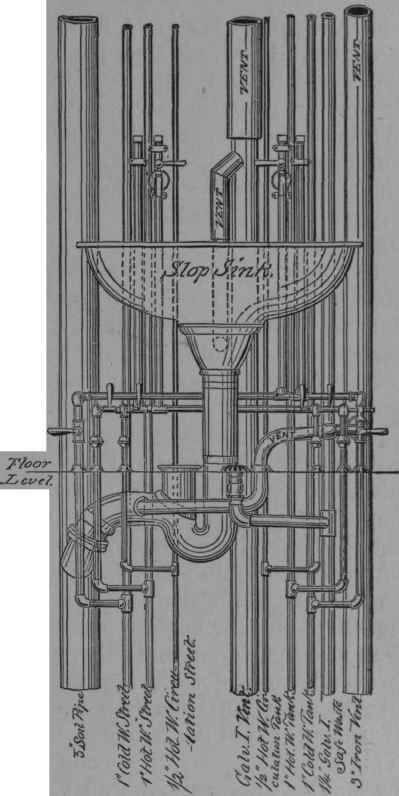
Fig. 21. - Complication in Piping.
In hotels and large club houses where their service is constant and under systematic supervision, and special attendants are detailed to take charge of them, their use may be recommended; but in private houses they should never be used. A good water-closet is much better, and need be no more expensive. It serves the purpose of a slop-hopper equally well, and being necessarily periodically flushed, it is without its objections. Formerly, when valve, pan and plunger closets were used to the exclusion of the improved hopper water-closets of to-day, there was some reason for the existence of the slop-hopper. In these closets, the closure of the outlet by the pan, valve or plunger was apt to cause an overflow of the slops when a large pailful was poured in quickly. But the modern hopper has a clear, open passageway into the drains, and being provided with the most improved form of flushing apparatus, is, in fact, the best form of slop-hopper that has been devised. Some persons argue that the utility of the slop-hopper or sink lies in the strainer. This serves, they say, to prevent the obstruction of the drain by scrubbing-brushes, rags, large cakes of soap, or other household articles used in scrubbing, capable of clogging the soil-pipe, which a careless servent might throw with the slops into the sink. This office of the strainer is certainly a useful one, and if every story in the house contained a slop sink convenient of access containing such a guard, and every water-closet had a movable or portable strainer, endowed with sufficient intelligence to close the outlet only when slops were poured in, the soil-pipes might actually be protected from the gross carelessness referred to. But as such a liberal distribution of slop-hoppers throughout a private house is out of the question, and as slops are collected on every story of a house as well as in the attic, no servant careless enough to throw scrubbing brushes into a water-closet trap would take the trouble to lug slops all the way up to the slop sink in order to protect the neighboring water-closet from such an accident, or, in other words, mount one or more flights of stairs to avoid the trouble of removing the scrubbing brush from the slop-pail.
The same prohibition must be placed on urinals in private houses. They are always very objectionable things, only to be endured when it is absolutely necessary, and this never happens in private houses. Urine undergoes rapid decomposition and then gives off a powerful and nauseating odor. When in this state it has the peculiar property of turning fresh urine into the same condition almost immediately, so that, unless the urinal be kept absolutely clean, it becomes a constant nuisance. It is much better to use a good water-closet raised to the height of a urinal upon a small platform, whose front edge comes out flush with the front of the water-closet bowl. For convenience of use as a water-closet, the platform may have two small projections at the right and left to serve as foot rests, leaving a space of eight or ten inches between to permit of access to the fixture when it is used as a urinal.
Continue to:


My Books

