


Simplicity And Economy. Continued
Description
This section is from the book "Improved Plumbing Appliances", by J. Pickering Putnam. Also available from Amazon: Improved Plumbing Appliances.
Simplicity And Economy. Continued
The writer has found by experience that this form of urinal never becomes foul, nor is its use as a water-closet attended, with the least inconvenience. The bowl, containing a large body of standing water, dilutes the urine, and prevents its fouling the sides. Habit with water-closets leads to its flushing after its use as a urinal at times when the ordinary form of urinal would have been left unflushed. But should, by any chance, the flushing be neglected, the next use of the fixture as a water-closet would insure its cleansing. Thus, by combining the two fixtures in one, we combine at once simplicity, economy, and avoidance of smell, of waste of water and of offensive appearance. The arrangement permits of use by both sexes, a consideration of much importance, especially in the hall of a private house, where the want of space limits one to the use of a single fixture.
To return to the drawing, Fig. 21. The upper vent-pipe, which is intended to ventilate the waste-pipe between the outlet of the fixture and its trap, corresponds with the overflow vent-pipe often recommended and carried out in the plumbing of costly buildings. This vent-pipe, in order to be operative, must be carried into a special heated flue, and where it is possible, it is so treated. As it is desirable in most places to place the trap as near to the fixture as possible, and the overflow vent must evidently be below the junction of the overflow pipe and the trap, it follows that the mouth of this vent-pipe must come close to the water-seal of the trap. The inevitable result is a very rapid destruction of this seal by the two currents of air passing over it, one of air from the room on the house side, and one of soil-pipe air on the sewer side of the trap. Hence, the owner who can afford the pleasure of having this double venting, must also provide himself with a trusty and ever-watchful attendant to repair the mischief they make whenever the fixture is left unused for two or three days at a time.
At the floor level a lead safe is provided, which drains into the special waste-pipe leading to the basement. To be consistent this special waste-pipe should also be vented, for, if it is ever to come into service at all, its service will consist in carrying off dirty water. A trap at its bottom will inevitably soon have its stagnating seal evaporated out, and air from the basement will rise through it into the room, carrying with it the impurities coming from the entire length of the pipe. With a simpler system of plumbing one of the chief objects of a safe and its waste-pipe would be eliminated, and this item of expense, complication and danger would be avoided.
Thus, one evil involves another, unnecessary complications exact others which are necessary, and a departure from the all-important rule that "other things being equal, the simplest is the best" is certain to result in an endless train of cares and troubles.
Fig. 22 shows a portion of the piping of a wash-basin and bath-tub in another New York residence. Part of the casing is removed in the drawing to show the work. What wonder that the poor plumber makes his frequent and serious blunders in the connection of his pipes - "bypasses," so called, which open unexpected avenues for the entrance of "sewer gas" into the house - when he finds such complication as this required by law! What wonder that the unhappy house owner becomes utterly discouraged at the sight of all this confusion, and thenceforth resolves to make it his chief mission in life to dissuade his friends from indulging like him in the luxury of set plumbing!
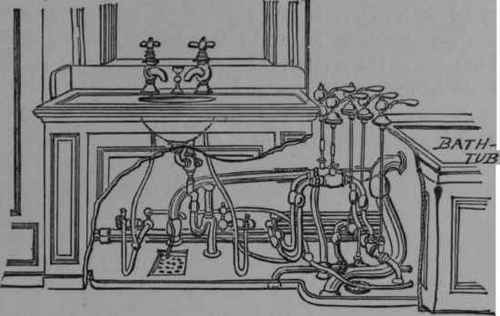
Fig. 22. - Complication in Piping.
The money thrown away on all this worse than useless piping should have been devoted to obtaining stronger and better fixtures, setting them in a handsome and workmanlike manner, and surrounding them with smooth white tile or marble work.
In another chapter we shall show how these fixtures might have been safely plumbed in a simple manner.
Economy of water in the usage of the fixtures and of labor in keeping them in repair are very important considerations which come under this head. A water-closet should be constructed in such a manner as to use every drop of water to the best advantage in flushing. None should be wasted, as it is in the mechanical seal closets and in the short and long hoppers of the ordinary kind (Figs. 23 and 24). These two last closets are appropriately called "dry" hoppers, because they contain no standing water in the bowl to receive the wastes. Hence, their sides become quickly foul, and constant attention and disagreeable labor is required for their cleansing. On account of this defect dry hoppers command but a low price. They are bought to save in first cost under a false idea of economy. They should never be used in the better class of houses, because the trouble necessary to keep them clean will not be endured; nor in the poorer class, because the trouble will not be taken and the closet soon becomes a nuisance in the house. If by exception, cleanliness in this direction be insisted upon, the extra labor and consumption of water soon offsets the saving in first cost. It is easy to see that the water required for cleansing the dry hopper is very much greater than that which is needed by the "improved" kinds, whether the scouring be done by the strength of the flush or by manual labor, for, as is well known, soil adheres with the greatest tenacity to a dry surface. In view of this fact, dry hoppers have to be constructed with a copious and powerful flush, and there is a strong temptation for the user, and especially for servants having them in charge, to try to remove the tenacious substances by prolonged flushing in order to avoid a disagreeable manual labor. This practice occasions a waste of water far greater than is generally supposed. An effort has been made to overcome this objection by using a valve or cistern constructed to give a small preliminary wash before using. But this complicates both the construction and the operation, and adds enough to the first cost to go far towards paying for a closet of proper construction. The preliminary wash is, moreover, often insufficient for the purpose, and is always, so far as it goes, wasteful of water.
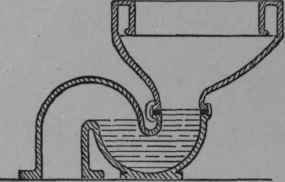
Fig. 23. - Short Dry Hopper.
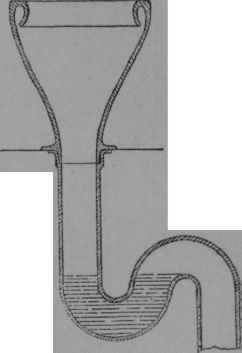
Fig. 34. - Long Dry Hopper.
Continue to:


My Books

