


Pantry Sinks
Description
This section is from the book "Improved Plumbing Appliances", by J. Pickering Putnam. Also available from Amazon: Improved Plumbing Appliances.
Pantry Sinks
The best material for these is tinned and planished copper, weighing from sixteen to twenty ounces to the square foot. Iron and earthenware sinks are made, but they are objectionable on account of their hardness, exposing dishes and glassware to greater danger of breakage. The copper is not surrounded by the rough frame as in bath-tubs, but stands free, and hence has great elasticity and yields to pressure. Cherry slabs are again preferable to marble, on account of their comparative softness. They should be set open, as shown in Fig. 60. The stand-pipe overflow and ample outlet is peculiarly desirable for pantry sinks. Since these fixtures are used for dish-washing, quantities of grease are carried into the pipes, and it is essential that the discharge should be free and rapid in order to prevent their clogging. The usual form of sink outlet is utterly inadequate, and furnishes a water-way in size but a fraction of that of the waste-pipe beneath it. When the ordinary plug is raised the water escapes slowly in a feeble stream, allowing the grease and sediment to deposit itself on the sides of the waste passages. When the usual concealed overflow passage comes into play the floating grease and other organic matters line its interior surfaces, and this sediment decomposing diffuses its unwholesome odors throughout the house, the air current conveying the products of decomposition being set up between the outlets of the fixture and of its overflow. These concealed overflow passages "are," as Col. Waring says, "practically never reached by a strong flushing stream, and their walls accumulate filth and slime to a degree that would hardly be believed. . . . They are more often than any other part of the plumbing work, except the urinal, the source of the offensive drain smell so often observed on first coming into a house from the fresh air. . . . Where the waste-pipe is closed at the bottom of the overflow by a plug or valve attached to a spindle rising through the overflow-pipe - a very favorite device with some plumbers - the difficulty is in every way aggravated, and the amount of fouled surface is much increased. The inherent defect here illustrated attaches to every overflow of this general character connected with any part of the plumbing work. In the case of a bath-tub it may very easily be avoided. Unfortunately such a substitute for the ordinary overflow is not applicable to wash-bowls as now made. It may be made available for pantry sinks if the pipe can be so placed in a corner (or niche, as shown in Fig. 58,) as not to interfere with the proper use of the vessel. If its universal adoption for bath-tubs could be secured, a very widespread source of mild nuisance would be done away with." (This was written before the stand-pipe overflow basin, described in the last number of this series of articles, had been placed upon the market, but after its invention and after the description of the stand-pipe pantry sink, with niche, illustrated by William Paul Gerhard in his "Drainage and Sewerage of Dwellings.")
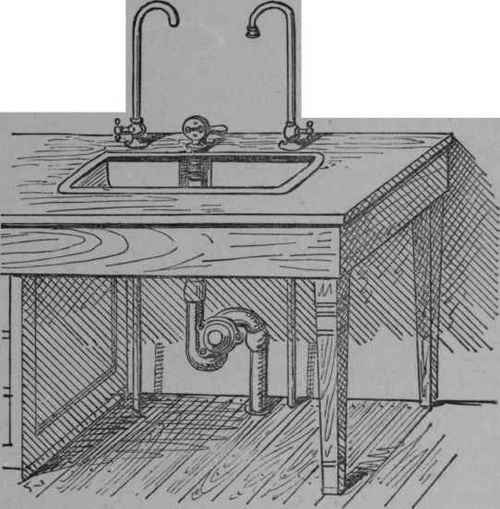
Fig. 60. - Improved Pantry Sink.
The stand-pipe in pantry sinks should be made of metal, like the rest of the fixture, since porcelain would be in danger of fracture in dish-washing.
Continue to:


My Books

