


Choosing the Right Kind of Bees. How to Begin. Equipment Necessary
Description
This section is from the book "Better Beekeeping Or How We Made Bees Pay", by D. F. Rankin. Also available from Amazon: Better Beekeeping: The Ultimate Guide to Keeping Stronger Colonies and Healthier, More Productive Bees.
Choosing the Right Kind of Bees. How to Begin. Equipment Necessary
5. Choosing the Right Kind of Bees
The little brown or black bees first imported from Germany are nervous and usually cross. They sting at the least provocation and often meet the beekeeper half way when he goes out to the hives. When the hives are opened and the frames handled, they run across the combs and often drop off in bunches.
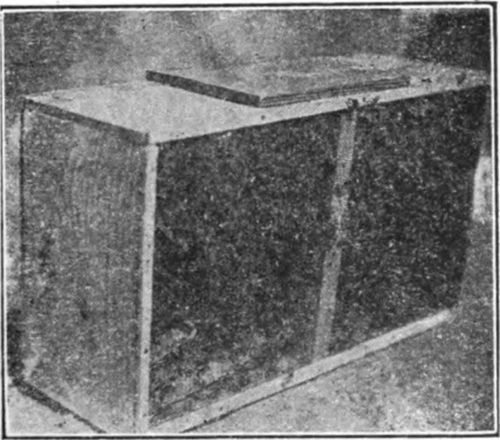
Three-pound package of bees as shipped. (Full directions for putting bees in hives are included).
Italian bees are larger and gentler; they produce more honey. When a hive is smoked and is opened, they arc found eating honey from the cells with their probosises. If pure they have three or more yellow bands across their abdomens. They are the bees usually kept by commercial bee men. Some of them are so gentle that hives can be opened without the use of smoke to keep them subdued. It is a pleasure to handle gentle bees.
6. How to Begin
Either buy two or three hives of Italian bees or purchase standard ten-frame hives, with full sheets of foundation, and have prime swarms placed in them, or in the spring send South and buy two or three pounds of bees and an Italian queen for each hive. Prime swarms are the first that issue from hives and they contain the field workers.
If black bees are secured, one can send South and purchase Italian queens. After finding the black queens and killing them, one can introduce the Italian queens and so in a few weeks have all Italian bees. Bee journals advertise bees and queens for sale. One may begin any time, but it is best to begin in the spring. Bees should not be moved in freezing weather. Wait till it will be warm enough within a few days for the bees to fly. Screen wire fastened before the entrance will confine them, and crate staples will hold the parts of the hive together. Bees should be fastened in their hives for moving after they have quit flying or before they fly out in the morning. A cool day is best for moving. If flying bees are moved less than three miles some of them may return to the old location. If moved more than three miles and left for a week, they may be then moved to a spot not far from the original location and will stay where placed. When one wishes to move bees a short distance, the hives may be moved a foot or more each day.
If possible, a beginner should spend a day with an intelligent bee man in his apiary and observe how he works with his bees.
7. Equipment Necessary
One learns from costly experience that he should use hives of only one size. The ten-frame standard hive is the one most popular. Full sheets of foundation should be used. An extra hive-body with ten combs will be needed to control swarming. There is no hive made that let alone controls swarming. Three or more shallow-supers, with frames having sheets of foundation, or three or more supers for sections will be needed for each hive run for comb honey. The by 1 7/8 two-beeway section is the standard.

Standard Hive with Shallow-depth or Full-depth Super is a Food-Chamber Hive.
Standard Smoker For lightness, perfect efficiency and low price.

4 1/4x4 1/4x1 7/8 Beeway Section Super.

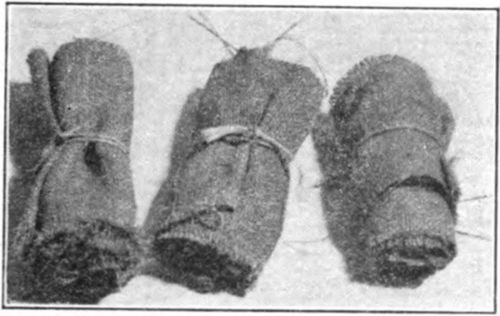
Gunny sacks dipped in chemical solution make good fuel.

Queen Excluder

Hive Tool.

Bee Gloves.

Bee Veil
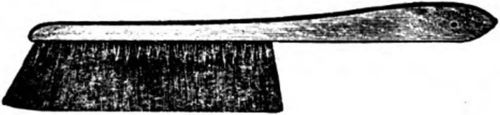
Bee Brush

Shallow Extracting Super, 5 11/16 in. deep.

Inner Cover
Two or more hive-bodies with combs drawn from full sheets of foundation will be needed for each hive run for extracted honey. The best way to secure these combs is to place a hive-body with ten frames of wired foundation over a strong colony of bees when there is a nectar flow or when bees are fed bountifully.
A queen-excluder is needed for each hive to control swarming, and wire will be necessary for fastening foundation in frames unless one buys wired foundation. A wire-imbedder is needed to fasten the wire in foundation. A hive-tool, a good bee-smoker, a bee-brush, and a bee-proof bee veil are essential.
Until the novice becomes acquainted with bee behavior, he should wear bee-gloves. Secure some leather gloves and have muslin extensions sewed to reach to the elbows, with elastic to hold them at the elbows, or purchase bee-gloves from a bee supply house.
Fuel for the smoker may consist of rotten wood, cotton rags, burlap sacks, cotton waste, or chips of wood.
Hives should be well painted, preferably white.
A bee-proof bee veil is an important item in a beekeeper's equipment. The first six years I had bees I was stung only once on the face and that because I did not have on a hat to hold the veil away from my face. Use the following directions to make one that with care will last for a long time if kept dry. Get a piece of black screen wire thirty-six inches long, six inches wide at the middle, and tapering to three inches at the ends. Sew a piece of muslin five inches wide to the upper edge and a piece fifteen inches wide to the lower edge. Turn over the outside edges of the muslin and leave a hem large enough for a narrow piece of elastic to be run through it. Now bring the ends together to make a truncated cylinder and sew them together -placing some muslin on the inside and outside of the screen wire -ends so that they will stay fastened together.
Put a piece of elastic through the hem of the five-inch piece of muslin so that it will fit tightly around the band of a hat when placed on the head, or sew that edge to the hat. Put a piece of elastic in the hem of the fifteen-inch piece of muslin so that edge of the veil can be pulled down and fastened with a safety pin to the front of the wearer's clothing. Strings may be fastened about four inches apart to the front edge of the fifteen-inch piece of muslin and brought around the back of the wearer and tied in front. With a bee veil made thus and securely fastened, one may work all summer without a sting on the face. No one should work with bees without a bee veil.
For extracting honey one will need an extractor for throwing the honey from the combs, uncapping knives and a pan to hold the hot water to heat the knives (or a steam heated uncapping knife), a receptacle to hold the cappings, a pail to draw the honey from the extractor, and a tank to hold the honey.
To keep the bottom-boards from rotting, hives can be placed on bricks or tile or on hive stands made of boards. Hives should be horizontal so that combs will be built straight in the frames.
The back of the hives should be slightly higher than the front so that water will run out and not in. Two hives can be set close together but with enough space between so that one can work each from either side. This arrangement makes it convenient to set covers and tools on adjoining hives. Hives usually face the east or south, away from prevailing winds.
Continue to:


My Books

