


How to Distinguish the Different Kinds of Bees and Cells. Drone Layers and Laying Workers. Opening and Examining a Hive
Description
This section is from the book "Better Beekeeping Or How We Made Bees Pay", by D. F. Rankin. Also available from Amazon: Better Beekeeping: The Ultimate Guide to Keeping Stronger Colonies and Healthier, More Productive Bees.
How to Distinguish the Different Kinds of Bees and Cells. Drone Layers and Laying Workers. Opening and Examining a Hive
8. How to Distinguish the Different Kinds of Bees and Cells
In a hive there are three kinds of bees-the queen, workers, and drones.
The queen is the only fully developed female in the hive and lays all the eggs. She is the longest bee and can readily be told by her shape.
The worker-bees are undeveloped females. They incubate the eggs, feed the larvae, build the combs, evaporate the nectar-in short do all the work in the hive. When two weeks old, they become field workers and gather water, nectar, and pollen to feed the brood; nectar to manufacture honey; and propolis-bee-glue-to fill the cracks to make the hive weather-proof.
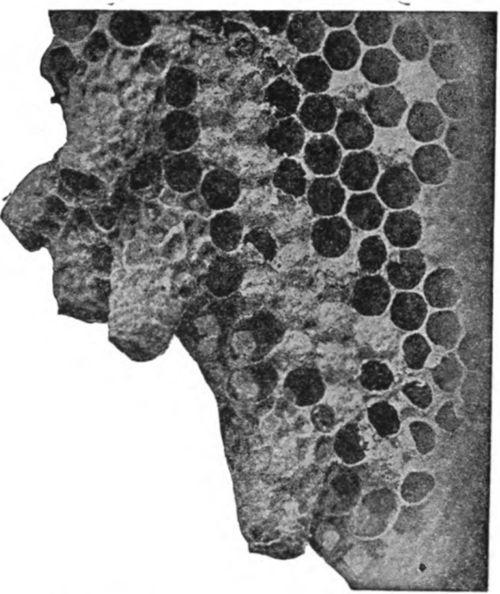
The queen cells are the large ones on the left, somewhat resembling peanuts.
(Gleanings, May 1934, p. 295).
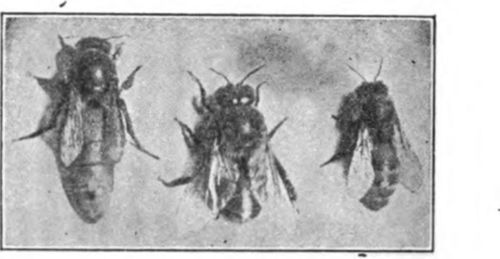
Queen. Drone. Worker.
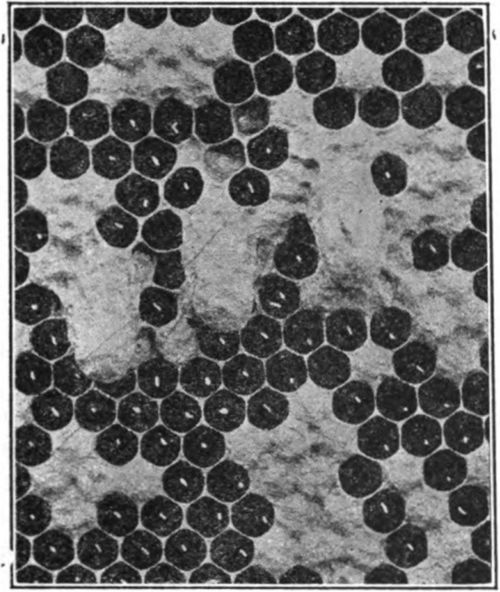
Three queen cells on side of comb. (Gleanings, Jan. 1934, p. 16).
The drones are the males. They are gentlemen of leisure. Their proboscises are not built for gathering nectar and so they are dependent on honey from the hive for food. If the hive has a queen when the nectar flow slackens, the worker bees drag the drones from the hives and let them starve. Because they have no stings, they cannot defend themselves. If there is no queen in the hive, the drones are not destroyed when the nectar flow slackens.
One should learn the days spent in the various stages of development. Memorize this table:
Queen | Worker | Drone | |
3 | 3 | 3 | |
Larva | 5 1/2 | 6 | 6 1/2 |
Pupa | 7 1/2 | 12 | 14 1/2 |
Total | 16 | 21 | 24 |
We have three kinds of cells-worker, drone, and queen. The worker-cells are hexagonal in shape and there are about twenty-eight to the square inch. The drone-cells are the same shape and about eighteen to the square inch. The queens are reared in round cells that are larger and that point down. Queen-cells look like peanut shells on the outside. They are usually found on the bottom of the combs, but sometimes they are built on the sides of the combs.
If the bees are given only "starters"-one inch strips of foundation-to build combs, they build from one-fourth to one-third drone-cells and the bees then rear thousands of useless drone boarders. If given full sheets of foundation, they build practically all worker-cells if the foundation is properly wired and drawn out by a strong colony during a honey flow.
9. Drone Layers and Laying Workers
Sometimes queens fail to mate and yet will lay eggs regularly in the cells, but these eggs always produce drones. It is only the queen that has mated that can lay a fertilized egg that will produce a worker or a queen-bee. Queens usually mate.
If a colony is without a queen or any worker larvae to produce a queen, some of the worker-bees will lay eggs that will produce dwarf drones. These worker-bees are known as laying workers.
If a queen is introduced to a colony with laying workers, the bees will almost invariably kill her. To introduce a queen successfully, set a hive with a queen protected by her own bees on the location of the laying worker colony. Then take the laying worker colony some distance from the location-a hundred feet or more-and shake the bees from the combs on the ground. The laying workers will be lost and will not find their way back to the colony with a queen protected by her bees. The laying worker colony may be united with another colony by setting it on top with a sheet of newspaper in between. Punch a few small holes in the newspaper.
10. Opening and Examining a Hive
Choose a warm day, after ten o'clock, when many of the field workers are away from the hive. Bees are likely to be cross on cool, wet days. When nectar is coming in they are more gentle and less likely to start robbing. Hives can be opened anytime when one learns bee behavior.
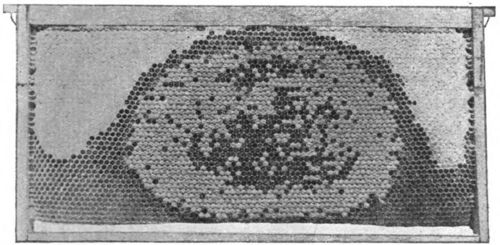
Comb containing brood, pollen, and honey. The lighter-colored cappings in the upper corners are over cells of honey. The capped cells in the middle of the comb contain brood in advanced stages. Open cells beyond the outer margin of sealed brood and in the middle contain eggs or young larvae.
(Gleanings, April 1930, p. 237).
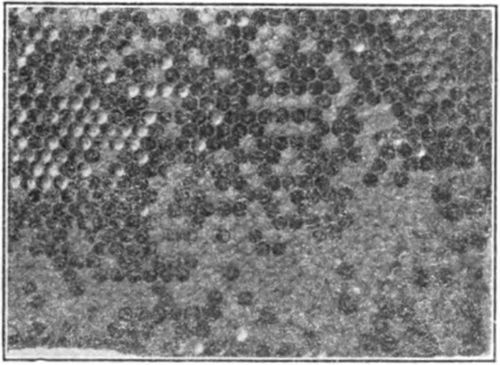
In the upper left hand portion of this comb are larvae in open cells, almost ready to seal. The capped cells contain older larvae or pupae. The material in some of the open cells in the upper right hand portion is pollen. The larger cells in the lower right hand corner are drone cells; the others are all worker cells.
(Gleanings, Apr. 1930, p. 237).
Having secured bees and necessary equipment, one should place the bee-veil over his hat, draw the muslin down tight in front and fasten it. Fasten the bottom of trousers with string or put on bicycle trouser-clips. Boys should wear overalls to protect the legs. Girls can wear overalls under their dresses.
Light the smoker and get it going well, put on the bee gloves, and with a hive-tool go to a hive and blow some smoke in the entrance to drive back the guards. Smoke should then be blown under the cover at one corner where one has pried up the cover, but not far enough to let a bee Out. Then pry up another corner and blow in smoke. In a minute or two one can pry up the cover, at the same time blowing smoke under it, and lift it with adhering bees from the hive. Lean the cover against the hive and blow some smoke across the frames, not too much, but just enough so the bees will run down between the combs and fill their nectar sacs with honey. The more they carry the gentler they are.
One should pry the frames apart and take a frame from the center of the hive. At the top of the comb one sees some honey, probably capped. In the center of the comb may be seen cells capped level and containing worker brood. Some cells will contain uncapped larvae or eggs. At the bottom of the comb, at the sides of the frame, are some larger cells, some with rounded cappings. They contain drone brood.
In some cells one can see brightly colored pollen or bee-bread. If the bees are making preparations to swarm, there will be some queen-cells along the bottom of the combs and, perhaps, on the sides of the combs. They may be only cups with or without eggs or larvae.
One should note the amount of honey and brood. If the queen is good, the brood is in each consecutive cell. If she is failing or poor, she will skip cells. Bees should have plenty of stores at all times for queens restrict their laying when honey is scarce. The colony may need feeding.
It is well to number the hives and keep a record of the condition of each hive in a book or on a piece of paper. The pages in the book can correspond to the number on the hives. Some colonies will have more honey than they need in the spring and other colonies less. One can equalize stores and brood.
A record of the ages of queens should also be kept. Know the condition of every hive. Do not guess.
Continue to:


My Books

