


Making More Colonies of Bees. Care of Honey. Feeding Bees. Robber Bees
Description
This section is from the book "Better Beekeeping Or How We Made Bees Pay", by D. F. Rankin. Also available from Amazon: Better Beekeeping: The Ultimate Guide to Keeping Stronger Colonies and Healthier, More Productive Bees.
Making More Colonies of Bees. Care of Honey. Feeding Bees. Robber Bees
21. Making More Colonies of Bees
Place on a hive a queen-excluder. Take three or more combs of capped or emerging brood from hives, shake the bees from the combs, and set the combs of brood in a hive-body above the queen-excluder. In an hour or two, the young bees will cover the combs. Then set these combs, with adhering bees, on a bottom-board and close the entrance of the hive with screen-wire. Give the nucleus a queen or capped queen-cell and place a cover on top. Shade the hive.
Open the entrance, on the opposite side from the frames of brood a bee-space-1/4 inch-the evening of the second or third day, after the bees quit flying. Leaning a board before the entrance will help the bees to mark their location and will aid in keeping them from returning to the old hive.
Supply frames with foundation as fast as the bees are able to draw them out into combs, first placing them at the sides of the combs and, when the bees begin to draw them out, placing them between the combs. Frames of capped brood may be given. Feed the bees if no nectar is coming in. This is an easy way to make colonies of bees.
The brood placed on top of colonies run for extracted honey, or placed in the "stack, " will in ten days all be capped and free from danger of being chilled, and can be taken with adhering bees to make new colonies of bees.
Where there is a fall nectar flow, six or more frames of capped brood with adhering bees can be taken from as many hives as late as August and placed in a hive, with frames of honey, and given a queen to make another colony. Frames with wired foundation or combs should be given to colonies from which brood was taken. They should be inserted singly between combs. Be sure you do not take the queen when thus taking frames of brood with adhering bees.
Never take a swarm to make a new colony. It divides the force of bees and reduces the crop of honey. Unite swarms with the colonies from which they came. One can strengthen weak colonies or nuclei by giving them combs of capped or emerging brood, or by shaking young bees in front of the hives.
22. Care of Honey
Honey should be kept in a warm dry place where the temperature varies little. If kept in a temperature above eighty degrees, it will not crystallize. Pure honey crystallizes in cold weather. Extracted honey heated and kept at a temperature of 150 degrees for a few hours is slow to crystallize.
Containers with extracted honey that has crystallized can be set on bits of wood in vessels of water kept as warm as one can bear his hand in and in a few hours the honey will liquify. Water too hot destroys the good flavor of the honey. Honey crystallized in combs cannot be liquified without melting the combs.
Sometimes comb honey and brood combs are destroyed by wax-moth larvae. If found working on the combs, they may be destroyed by fumigating with carbon bisulphide. Stack the honey or brood combs and for five hive-bodies place two ounces of carbon bisulphide in a dish above the honey. Enclose the dish with a hive-body and cover with a tight fitting cover. The fumes of the carbon bisulphide being heavier than air will sink to the bottom of the stack and kill all larvae. Brood combs not badly affected by wax-moth larvae can be given to strong colonies of bees to clean.
Carbon bisulphide is explosive and should be kept from fire. Be careful not to breathe the fumes.
23. Feeding Bees
Bees require about fifty pounds or more of honey in the hive for wintering and rearing brood till fruit bloom. If they do not have this amount in the fall of the year, while bees still fly, make a syrup with two parts of granulated sugar to one part of water by measurement and feed. Heat the water and stir in the sugar till it dissolves. Take a mason jar cover and with a pencil draw a circle around it on an inner-cover. One can make five or more holes for rapid feeding. Cut out the circle of wood, and having filled the jar with syrup and placed on it a rubber and the lid perforated with 20 to 50 small holes as in a pepper box, set the jar with the lid down in the hole cut in the inner cover. Put on an empty hive-body and the cover on top.
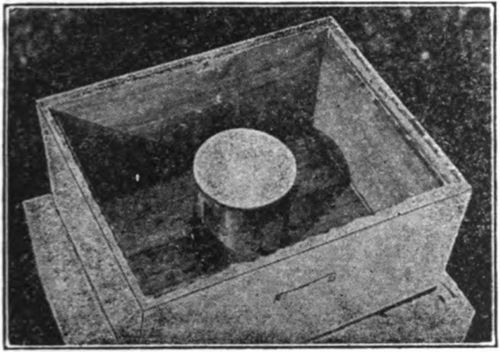
Boardman Entrance Feeder.
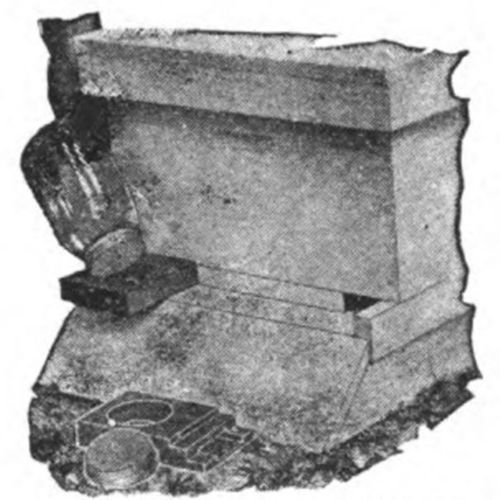
An ordinary friction-top pail makes an excellent feeder.
Or take a friction-top pail and perforate the lid with about 50 small holes. Fill the pail with the syrup and set it inverted over the hole in an inner cover. The bees will carry the syrup down and place it in the combs. This makes excellent winter feed. Some beekeepers feed each colony of bees ten pounds of sugar, made into syrup, after the frost has killed the fall flowers. It is better for the bees than poor honey where bees cannot get cleansing flights frequently during the winter. Poor honey may cause dysentery and may cause the bees to spot their hives.
One can exchange combs of honey for light or empty combs. When doing this, place all the combs of honey together in the hive. Or a super of honey can be left on the hive.
Feed the bees in the spring when necessary one part of sugar to two parts of water by measurement.
For slow feeding make only three or four holes in the lid of the mason jar or friction-top pail used.
Robber Bees
Bees have an insatiable desire for honey. A strong colony, when there is a dearth of nectar, will pounce on a weak colony, rob it, and leave the colony to starve. It is better and easier to prevent bees from robbing than to cure them when once they get started. Leave no honey exposed. Always see that there are no unnecessary cracks in hives for robber bees to enter and always restrict the size of the entrance according to the strength of the colony.
In the spring begin with a small entrance-about inch squareand enlarge as the colony gets stronger. There will be no trouble from robbing during the nectar flow. If a colony is being robbed, reduce the size of the entrance so that only one or two bees can enter.
Throw some straw or hay at the entrance and pour a little kerosene on it. An ounce of prevention here is worth a pound of cure.
Continue to:


My Books

