


Producing Extracted Honey Without Swarming. Giving Supers as Needed for Comb Honey. Taking Honey Without Stings
Description
This section is from the book "Better Beekeeping Or How We Made Bees Pay", by D. F. Rankin. Also available from Amazon: Better Beekeeping: The Ultimate Guide to Keeping Stronger Colonies and Healthier, More Productive Bees.
Producing Extracted Honey Without Swarming. Giving Supers as Needed for Comb Honey. Taking Honey Without Stings
18. Producing Extracted Honey Without Swarming
Manage the bees the same as for comb honey until time for the spring nectar flow. At the time of the nectar flow, or if the bees are making preparation for swarming, take from the upper hive-body a frame of brood containing no queen-cells and exchange it for a comb out of the center of the lower brood-body. Be sure there are no queen-cells on the combs in the lower brood-body. Usually by this time there is little brood in the lower brood-body.
Now place a queen-excluder on the lower brood-body. On the queen-excluder set a super of extracting combs spaced evenly nine to the super or ten frames of wired foundation, and then proceed to shake the bees from the combs that were in the top brood-body in front of the hive so as to get the queen below. It is not necessary to shake off all the bees. Having shaken the bees so the queen will run into the entrance, destroy any queen-cells found on the combs and place these combs on top of the super of extracting combs or frames of wired foundation and put on the cover. Eight days later examine these combs and destroy any queen-cells found, or use capped queen-cells with several frames of capped brood to start other colonies. The brood from one hive may be taken and used to start three more colonies using capped queen-cells or queens, but if this is done the colony will make less honey. Leave only eight or nine combs in the supers so the bees will make thick combs that will be easily uncapped at extracting time.
Some years and in some locations more than two supers are needed. If the hives are in a location where the bees can gather a large amount of nectar and three or more supers are needed, it would be better to place two or three frames of brood in a hive-body and fill with empty combs or frames of foundation and set it on the bottom board. Place on it a queen-excluder. On the queen-excluder place a hive-body of eight or nine empty combs and then shake the bees from the comb in the two hive-bodies to get the queen below; destroy any queen-cells found and place these combs on top. Eight days later destroy or use any queen-cells found on these combs.
19. Giving Supers as Needed for Comb Honey
When the hive run for comb honey has drawn out the foundation in the super and the bees are filling the combs with nectar, it is best to lift the super, before the combs are capped, and place another super between the partly filled one and the brood-chamber. Another one can be set on top and, when the bees begin to work in it, place it next to the brood-chamber, always keeping the supers most nearly finished on top. One must be careful to give only about the number of sections the bees will finish. Always take off comb honey when capped to prevent it getting travel-stained by bees passing over it. When the nectar flow weakens, take out finished sections and reduce the number of supers, giving them to colonies that experience shows best suited for finishing sections.
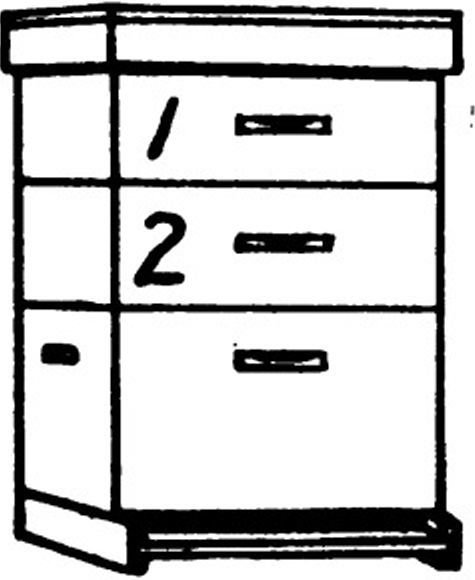
Partly filled super (1) is raised up and new super (2) is placed on brood-chamber during good honey flow.
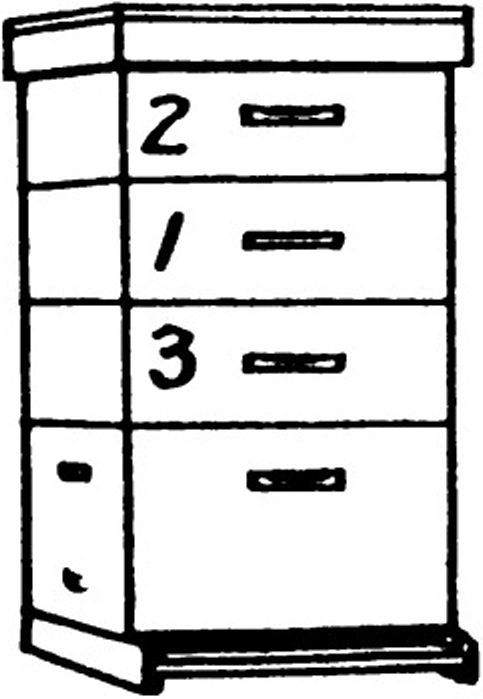
New super (3) is placed on brood-chamber with one nearest completion (1) just above it.
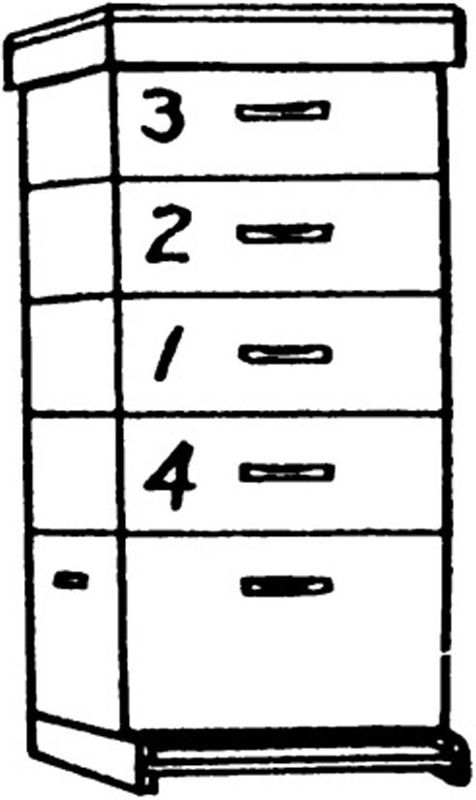
If honey flow continues strong fourth super is placed below, the one nearest completion still Just above it.
Honey in combs for extracting can be left on the hives and taken off at the end of the nectar flow. Usually the longer it is on the hive the better the quality. Where a dark honey flow follows a light honey flow, care must be taken to keep the two kinds separate.
Sometimes bees refuse to work in a super when there is a nectar flow. Exchange the super for one from a hive in which bees are already working in a super.
20. Taking Honey Without Stings
Purchase phenol from a drug store. It comes in crystal form or it may have been liquified. If in crystal form, set the bottle in warm water till it liquifies. About five percent of water added will keep it in a liquid state. Secure a bottle and get a stopper with a perforated tin top such as is used for sprinkling clothes. Fill the bottle with equal parts of phenol and water. The two will not mix, but if you shake the bottle they will make a milk-like fluid.
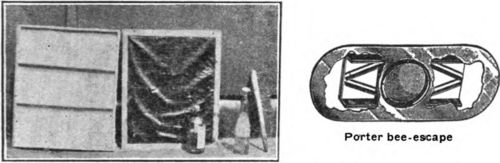
Fig. 1. -Equipment used for taking off honey. At the left is a screen as it appears from the bottom. Next is a top view of a similar screen. The tall bottle contains carbolic acid diluted with water ready for use and the short bottle contains a supply of undiluted acid.
(Gleanings, July 1932, p. 412).
Out of 1x1 material, the size of an under-cover, make some frames with one or two cross bars, and tack on them four thicknesses of cheese-cloth. Over the cheese-cloth nail tin. Shake the mixture of phenol and water in the bottle and sprinkle on the cheese-cloth till it is wet, but not enough so that it will drip. Be very careful not to get any of the solution on the skin or in the eyes, for it will burn (alcohol in any form is an antidote).
Go to a hive, smoke the entrance to drive back the guards, blow smoke under the cover, and lift it from the hive. Blow smoke between the frames to start the bees down and set the frame of carbolized cloth on the hive. On it set the cover, upside down, to keep the fumes of carbolized cloth in the hive. By the time you have placed several frames of carbolized cloth on hives, the bees will have been driven out of the super of the first hive. A few bees may be on the bottom-bars and can be brushed off. Apply heat to the tin cover of frame in cold weather to cause the solution to vaporize.
Bees affected by the fumes never offer to sting. Honey is not affected by the fumes. However, the carbolized cloth should not touch frames or honey. A strip or two of wood across the center of the frame will keep the cloth from sagging and touching frames. The frames with carbolized cloths will work satisfactorily for several hours with one sprinkling. Increase the strength of solution or sprinkle cloths as needed.
One can insert a Porter bee-escape in the hole in an inner-cover, place the inner-cover between supers of honey and the brood-chamber, and later, when the bees have gone below, take off the honey free of bees. Bees will usually leave the supers in twenty-four hours, if the supers contain no brood.
If only a small amount of honey is to be taken from the bees, one can do it by smoking the bees, and brushing them off. Do this on bright days. Bees are cross when worked on cold, wet days.
Continue to:


My Books

