


Profit in Bees. Who Should Keep Bees. Where Bees Can Be Kept
Description
This section is from the book "Better Beekeeping Or How We Made Bees Pay", by D. F. Rankin. Also available from Amazon: Better Beekeeping: The Ultimate Guide to Keeping Stronger Colonies and Healthier, More Productive Bees.
Profit in Bees. Who Should Keep Bees. Where Bees Can Be Kept
My special interest in honey-bees "was awakened by a visit to the Morrisson-Reeves Public Library in Richmond, Indiana. There I found a bound copy of "Gleanings in Bee Culture" for the year 1906 and in it I read how J. M. Doolittle of New York State ran an out-apiary, artificially swarmed his bees, and had no spontaneous swarming from the bees. He took off an average of 114 1/2 pounds of comb-honey per hive.
This idea of controlling swarming interested me. I had bought three colonies of bees, but I did not know how to manage them. I purchased a note book, spent some time copying Mr. Doolittle's method, and then went home to experiment.

Apiary at Kansas Experimental Station.
(Gleanings, Nov. 1935, p. 653).
I prepared a hive just as I thought he had directed and I told my wife the bees would not swarm. In about half an hour a swarm came out of the hive. I failed, but I became so interested that I determined to learn how to control swarming.
That spring I found one of the colonies queenless. I sent to Tennessee and purchased an Italian queen and introduced her to the queenless colony of bees. This colony made 130 sections of honey. I sold them to a grocer for twenty cents each. The other colonies of hybrid bees each made about fifty sections of honey. I learned there were better bees. With twenty-six dollars from the product of one hive, I got a vision of the bees helping to educate the children.
When my oldest son graduated from high school, he wanted to go to college. We had 23 colonies of bees on the lot back of the house. That spring and summer they gathered nectar and made a ton of honey. I sent the boy to Hanover College, paid his expenses and had forty dollars left. The next year we had 24 colonies of bees and they made another ton of honey to pay for the boy's second year at college. Let it suffice to say that the bees helped largely in paying the expenses of four children who were graduated from college. They have proved to be "the blessed bees. "
2. Profit in Bees
Many people obtain a livelihood from keeping bees. Given a good location, where one can average one hundred pounds of honey per hive each year, one can often secure as much or more profit from a hive of bees than from an average acre of farm land. They often pay their cost in one summer. In a very good season as much as 200 pounds of honey is often secured from a colony of bees. A trained beeman with some assistance can manage from 200 to 500 or more colonies of bees. Much depends on the location, the kind of bees, the season, and how they are managed.

Fig. 2. -The colony shown did a good summer's work.
This is the way the hive appeared at the close of the season.
Dr. C. H. English (Gleanings, March 1930, p. 159).
Thousands of farmers and people living in semi-rural areas, by managing by modern methods two or three hives of bees, could have all the honey the family could use. The bees require little care and they feed themselves and their owners. Much enjoyment can be obtained from their observation.
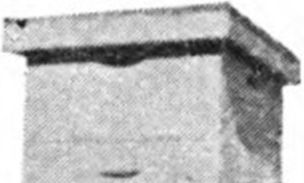

This colony headed by a hybrid queen produced over 425 pounds of honey.
(Gleanings, Jan. 1936, p. 22).
3. Who Should Keep Bees
Many people fear the sting of a bee and so are deterred from bee keeping. No one is immune from bee-stings. Bees do not know one person from another, and no one should work bees without adequate protection. When he learns bee behavior and has the proper equipment and gentle bees, the beeman gets few, if any, stings. Usually men who work bees become inoculated by stings and, although they feel the burning of the formic acid when stung, there is neither swelling nor bad after effects.
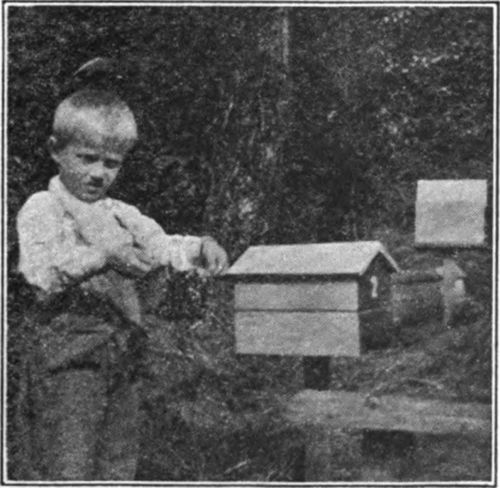
Five-year-old Odd Claus is not afraid of bees. (Gleanings, Dec. 1935, p. 754).
Anyone can learn to keep bees profitably. Often bees are very successfully managed by women. Boys readily learn to care for them and find beekeeping a delightful occupation. One may begin in a small way and make the bees pay for their increase as he becomes skilled in caring for them.
4. Where Bees Can Be Kept
Bees fly readily within a radius of three miles and have been known to bring in nectar five miles. They can be kept on a back lot, on a roof, or in an attic. Locations are excellent in which the bees can be sheltered from north and west winds by buildings, woods, or fences. An orchard or woods often furnishes a splendid location. The shade makes it pleasant to work with the bees in summer.
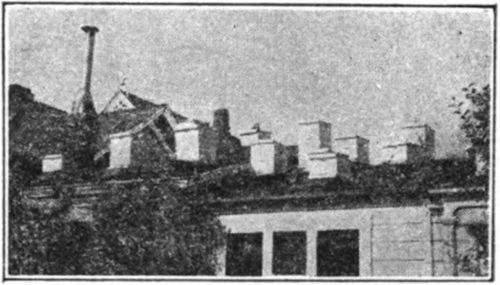
An apiary located on the roof of a city house.

Apiary in sweet-clover locality almost surrounded by woods. Hives face east and south
Bees do well out in the sun when protected by shade boards. Water should be provided in a vessel with some sticks on which the bees can alight and not drown in the water.
If a garden is near, the garden should be worked early or late in the day when the bees will not bother. Using a hoe in their line of flight causes bees to sting. They should not be located where horses are hitched nor near ground that is cultivated by horses.
Bees cleanse themselves on the wing and, if kept in hives for some time in cold weather, they will spot with their feces clothes hung out to dry on a warm day when they can fly. However, hundreds of colonies are successfully kept in residence sections of towns. Much depends on the kind of bees and how they are managed.
Continue to:


My Books

