


Wintering Bees Successfully. And Last
Description
This section is from the book "Better Beekeeping Or How We Made Bees Pay", by D. F. Rankin. Also available from Amazon: Better Beekeeping: The Ultimate Guide to Keeping Stronger Colonies and Healthier, More Productive Bees.
Wintering Bees Successfully. And Last
35. Wintering Bees Successfully
Many colonies of bees winter-kill for lack of proper protection. If the temperature drops to zero and remains there for three weeks, the unprotected bees, which at 57 degrees have clustered on the combs in the hive, consume all the honey within the cluster and are too numb to move over and enclose other honey and starve with the hive full of honey beyond the cluster. Bees in northern latitudes are wintered often in cellars but it has been found that bees in almost all latitudes do better outside when given adequate protection.
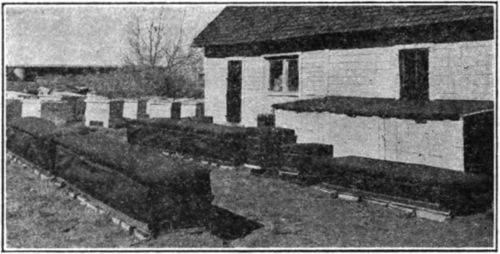
Rows of hives packed for winter. (Gleanings, Oct. 1935, p. 598).
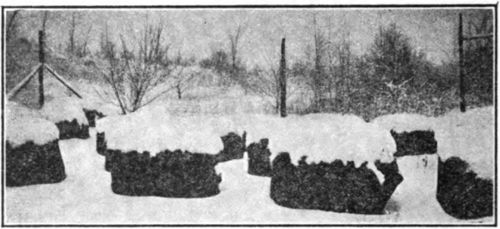
Packed hives covered with snow. (Gleanings, Nov. 1935, p. 669).

This apiary is well protected against the prevailing winter winds. (Gleanings, Nov. 1935, p. 672).
One of the cheapest and best ways of protecting bees is as follows: Nail to the protecting strips-on which the hive-body rests-at the front of the hive, pieces of boards the length of the width of the hive and as wide as the distance the bottom-board projects beyond the hive-body in front. Then cut a piece of tar paper long enough to go around the hive, allowing for four or six inches between the tar paper and the hive and six or eight inches for the lap. Pack dry leaves, chaff, sawdust, or planer shavings under the bottom-board of the hive. Fasten the tar paper together at the lap with nails for pins and then nail a piece of lath or strip of wood, through the tar paper, to the edge of the board nailed above the entrance of the hive, so that the packing will not close the entrance to the hive. Tie two pieces of stout cord or binder-twine around the tar paper to help hold it together. Fill the space between the tar paper and hive with the packing material, first filling the four corners. Press firmly the packing. Fill packing material above the inner cover on the hive to a depth of six or eight inches. Fold the tar paper to cover the packing on top. Place another piece of tar paper on the folded tar paper and set the hive cover on top. Place a brick or weight to hold the cover in position. Cut a hole about one-half inch high and three inches long in the tar paper at the front so that the bees can fly out to cleanse themselves whenever the temperature rises to 57 degrees. Two or more hives can be set side by side and packed together, perhaps to the advantage of each. Some beekeepers have successfully used baled straw for packing.
Be sure to reduce the size of the entrance before packing the hives, to prevent mice from entering and destroying the combs. Cut five V-shaped notches large enough for a bee to pass through, one inch apart, in a board and nail it to the front of the hive to reduce the size of the entrance for winter. Do this early in the fall.
Leave the bees packed till time of fruit bloom in the spring. This packing in the spring, when the queen begins to lay, greatly aids in keeping the temperature right for the incubation of the eggs and enables the bees to build up more rapidly. The queen will lay more eggs and at the time of fruit bloom the hive will be crowded with bees.
Do not allow anyone to jar the hives in winter or the bees may consume more honey and get dysentery. If left plenty of honey, they need no attention except to see that ice does not close the entrance. Snow on the hives is added protection.
A fence with boards spaced apart or wire fencing with corn fodder woven in it to act as a wind-break is an additional protection. Any wind-break helps. Hives should face the opposite direction from prevailing winds.
86. And Last
Do not be discouraged if you do not at first succeed. Many of our best beekeepers were slow to succeed. Only as one reads and studies bee-culture and works with the bees can he master the subject. And do not rush into beekeeping on a large scale without the experience necessary.
Beekeeping enlarges one's horizon. The beekeeper is drawn closer to nature. He observes when the maple, elm, and other nectar-giving or pollen-producing trees bloom. He learns to examine carefully the clovers and other nectar-secreting plants. Climate, temperature, rainfall, bee enemies, all become subjects of absorbing interest. Bees themselves never cease to interest. Many have found beekeeping a delightful hobby aside from monetary profits. It is a great outdoor avocation.
Having mastered the subject as presented in this volume, one will find great pleasure in further study of beekeeping. For this purpose a bibliography is added.
Continue to:


My Books

