


Composition Of Liquid And Vapour Phases. Theoretical. Part 10
Description
This section is from the book "Distillation Principles And Processes", by Sydney Young. Also available from Amazon: Distillation Principles And Processes.
Composition Of Liquid And Vapour Phases. Theoretical. Part 10
General Conclusions
The conclusions arrived at may be stated shortly as follows: 1. The composition of the vapour from a pair of non-miscible liquids at a given temperature may be accurately calculated from the vapour pressures and vapour densities of the components.
2. The composition of the vapour from a pair of closely related miscible liquids at a given temperature may, so far as is known, be calculated by means of Brown's formula

The value of the constant, c, certainly does not differ greatly from the ratio of the vapour pressures of the components at the temperature of experiment, but the data at present available are perhaps insufficient to warrant the statement that it is always equal to this ratio, and it appears to be necessary to determine it experimentally.
3. As regards substances which are not closely related, Brown's formula is only applicable when the vapour pressure of any mixture is given by the formula and this is probably never the case when there is a marked volume or temperature change on mixing the pure liquids.

4. If the vapour pressures at constant temperature of mixtures of two infinitely miscible liquids - the molecular weights of which are normal - are not given by the formula the relation between vapour pressure and composition must be determined experimentally at the required temperature. The composition of the vapour from any mixture may then be calculated with moderate accuracy by means of the formula adopted by Zawidski (p. 90), the values of the constants a2 and a3 being ascertained from the pressure-composition curve by the method of Margules; but much better results are given by the equations put forward by Rosanoff, Bacon and Schulze.
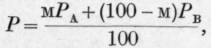
5. When the molecules of either liquid are associated, the relation between the composition of the vapour and that of the liquid cannot be ascertained, even approximately, by means of Zawidski's formula unless the average molecular weights of the associating substance under the varying conditions of the experiment are known.
In the case of chloroform and acetone, however, the formula of Rosanoff, Bacon and Schulze gave satisfactory results in spite of the fact that the molecules of acetone are associated to some extent.
6. If, for two miscible liquids, a sufficient number of determinations of the relative composition of liquid and vapour at constant temperature have been made to allow of a curve being constructed - the molecular percentages of the vapour being mapped against those of the liquid, m'Am'B against mA/mB, the logarithms of these ratios against each other, or the partial pressures of each component separately against the molecular fractional amount of one of them - other values may be read from the curve, or the constants for an interpolation formula may be calculated.
If the vapour pressures of mixtures of the two substances differ but little from those given by the formula a modification of Brown's formula may be used; m'A/m'B = c'mA/mB, where c' =c0 +aM.
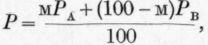
Better results are, however, generally given by Lehfeldt's formula, log t = K + r log q., and this may be used even when the observed vapour pressures differ somewhat considerably from the calculated. If, however, these differences are great, the formula of Zawidski is to be preferred.
Most of the investigations of the relation between the composition of liquid and of vapour have been carried out at constant temperature, but in practice a liquid is almost always distilled under constant pressure. Brown, however, whose distillations were carried out in the usual manner, found, in the case of carbon tetrachloride and carbon disulphide, that when a mixture was boiled the composition of the vapour was independent of the pressure under which ebullition took place, and, if this were generally true, a curve constructed from results obtained at constant temperature could be used to ascertain the vapour composition in a distillation under constant pressure. It is, however, to be noticed that the ratio of the vapour pressures, even of two closely related liquids, is not the same at different temperatures, and if the relation m'A/m'B = PAmA/PBmB is really true for such liquids, PA/PB would be a constant for a distillation at constant temperature, but would vary slightly if the distillation were carried out under constant pressure.
Lehfeldt found that, in the case of Brown's distillations, the logarithms of the ratios of the masses of the components in the liquid and vapour phases had a linear relation, and Baly1 obtained a similar result with the distillation of mixtures of oxygen and nitrogen under constant pressure. Lehfeldt's formula could therefore be used for interpolation in these cases.
The question has been discussed by Rosanoff, Bacon and Schulze,1 who determined not only the vapour pressures of mixtures of benzene and toluene at a constant temperature, but also the boiling points of mixtures of the same substances under a constant pressure (750 mm.). It had been shown by Rosanoff and Easley 2 that the composition of vapours from binary mixtures may, in general, be accurately represented by an expression of the formand that the coefficients a2, a3 and a4 are, in all cases in which the heat of dilution is moderate, practically independent of the temperature, so that changes of temperature influence the vapour composition only by affecting the value of PA/PB. If, therefore, from an expression found for some given temperature the logarithm of PA/PB corresponding to that temperature is subtracted, and to the remainder is added an expression representing the logarithm of PA/PB as a function of the temperature, a more general expression would be obtained, from which the vapour composition could be calculated for any temperature or temperatures within the given range.

In the case of benzene and toluene the heat of dilution is very small and the authors therefore felt justified in applying the principle just stated within the temperature range involved, and they thus arrived at a formula which enabled them to calculate the molar percentage of benzene in the vapour from mixtures boiling under a pressure of 750 mm.
1 Loo. cit. 2 J. Amer. Chem. Soc, 1909, 31, 957.
Continue to:


My Books

