


Chapter II. The Boiling Point Of A Pure Liquid
Description
This section is from the book "Distillation Principles And Processes", by Sydney Young. Also available from Amazon: Distillation Principles And Processes.
Chapter II. The Boiling Point Of A Pure Liquid
The Statical Method
There are two methods by which the "boiling point" of a liquid under a given pressure may be determined, the statical and the dynamical. By the first method the pressures exerted by the vapour of the liquid at a series of temperatures are ascertained and plotted against the temperatures, a curve, the vapour pressure curve, being then drawn through the points (Fig. 17).
This curve has a twofold meaning; it represents not only the vapour pressures of the liquid at different temperatures, but also the boiling points of the liquid under different pressures. Thus, the vapour pressure of water at 50° is 91.98 mm., and water boils at 50° under a pressure of 91.98 mm.
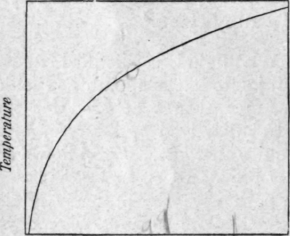
Pressure Fig. 17. - Vapour pressure curve.
Evaporation In Absence Of Air
The vapour pressures of a liquid at temperatures lower than its boiling point under atmospheric pressure may be determined by placing some of the liquid over the mercury in a barometer tube and heating the tube to different temperatures. The difference between the height of the barometer and that of the column of mercury in the tube, after correcting for the expansion of the mercury, and, if necessary, for its vapour pressure, gives the vapour pressure of the liquid.
It is necessary to take great care that the liquid introduced is quite free from dissolved air, otherwise, under the reduced pressure and at the higher temperature, some of this air would be expelled and the measured pressure would be the sum of the pressures of the vapour and of the air. If the liquid is pure and free from air, the pressure varies only with the temperature and does not depend on the relative volumes of liquid and vapour so long as both are present. This constancy of vapour pressure is, in fact, a very delicate test of the purity of a liquid.1
Evaporation In Presence Of Air
On the other hand, Regnault has shown that almost exactly the same amount of evaporation will take place into a vacuous space as into the same space containing any gas which does not act chemically on the liquid and is only very slightly soluble in it. The only difference is that evaporation into a vacuum usually takes place almost instantaneously, whereas in presence of a gas the process is a slow one, owing to the time required for diffusion between vapour and gas.
If, then, the barometer tube contained air, and we were able to measure its pressure, we could calculate the true pressure of the vapour by subtracting that of the air from the total pressure.
Dalton's law of partial pressures is, in fact, applicable to this case, and in constructing the vapour pressure curve from such results, it is the partial pressures of the vapour, and not the total pressures, that must be plotted against the temperatures.
The Dynamical Method
A liquid is said to boil when it is in a state of ebullition, but the scientific term "boiling point " is not applied to the temperature of a boiling liquid. The temperature of ebullition depends partly on the gaseous, or other, pressure on its surface, partly on the vertical depth of the liquid, and partly on the cohesive force between its molecules and the adhesion of the liquid to the walls of the vessel; it would be very difficult, if not impossible, to frame a convenient definition to include all these factors.
Ebullition
If we heat a liquid in an ordinary glass flask by means of a Bunsen burner.placed below it, the formation of bubbles of' vapour at the lower surface of the liquid, in contact with the glass where the heat is received, is facilitated by the presence of air dissolved in the liquid or adhering as a film to the glass and by sharp points, or roughnesses, on the surface of the glass.
If a minute bubble of air is formed, it will serve as a nucleus for a larger bubble of vapour, but in order that the bubble may increase in size by evaporation from the liquid surrounding it, it is clear that the vapour must overcome the pressure of the column of liquid above it as well as that of the atmosphere. Now the pressure exerted by the vapour of a liquid, in contact with that liquid, depends solely on the temperature, and therefore, under the most favourable conditions, the temperature of the liquid surrounding the bubble must be so high that the vapour pressure is equal to the sum of the pressures of the atmosphere and of the column of liquid.
1 As will be seen later, there are certain liquid mixtures which behave in many respects like pure liquids; at a given temperature the vapour pressure of such a mixture would not depend on the relative volumes of liquid and vapour, but at a different temperature the vapour pressure would no longer be quite independent of the volumes.
Cause of "Bumping." - But if the liquid is very free from air, and if the walls of the vessel are very smooth and clean, bubbles are formed with much greater difficulty and the temperature of the liquid may rise much higher ; it is then said to be superheated, and when a bubble forms, the vapour pressure corresponding to the temperature of the liquid is much greater than the sum of the pressures of the atmosphere and of the column of liquid ; consequently vapour is evolved and the bubble increases in size with great rapidity, and at the same time the temperature of the liquid falls to some extent. Under these conditions the liquid boils irregularly and is said to "bump."
The liability to intermittent ebullition is still greater when the liquid is covered by a layer of another lighter but less volatile liquid, as when water has a layer of oil over it: if a globule of well-boiled water is immersed in a bath of oil of the same specific gravity, so that the water is in contact only with the oil, the formation of bubbles is very difficult indeed, and the temperature may be raised far above 100° ; when a bubble is at last formed, the whole of the water may be suddenly converted into steam with explosive violence.
Definition of the term " Boiling Point." - By the term boiling point is to be understood the highest temperature attainable by a liquid, under a given pressure of its own vapour, when evaporating with a perfectly free surface, and when the heat reaches the surface from without. Thus, if we cover the bulb of a thermometer with cotton wool or other porous material, saturate the wool with the liquid under examination and suspend the thermometer in a test tube heated in a bath to a temperature at least 20° higher than the boiling point of the liquid, the temperature will rise, vaporisation will take place, and the air in the test tube will be expelled by the vapour. Under these conditions, so long as the cotton wool remains thoroughly moistened by the liquid, the temperature cannot rise above a maximum which is not influenced by that of the bath, but depends solely on the pressure of the vapour and therefore, since these are equal, on the atmospheric pressure.
This maximum temperature is the true "boiling point' of the liquid under a pressure of its vapour equal to that of the atmosphere. It will be observed that the boiling point of a liquid can only be correctly determined by observing the temperature of the liquid itself under such conditions that ebullition is impossible.
Determination of Boiling Point - The true boiling point of a liquid is identical with the condensing point of its vapour under the same pressure, provided that some liquid is present and that the vapour is not mixed with an indifferent gas or vapour, and it is usually more convenient to measure the condensing point of the vapour than the boiling point of the liquid. To do this an ordinary distillation bulb is generally employed (Fig. 3). The walls of the vertical tube give up heat to the surrounding air, and some of the vapour condenses, the remainder being therefore in contact with condensed liquid. Condensation also takes place to a slight extent on the thermometer unless the amount of liquid in the still is very small, when the vapour is liable to be superheated owing to the flame, or the heated gases from it, playing against the dry walls of the vessel, and as the thermometer loses heat only very slowly by radiation it may, under these conditions, become too hot for vapour to condense on it. The vapour is especially liable to be superheated when a water or oil bath is employed as the source of heat.
Condensation on the thermometer is promoted by covering it with a little cotton wool,1 or, for high temperatures, fibrous asbestos, and, in determining a boiling point or carrying out a distillation with the ordinary apparatus, it is always advisable to cover the thermometer bulb in this way. On the other hand, the thermometer should be protected from loss of heat and possible fall in temperature by radiation, and for exact determinations it is advisable to surround the vertical tube with a jacket of the vapour of the boiling liquid. A convenient apparatus is described by A. Edwards 2 and is shown in Fig. 18. The flask A is fitted with a cork through which passes the wider of the two concentric vertical tubes B and c. The inner tube b passes through a cork at the top of c and is itself provided with a cork which holds the thermometer (not shown). The tube b may be enlarged a little near the bottom or the tube c constricted so as to bring the two tubes so close together that the narrow space between them becomes primed with condensed liquid. The vapour from the liquid boiling in a therefore passes up the inner tube, through the hole blown in this near the top, down between the two concentric tubes, and finally up into the narrow side tube d which acts as a reflux condenser. The condensed liquid flows easily through the narrow space between the tubes and returns to the still.
If the liquid, the boiling point of which is to be determined, is not known to be quite pure, it is advisable to distil a fair quantity of it; if it is pure the boiling point should remain quite constant during the whole distillation ; if not, the temperature will rise (unless we are dealing with a mixture of constant boiling point), and some idea of the nature and amount of the impurity will be gained by observing the extent of the rise and whether it takes place in the early or late stages of the distillation, or both, or whether there is a steady rise during the whole period.
Continue to:


My Books

