


Joints In Framing
Description
This section is from the book "Text-Book Of Modern Carpentry", by Thomas William Silloway. Also available from Amazon: Text-book of Modern Carpentry.
Joints In Framing
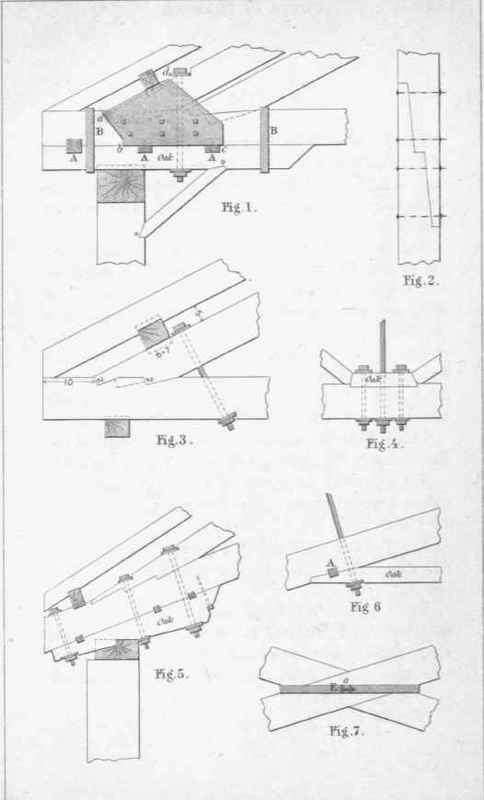
Nothing is more essential to the permanency of a piece of carpentry than properly made .joints. If the parts do not so fit together that each may have its full bearing, the structure will inevitably be weak. The examples on this plate are designed to represent in detail the best manner of forming joints of the various kinds most in use.
Plate XX
Fig. 1 represents the framing at the foot of the rafters of Fig. 1, Plate XIV. abed is a cast-iron shoe, or boxing. AAA are oak-keys, two inches square. BB are wrought-iron straps, in place of which bolts may be used if desired.
Fig. 2 exhibits the method of splicing an upright timber; as, for instance, a tower-post. The length of such a splice should be three times the diameter of the stick, and bolted together with half or five-eighth inch bolts.
Fig. 3 illustrates a method of framing work at the foot of the rafters of a common roof. This method is much used. Each timber is to be notched into a half-inch to receive the purlin.
Fig. 4 shows the manner of framing a centre-bearing like that at A, Fig. 2, Plate VII.; or B, Fig. 5, Plate XV.
Fig. 5 exhibits the method of framing the foot of the rafters in a roof having inclined beams, as the example on Plate VIII.
Fig. 6 shows the detail of a piece of framing, as at AB, Fig. 1, Plate VII. At A is an oak-key two inches square.
Fig. 7 is the detail of framing at the intersection C of the plate before referred to; E being a wrought-iron strap, three-eighths of an inch thick and three inches wide, made in two parts, with shoulders, and a small bolt at a for securing the work.
Joints
Pl.XX
Smith Knight &Tappan Eng rs..
Continue to:


My Books

