


Bridge-Centerings
Description
This section is from the book "Text-Book Of Modern Carpentry", by Thomas William Silloway. Also available from Amazon: Text-book of Modern Carpentry.
Bridge-Centerings
A centering is a frame of timber designed to support the stones of an arch while building. Where the bed of the river is not very deep, nor the tide strong, a centering may be made at small expense; but in other circumstances, and where the span is large, a more complex and expensive system of framing must be adopted.
In the construction of a centering, the principal object is so to arrange the timbers that a weight or pressure, when exerted upon any particular part, may be resisted, and the structure retain its original form throughout; and it should be so designed as to admit of removal without injury to the work resting upon it. In most examples, this is done by the insertion of a piece at the springing points, cut on its sides into a series of inclined planes: over these, oak wedges are driven, which, being easy of removal, admit the uniform releasing of every part of the work.
Pi XVIII Centres
Smith Knight & Tappan Eng rs..
Bridge-Centerings
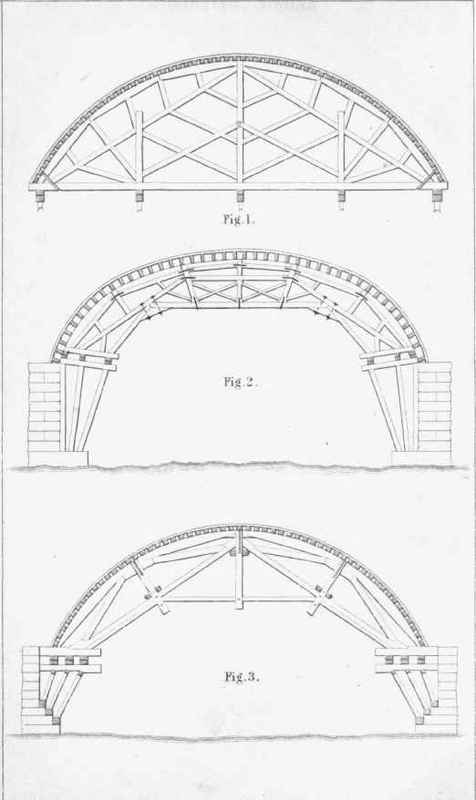
Plate XVIII
Fig. 1 of this plate exhibits a centre designed by Mr. Smeaton, architect of the celebrated Eddystone Lighthouse. It is familiarly known as the "Cold-Stream Centre" taking its name from the river over which the bridge was built. The span of the large or middle arch is sixty feet eight inches. The bridge is twenty-five feet wide outside; and, in its construction, five centres were used to each arch.
Fig. 2 exhibits a centre used in building the arches of a railroad-bridge over the river Ouse, near York, England. The bridge consists of three arches, each sixty-six feet span; the soffit of the arch (or width of bridge) being twenty-eight feet seven inches.
Fig. 3 is a design for a centre given by Mr. Tredgold, which may be used for any span short of seventy-five feet
Bridge-Centerings
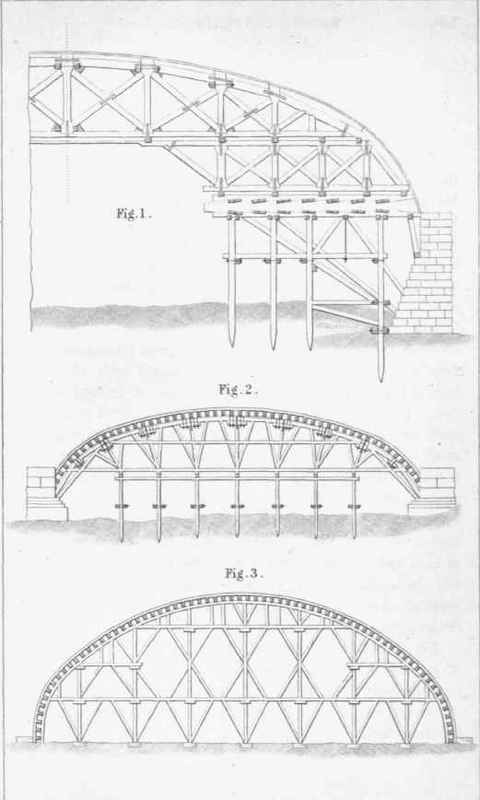
Plate XIX
Fig. 1 exhibits a part of one of the centres used in the construction of London Bridge. It was designed by Mr. Rennie in 1826. The width of the bridge, from "out to out," is fifty-six feet. The middle or centre one of its five arches is a hundred and fifty-two feet span, and has a rise of twenty-nine feet six inches. Each arch used eight centres, composed of fir; the springing-pieces being of elm, and the striking-wedges of oak.
Fig. 2 exhibits the design of a centre executed by Mr. Thomas Telford in building a stone bridge at Gloucester, England. The bridge consists of a single arch of a hundred and fifty feet span, with a rise of thirty-five feet. It is thirty-five feet wide; and six centres were used, connected by cross-bars and caps, and the whole steadied by diagonal braces. Between the timber which rested on the top of the piles, and the lower horizontal timber of each centre, were placed the wedges, which, being driven back, slackened it after the stone-work was completed. The piles were of Memel fir, shod with iron at each end, and the remainder of the work of Dantzic fir; the whole being fifteen inches square. Each centre was framed entire; and then, by the aid of barges and two cranes on the shore, was lifted into its place.
Fig. 3 exhibits a centering, simple in construction, but of great utility. It may be employed to advantage wherever the bed of the river can be used, and the tide is not too strong; and for any span from a hundred to two hundred feet.
Centres Pl.XIX
Smith Knight & Tappan Eng rs..
Continue to:


My Books

