


Producing Queen Bees
Description
This section is from the book "Better Beekeeping Or How We Made Bees Pay", by D. F. Rankin. Also available from Amazon: Better Beekeeping: The Ultimate Guide to Keeping Stronger Colonies and Healthier, More Productive Bees.
Producing Queen Bees
33. Producing Queen Bees
Bees made queenless, if given combs with worker larvae three days old or younger, can produce queens. They will enlarge the cells, build queen-cells, and feed the larvae only "royal jelly. "
It has been noted how bees at the time of a nectar flow will make queen-cells on combs of brood that are placed on a hive with a queen-excluder and a hive-body of empty combs between these combs and the brood-chamber. The queens reared in these cells are usually fed an abundance of "royal jelly" and are excellent.

Fig. 1--Queen cells 10 days after grafting, ready to be placed into nursery cages.
(Gleanings, April 1932, p. 216).
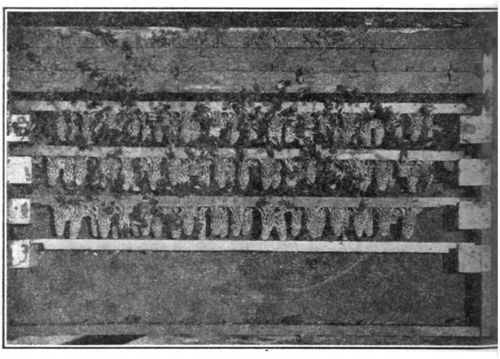
A double row of cells on each bar prevents the building of comb over the cells.
(Gleanings, Feb. 1931, p. 86).
If there is no nectar coming in, and one wishes to produce a large number of queens, he should feed one-half pint of sugar syrup-half and half by measure-to a colony each day for a few days before beginning to produce queens and while producing them.
Take from the colony the queen and all the combs containing eggs and larvae and leave the colony without larvae to produce queens -hopelessly queenless. In front of the hive shake most of the bees from the combs taken. Combs of emerging brood or capped brood may be given to the colony. In a frame fasten a few more artificial queen-cells than the number of queens wanted. One can buy these artificial cells from bee-supply houses or he can make them.
The next day go to a hive and take from it a natural queen-cell the bees have constructed. In it is the queen larva and a creamy substance the bees secrete and feed all the larvae for the first three days of their larva life, called ''royal jelly. " Take as much as the size of the head of a pin of the ''royal jelly" and place it in each of the artificial cells. This gives them the scent or odor of the natural cells.
Then go to a hive that has a prolific queen, one that will build up a strong colony of bees that will gather nectar and make as much as one hundred pounds of honey in a season. Take from the hive a frame of worker brood and shake the bees from the comb.
Lift the worker larvae, about eighteen hours old, from the cells- they are about the size of the head of a pin-and place one on the ''royal jelly'' in each of the artificial cells. Give these grafted cells to the colony from which the day before was taken away the queen and brood and which was thus made hopelessly queenless. Place them in the center of the hive.
In the one day this colony has been without a queen and brood, the bees have come to realize they will soon all die and the colony cease to function, and so they eagerly accept the cells given them. Sometimes they will draw out the cells twice their original length in twenty-four hours. They feed the larvae a large quantity of "royal jelly'' and so there is usually a residue in the cells when the queens have emerged.
The queen larvae feed on the "royal jelly" and in about five days grow the length of the cells. The worker-bees then cap the cells with a porous capping. The larvae spin silken webs and develop into queen-bees, and sixteen days from the time the eggs are laid, eat through the cappings and come out fully developed queen-bees. However, they must be separated the twelfth day after grafting, before they emerge, or the first queen to come out will cut a slit in the other cells and sting and kill the queens before they can come forth.
By means of a large wire hive-staple, fasten one of these ripe queen cells between two frames of bees and brood in a hive or mating box.
The next day the queen will emerge, about seven days later will mate on the wing, and about two days later will begin to lay. A queen ordinarily mates only once and only on the wing.
If there are failing queens or poor queens in the hives, find them, pinch off their heads, and introduce young queens, or, by using combs and the capped queen-cells, build up nuclei into strong colonies by fall.
One can take the queen from a strong colony of bees so that the bees will make queen-cells on the combs. He can use these cells to produce queens, but usually the queens so made are from larvae as much as three days old and may be inferior. Or one can insert frames with foundation in the center of hives and, when the queens have laid in the cells and the larvae are eighteen hours old, give them to colonies made queenless, to produce good queens. The colonies should be well fed if no nectar is coming in.
Continue to:


My Books

