


Floors
Description
This section is from the book "Text-Book Of Modern Carpentry", by Thomas William Silloway. Also available from Amazon: Text-book of Modern Carpentry.
Floors
The construction of floors is a branch of carpentry which does not demand much scientific consideration. If the timber be of proper size, sufficient in quantity, and the work well done, all is accomplished that can be desired. To effect this, however, the carpenter should avail himself of such rules as experience has proved to be valuable. The timbers of a floor should be selected of proper size to support any weight that will probably be placed upon them. A warehouse-floor, for instance, may at times be subjected to great strains, and should therefore be heavily timbered. It is often the practice, in constructing floors of the kind, to use long floor-joists extending from eighteen to twenty-four feet; in which case, the timbers vary in dimensions from three by thirteen inches to five by fourteen inches, and they are usually placed from fifteen to twenty inches apart from centres. A church or hall floor, when covered with people in a standing position, packed close, is loaded a hundred and twenty-five pounds to each square foot. Timbers three by twelve inches, if the bearings are not more than ten feet apart, placed sixteen inches from centres, will sustain the weight; and these dimensions are generally used in buildings of the kind.
The floors of dwelling-houses may be lighter. If the joists are materially longer, the size should not be much decreased. The lengths being from nine to fifteen feet, two by twelve will answer the purpose: two by ten inch joists, and even two by eight inch, are frequently used in cheap buildings. The principal objection to light timber arises, not from its liability to break, but from its vibration, which is apt to crack the plaster of the ceiling below.
Pl.I
Smith. Knight &Tappan.Engrs..
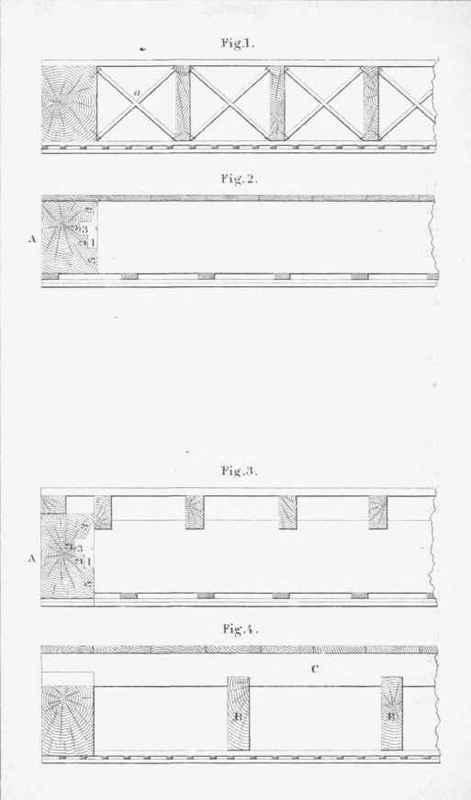
Plate IV
The method of framing shown at Fig. 1 of this plate, is, all things considered, quite as good as any in use. More complicated methods are not often attended with proportionate advantage. Fig. 2 exhibits the side of the joists of the same floor, the girder, etc, all of which will be readily understood without further explanation.
Fig. 3 exhibits a section of what is called a bridged floor. It is, in principle, like the other, with the addition of the smaller joists which bridge over the principal ones. Floors of this kind are seldom built in this country, but are much used in Europe. , Fig. 4 exhibits a side-view, or section, of the floor last described; BB showing the ends of the principal^ and C the side of the bridging, joists. The part of the diagrams at A illustrates the method of framing the joists into the girder; the figures thereon denoting the dimensions of each part, being calculated for a stick twelve inches deep.
Even* floor should be well bridged. This may be done in either of two ways: first, by cutting in between the sides of the joists, and at right angles to them, pieces of the same thickness and width as the joists themselves; secondly, by cutting in pieces of board one inch thick and three inches wide, crossing each other diagonally, as seen at a, Fig. 1, Plate TV. The ends of these pieces are scarfed, or cut bevelling, and firmly nailed to the sides of the joists.
Continue to:


My Books

