


Trussed Beams
Description
This section is from the book "Text-Book Of Modern Carpentry", by Thomas William Silloway. Also available from Amazon: Text-book of Modern Carpentry.
Trussed Beams
It frequently happens that beams are required to support a great weight, while they extend across a wide space, and can have no support from beneath. In such cases, it is necessary to truss the work.
Plate V
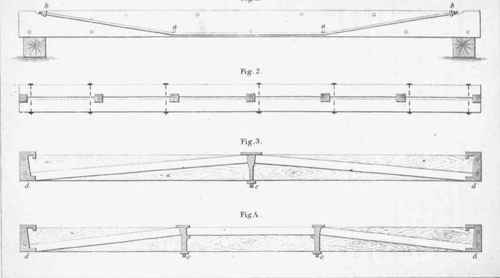
Fig. 1, Plate V., exhibits a method of trussing a beam by the use of an iron rod. All trussed beams are composed of two pieces. In the example at Fig. 1, the pieces are placed an inch apart, and the rod so bent as to take the sag of the beam at the points aa. A bolt, an inch in diameter, passes through the beam, and rests on the truss-rod. At bb are iron plates, through which the ends of the rod pass. This method may be employed where the span is from twenty-five to thirty-five feet. If the work is well done, the girder is strong; but the expansion and contraction of the rod subject the work to variation as the rod becomes longer or shorter.
Trussed Beams
Figs. 3 and 4 are examples where oak-pieces and cast-iron keys are used instead of a rod. The oak-parts should be two by four inches, and let into the wood a quarter of an inch on each side, leaving the beams an inch and a half apart. The keys should be made with a screw and nut at c to tighten the work. The abutments at dd should also be of cast iron, and let into the wood, like the oak.
Fig. 2 represents a beam built with oak-keys, two inches square, let half an inch into the pieces, and the whole bolted together. This method produces a very strong beam, and is of great value. It is often the practice in carpentry to bolt two pieces of spruce together, with an oak-board an inch thick between them. The bolts should be of wrought iron, and five-eighths of an inch in diameter. Should unusual strength be required, the beam may be built with three or even four pieces, with the truss-work between them, and the whole bolted together as in an ordinary beam.
Continue to:


My Books

