


The Modern House. Part 3
Description
This section is from the book "Interior Decoration: Its Principles And Practice", by Frank Alvah Parsons. Also available from Amazon: Interior Decoration: Its Principles and Practice.
The Modern House. Part 3
Better for a man to have a pine table, chair, bench and bed, decently stained, with respectable lines and well placed in his room, than a Queen Anne table, a marble-top black walnut dresser, a Morris chair and a Mission bed, any one of which may or may not be an atrocity beyond words. There is always the wood pile, the unspeakable attic, and as a last resort, if the house is large enough, a special room set apart for idols.
Again we constantly meet the objection, particularly in rented houses, that the landlords refuse to do anything. If there is no landlord to refuse and the man owns his house, then it is, that he cannot afford it or does not like to destroy or mar anything that has been so for a length of time.
Let us first deal with the landlord. In many houses or apartments built twenty-five years or even fifty years ago are found grills over doors, plate rails anywhere, abnormal growths on and around the chimney piece and set mirrors. There are also atrocious stair balustrades, garish tiles around the chimney piece, wedding-cake decorations about the ceiling and impossible varnished or grained wood surfaces in the trim. These things have made such places not only uninhabitable but dungeons of misery to all persons of feeling or intelligence.
It is sometimes hard to get the landlord to tear these things out. There can be no background until every one of these things has been changed. The grills, the abnormal growths, the wedding-cake decorations and the balustrades must come out, while the trim must be redone. Almost always this can be, at least, painted old ivory or gray, which, though a last resort, is under most circumstances the thing to do. The tiles can also be painted and should be the colour of the trim, for they, too, are an essential element of the background idea which is the fundamental one in the whole conception. The elimination of these stumbling-blocks is quite as necessary to carrying out any scheme of furnishing as the purchase of any number of new things or the arrangement of these things after one has acquired them.
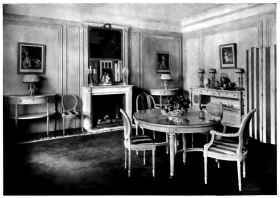
MODERN DINING-ROOM IN A CITY APARTMENT, EXPRESSING ELEGANCE. DIGNITY AND REFINEMENT, OMITTING OSTENTATIOUS DISPLAYS OF FURNISHINGS AND FITTINGS.
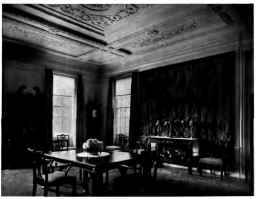
A MODERN DINING-ROOM SHOWING THE "GEORGIAN AND CHIPPENDALE FEELING" SUCCESSFULLY AMERICANIZED AND EXPRESSED IN TERMS OF GOOD TASTE. NOTICE THE BEAUTIFUL ARRANGEMENT OF TAPESTRY AND ITS ACCESSORIES, THE WINDOWS AND HOW THE ORNAMENTAL CLOCK AND CABINET ARE POSSIBLE BECAUSE OF A SIMPLE BACK.
The assertion is often made that it is impossible to find good things in the trade. Frequently one hears a remark such as: "There are no wall papers except flowered ones to be bought in our town." "There are no one or two tone rugs nor other types whose ornament figures do not stand out and offend the sensitive eye." "Cretonnes, printed linens and other textiles are much too bright and too floral in their pattern and good, dignified, unobtrusive patterns cannot be bought." Furniture, too, comes in for its share of criticism along exactly the same line.
In answer to this let me say that demand always has and always will govern the supply; that the supply will be furnished when there is a demand, and that the trade has in stock exactly what people want. When people demand better things, manufacturers will make them and tradesmen will sell them. It is the public taste that is at fault and not the trade.
After twelve years of intimate acquaintance with every branch of allied interior decorating trades in the largest city in America, I am convinced that one thing is true: that there is no one class of persons in this country more anxious to learn, more ready to respond or more loyal in their efforts for better things than the trade. This statement applies to wholesale and retail men, to those managing the textile shops, wall-paper shops and furniture shops. It is a very general and clearly defined feeling. When the consumer raises his standard of what is good the producer will raise his, and the middleman will respond naturally and quickly.
The greatest hindrance to our realization of what is best in house planning is found within ourselves. Do you not frequently hear people say: "I like it. I do not care whether it is right or not; it pleases me, so what difference does it make? It was good enough for my day and I guess it is good enough for yours." Or, "I love nature and therefore want it as much as possible about me in the house." These personal whims are responsible for more than is at first apparent. Is it not well to ask ourselves: why do I like it, or why am I pleased? Is it because it conforms to the laws of beauty and arrangement, or is it because I do not know whether it is good or not? Does it please me because it does not please somebody else, or because I have a reason for being pleased? Some who in their day made long journeys on horseback instead of a steam train, or went to bed with a candle instead of an electric light, may have changed their attitude of mind in respect to these conditions while they have not changed them quite so radically in other matters equally important. To deal with nature as nature and to deal with a defamation of nature as interior decoration are two radically different matters.
Let not the nature lover believe that anybody is likely to translate nature into carpets, wall papers, brass ornaments and plaster of paris, and do so successfully. Let him go on loving nature in nature's place. It is meet and right so to do. At the same time let him wake up, and wake up now, to the fact that whatever of nature is translated into material must be conventionalized so as to be consistent in that material, or it loses all its art value and becomes a cheap attempt to imitate something which it is impossible to imitate.
There is a difficulty, too, with persons who are entirely wedded to some one historic period and believe that no other is worthy of expression, or that no other national one is fit to use for any kind of individual expression. Some people are essentially French in their manner and form of expressing themselves. Others are English. Some are so individual as to be Louis XV or Jacobean, and a few, I regret to say, are still Queen Anne. But people are indeed rare that are adequately expressed by any one period idea, and the growing tendency is to ignore the exactly reproduced period and to accept, adapt and use objects from related periods to express a mixed national life.
The chapters on historic periods have been given principally to show the qualities for which they stand and our need to assimilate these qualities, whatever their period name is. This does not mean that a person should not be individual in his colour choice, and personal in his likes and dislikes, as well as quite natural in his selection of forms and decorative effects. It means that the more he knows what others have done, the more he will know what not to do, as well as what to do, and it also means that the less he limits himself to one colour scheme, one furniture style, one decorative idea, the broader becomes his concept, the wider his experience and the more versatile and refined his expression.
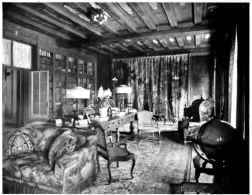
A MODERN LIBRARY WHOSE LUXURIOUS DECORATIVE CHARM LIES IN ITS UNITY OF TREATMENT. THE HALLS, CEILING AND FLOOR, WITH THE UPHOLSTERY MATERIAL, ARE SO SCALED AND ARRANGED THAT NO ONE THING APPEARS AT THE EXPENSE OF THE OTHERS. THE LAMPS AND THEIR PLACING EMPHASIZE THE DECORATIVE FEELING, life. To choose an article without a knowledge and feeling for its fitness and beauty is unwise. To choose it without considering it in its relation to its background and to each of the other objects with which it will be used in a room is worse. The failure to test one's arrangement by the principles of form is often the cause of a failure to make the most of whatever one has. Knowledge grows as one demonstrates what he has already learned. Nothing is thoroughly understood until it can be consciously demonstrated.
It has been the purpose of this chapter to call the reader's attention to the wonderful opportunity that the interior decorator and the house maker has to create an environment which will be the means of a higher state of aesthetic appreciation in the generation that is to follow. It has also been our aim to point out the stumbling-blocks to a full realization of an aesthetic ideal in furnishing and to incite a determination to make a beginning in the direction of overcoming these obstacles. It is further designed to arouse a desire to investigate the fundamental principles which govern form and decoration, and to use these principles daily in our selections and in our arrangements until, unconsciously, what we touch shall express a new state of personal consciousness in which good taste is not a thought-out act but an unconscious, irresistible impulse in all we do.
Continue to:


My Books

