


Chapter XVI. The Individual House
Description
This section is from the book "Interior Decoration: Its Principles And Practice", by Frank Alvah Parsons. Also available from Amazon: Interior Decoration: Its Principles and Practice.
Chapter XVI. The Individual House
IT is preposterous to think that there can be a class of set formulae given by which any and every room may be properly planned. One meets, however, those who want such formulae and those who are quite willing to give them. This creates a situation quite like that in which a patent medicine is put on the market with the assurance that it will cure every human ill, when, as a matter of fact, it is probably inadequately adapted to even one badly disordered state.
The house is an individual thing. Each room in it is individual, for the varied functions of the rooms and the personal differences of those who may use them all influence each particular element in the unit.
To say that a dining-room should be in this or that colour scheme, with this or that style of furniture, is not only absurd but entirely misleading as to what interior furnishing means. What is true of the dining-room is no less true of the living-room, the sleeping-room, the library, or other rooms in which the personal element is concerned.
What one can do, however, is to stick fast to the principles which govern all forms of expression, and then use his intelligence, and that of his advisory decorator, to make the elements that go to make up the room an expression of the personality of the one for whom the room is planned. When principle takes the place of fad or formula and impersonal qualities are seen as a media of expression, personality will find no difficulty in manifesting itself in any room under any conditions.
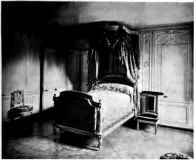
ONE'S OWN ROOM SHOULD ENPRESS THE "ESSENTIAL QUALITIES OF HIS PERSONALITY.
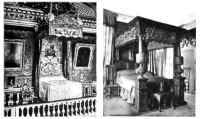
A. BEDROOM OF MARIE ANTOINETTE; LITTLE TRIANON.
B. BEDROOM OF LOUIS XIV AT VERSAILLES.
C. BED OF QUEEN EI.IZABETH OF ENGLAND.
COMPARE THE QUALITIES WHICH ARE FOUND TO BE PROMINENT IX THE CHARACTEROF BACH PERSON WITH TUB QUALITIES EX-PRESSED BY THE ROOMS AND THEIR FURNITURES.
Each house is the natural expression of an individual's (idea of functional fitness, beauty in environment and good taste. Function or fitness is the fundamental idea of the room. There is a tendency frequently to let other elements creep in which in themselves are not bad, but which destroy the functional idea for which the object stands.
For example, sentimental souvenirs, or decorative objects, are allowed to occupy space in the room that one can ill afford to give to such trash. These objects also are frequently placed upon tables, pianos, cabinets, dressers and the like in such a way that the real function of the object on which they are placed is completely obscured. Mirrors cannot be used, drawers opened or shut, pianos closed or opened, tables used for any practical purpose, without moving these senseless things.
How often lamps or other lighting features are so placed that it is impossible to read or sew by them. In the same way hangings and curtains are so placed that windows no longer admit light or serve to protect from outside observers; chairs bear no relation to tables so far as reading, writing or other work is concerned. In short, the acquisition or the placing of objects functional or beautiful in such a way that they do not fully express their use idea is in bad taste. To destroy the functional feature of an object by the addition of a less important one or by a bad placing of that one is neither sensible, economical nor artistic.
The first essential in the individual room is the judgment necessary to ascertain that every object in it is so placed that it does its own work in the most efficient manner. Until each object is so placed the room is not right, however individual it may seem. It must be clear that no formula can be given for this. A writer or author requires a table, perhaps a desk, chairs and other material in quite different relations to each other and to lighting than the person who uses the same type of room for visiting purposes or as a reading-room or library.
The dining-room in the moderate house is sometimes used for other purposes. In this case function demands quite a different arrangement of the table, chairs, light, sideboard and other articles.
It is well to raise the question as to whether every article in the individual room you have in mind meets as nearly as possible the criterion you have of functional fitness. If it does, it matters not whether you are a musician, an artist, an author, a seamstress, a lawyer or a doctor - the room is in harmony with your life work, which is yourself, and will become personal when you know how to express yourself in terms of colour, form, line and texture.
Beauty is the quality of harmonious relationships. A formula to produce it does not exist. But principles of harmony in colour, line, form, texture and arrangement do exist and no two people can interpret them alike. Nor will they do so if these principles become unconscious working elements of the mind. Accept, in structural unity with room structure and furniture placing, avoid triangular then, the fact that beauty is harmony. Learn next what things are harmonious. Use, in the third place, such elements as express your idea, personal and individual, of the function included in your room idea. As far as you can, demonstrate these principles; beauty will result.
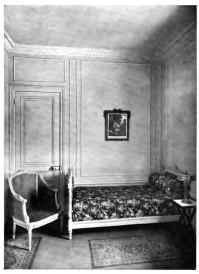
SIMPLE DECORATIVE CHOICE AND ARRANGEMENT OF MATERIALS, EXPRESSING THE QUALITIES OF FEMININE REFINEMENT AND GOOD TASTE, IN A MODERN BEDROOM. VERY INDIVIDUAL.
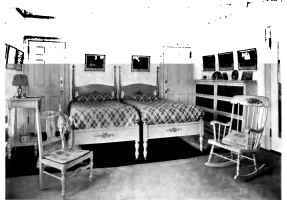
BEDROOM IN SUBURBAN HOUSE. EXPRESSING QUA1NTNESS AND A CHARM UK DECORATIVE ARRANGE-MENT. EMPILSIZED BY ITS SIMPLICITY, DECORATIVE COLOURINGS AND PLACINGS OF PICTURES.
Continue to:


My Books

