


The Modern House. Part 2
Description
This section is from the book "Interior Decoration: Its Principles And Practice", by Frank Alvah Parsons. Also available from Amazon: Interior Decoration: Its Principles and Practice.
The Modern House. Part 2
As to the second objection given, it may be said that it is never too late to begin to do right. The first ray of light as to what is good in furniture or fittings should be followed. Have definitely in mind what your ideal of the room would be if you could have everything new and have it at once. A mental picture of a result is essential before the first step in the solution of a problem in interior decoration can be successfully taken. Buy each article with the finished whole in mind, and as fast as a bad thing can be eliminated procure another in its place that harmonizes with this mental picture. The house will turn out better than one expects, and the best of it all is that the individual grows with it.
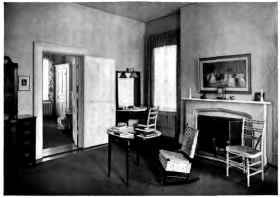
A DELIGHTFULLY SIMPLE MODERN BEDROOM WITH FEMININE TOUCH, EXPRESSING QUALITIES ESSENTIAL TO REST AND SLEEP. THE FURNITURE IS PLACED FOR COMFORT AND USE. THE TREATMENT OF THE WINDOWS, MANTEL AND FURNITURE PLEASING AND DECORATIVE. PICTURE
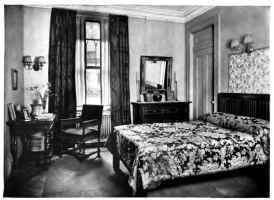
MAN'S BEDROOM, IN A MODERN APARTMENT, EXPRESSING RESTFULNESS, INDIVIDUALITY AND MASCULINE QUALITY. CHARM DISTURBED BY THE BAD SCALE IN THE MOTIFS OF TEXTILE AT HEAD OF BED. GOOD MIRROR FRAME, WELL HUNG.
If the available money is limited start with the background of the room. If $25, $50, or $100 be used, let that be expended to make the woodwork, the walls, the ceiling and the floor a suitable background. The quality of rest will find its way into the room and right relationships of colour be easy to establish the moment the backgrounds are satisfactory.
If more changes can be made let them be in the hang- ings and rugs for, next to the background, these are the most important things in any room.
Having disposed of background, rugs and hangings, furniture and decorative material can be dealt with very easily, very simply and quite gradually with a continued feeling of satisfaction that the room is growing better every day. The mistake made by most people, including many decorators, is in trying to make things appear moderately satisfactory against impossible backgrounds.
Do not buy sideboards until the wall paper and floor are suitable. Never mind what your furniture is until you have something to put it against. Do not be distressed about vases, fancy clocks and other unnecessary and distracting objects until your furniture is right and the more important decorative ideas are well looked after. In other words, build from the bottom up. The background is the foundation upon which all things must rest.
Another objection has been made, something like this: "There are the old inherited pieces of furniture" (usually mahogany) "which have belonged to the family for generations. These, of course, are not good, but how can I part with them since they are family heirlooms?" If one is not handicapped by these things he usually is by wedding presents, holiday gifts or senseless purchases made without thought or because they were believed at the time to be bargains.
Heirlooms, gifts and foolish purchases are either a matter of sentimentality or of supposed economy.
Aunt Jane may have been a good woman. She may, however, have had some misconceptions as what constitutes the most artistic combination of colour, line and form in a chair or table. In this state of Aunt Jane's consciousness she probably bought the table which you now have. Now that she is probably in a state of consciousness in which she realizes how bad the table is, neither you nor I can be expected to accept this table as our idea of what a table should be. The fact that one disposes of Aunt Jane's table in the wood pile or the attic in no way interferes with one's respect and love for Aunt Jane.
Until it is possible to disassociate tables, chairs and other objects from human beings, and particularly from human beings in other states of existence, it will not be possible to deal successfully with family heirlooms in modern houses. Let us judge the table, the chair, the chest or the bed, on its merits as an abstract idea, disassociated from whoever had it, and be big enough and broad enough to take a stand against anything that is not good and right, be its associations ever so closely connected with family or friends. This is the only possible way in which one can be in a frame of mind to consider the disposition of such articles as he knows to be unfit for further use. It may be well to remember that there is a difference between that noble and highly spiritual quality called sentiment and the weak, sickly counterfeit of it which we call sentimentality.
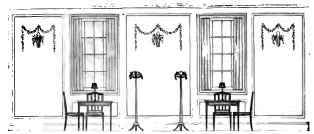
SIMPLE ELEVATION SUGGESTING WALL AND FURNITURE TREATMENT FOR COUNTRY TEA-ROOM, MODERN AND DECORATIVE.
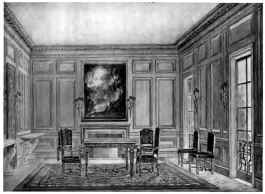
SKETCH FOR LOUIS XIV DINING-ROOM, MODIFIED AND ADAPTED TO MODERN CONSTRUC-TION AND MODERN, DECORATIVE IDEAS.
What to do with these things, provided one is willing to part with them, is willing to risk family criticism, the friendly questions that arise when the occasional visitor finds his gift missing from the top of the piano, is a serious question. The habit of giving furniture that is unfit for use to the poor is deadly, if one considers at all the establishment of a taste standard. Why should the poor have things in worse taste than anybody who is not poor? A man has a right to good things, and the practice of giving half-worn bad things in clothing and in furnishings to somebody who is supposed to be grateful for anything on earth is perhaps responsible more than any other one thing for the present way of regarding the interior of the house.
Continue to:


My Books

