


The "Sanitas" Closet
Description
This section is from the book "Improved Plumbing Appliances", by J. Pickering Putnam. Also available from Amazon: Improved Plumbing Appliances.
The "Sanitas" Closet
In the effort to obtain a water-closet which should fulfill all of the above-mentioned requirements, the writer has made use of a principle of hydraulics new in the practice of plumbing, namely, that of supporting a water column by atmospheric pressure acting only at its lower end. The principle is explained by the simple laboratory experiment of the inverted bottle in the basin of water (Fig. 71). If an ordinary bottle be filled with water and inverted in such a manner that its mouth shall be immersed below the surface of water in a basin below, the water in the bottle will be supported by atmospheric pressure acting on the surface of that in the basin. Let now this surface be lowered by any cause, and we shall find that it will be instantly restored from the bottle as, soon as it sinks below its mouth, as shown in
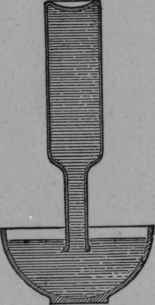
Fig. 71. - Inverted Bottle.
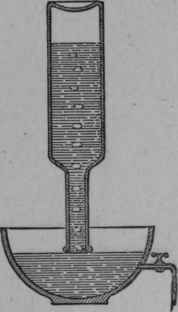
Fig. 72. - Water exhausted from the Bowl.
Fig. 72.
We have applied this principle to water-closet construetion in the manner illustrated in Fig. 73. The water-closet represents our basin, and its supply-pipe our inverted bottle, which is closed at its top by the cistern-valve. If water is exhausted from the closet bowl by evaporation, si-phonage or any other cause, a fresh supply descends automatically from the pipe as soon as the surface sinks below its mouth. Inasmuch as, in the construction of the closet, this mouth is placed above the bottom of the water-seal, it is evident that water will instantly descend from the pipe before the seal can be broken. This seal is four inches deep and the mouth of the pipe is midway beween the top and bottom of the seal, or, in other words, two inches below the normal level of the standing water in the bowl.
Fig. 74 represents the actual construction of the closet.
The action of the apparatus is as follows:
The cistern valve being raised, the balance of atmospheric pressure is restored, the water column in the pipe instantly begins to move, and, since it connects with the water in the closet below its level, it acts noiselessly and effects a thorough flushing.
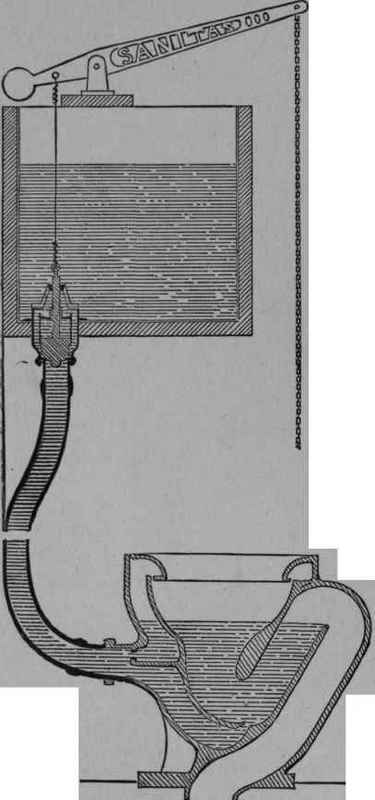
Fig. 73 - Diagram illustrating the Principle of the "Sanitas" Water-closet.
A novelty in the general principle of construction involves corresponding novelties in many details.
The lower end of the supply-pipe is not simply opened at a single point below the water level, but is conducted to two places independent of each other, the first being intermediate between the overflow of the trap and the bottom of the seal, as is shown more clearly in Fig. 70, and the second at the bottom of the trap, as shown in both Figs. 70 and 71. The first forms the mouth proper of the "inverted bottle" and supplies water to the flushing rim, and the second furnishes a jet which lifts part of the water out of the trap and bowl by its propelling power. Since both jets enter below the level of a large body of standing water in the bowl, their noise is deadened, and, as the supply-pipe always stands full, they act instantly, and the flushing of the closet is very rapid. The lower jet causes the water and waste matters in the closet to sink into the neck of the bowl. Meanwhile the upper jet fills the passages and annular chamber leading to and surrounding the flushing rim, overflows, and, descending into the neck of the bowl, falls upon and drives out the waste matters collected in the neck quietly and without waste of water.
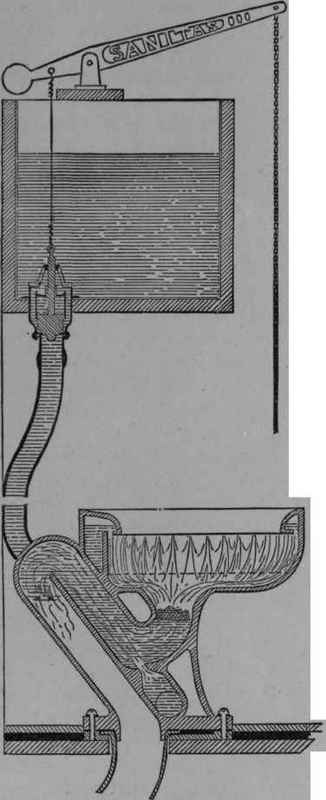
Fig. 74. - Actual Section of the "Sanitas" Water-closet.
The cistern valve being again closed, movement in the supply-pipe immediately ceases, and the water in the flushing rim and passages leading thereto falls back into the closet and restores the normal level of the standing water in the bowl and trap.
The form of the closet bowl is shown in plan in Fig. 75.
The standing water has the shape best calculated to receive and deodorize the waste matters falling into it. It is deepest at the back of the closet and very deep at the point where the wastes strike. Its surface is long and comparatively narrow, and is not round or elliptical as has heretofore been customary. The reason for this is simple, and will easily be understood upon reflection. We know that the user of a closet will sometimes sit forward and sometimes back on the seat according to circumstances, but it rarely if ever happens that he will sit laterallv out of center, inasmuch as this would be extremely awkward and uncomfortable. Hence the water surface should have considerable longitudinal extension, while much less lateral extension is required, and we have found that the narrower the water surface within certain limits, the more easily, quickly, and economically in respect to water consumption will the waste matters be expelled. By examining Fig. 73 it will be observed that the under surface of the bowl is horizontal from front to rear except at the outlet, and that this surface is immersed under an inch or so of water. It will also be observed that the water-slots in the flushing rim are largest in the front and rear and gradually diminish as they extend round to the sides. The result of this conformation is that the upper flushing water jumps on top of the waste matters and acts to the best possible advantage in driving them quickly out, and the closet can be easily flushed in three seconds by less than a gallon and a half of water.
Continue to:


My Books

