


Gliders
Description
This section is from the book "Boy's Fun Book Of Things To Make And Do", by Grosset & Dunlap Publishers. Also see: The Pocket Dangerous Book for Boys: Things to Do.
Gliders
Homemade folders as a rule are too stiff to fold back, but commercial ones do and aid greatly in saving propellers. There are three blades on the prop below, made by a builder in New Jersey. The number doesn't matter as all can be folded back.
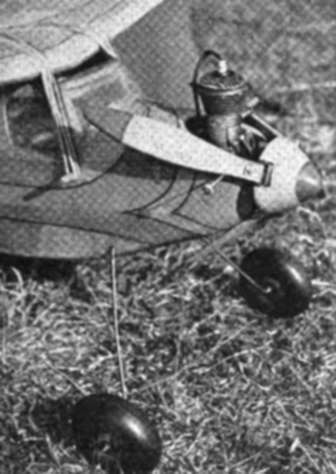
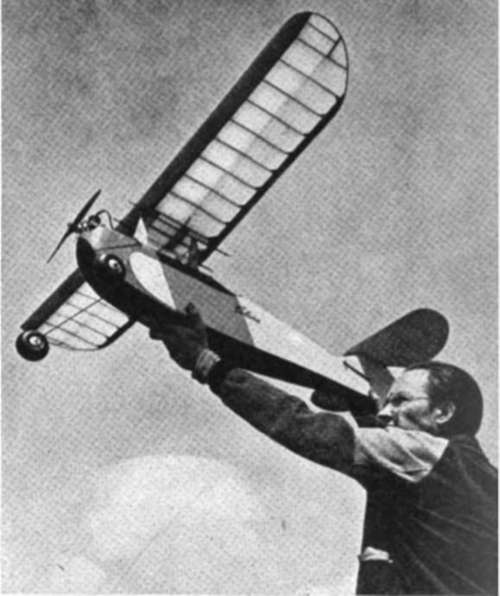
This is the Cobina model shown dismantled and also packed in its carrying case on the facing page. Here Rapien has attached his folding wings, stabilizer, and landing gear, installed motor and propeller, and is set for the take-off.
A great deal of freedom is possible in designing the fuselage, especially since new competition rules place no limits on cross-sectional area. A fuselage that the writer is developing is shown in the drawings. The boom is cut from hard balsa. It was found that a hollow boom snaps easily, whereas a solid one of the same weight merely bends and springs back.
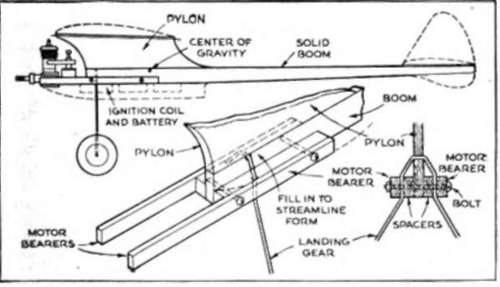
Design of a practical motor mount. Wooden bearers are attached to the boom with only two screws, facilitating replacement of a damaged bearer.
Perhaps the greatest difficulty in designing a gas model lies in planning the motor mount. Aluminum, if available, is good for small motor mounts, especially if used as removable units to which the batteries and coil are affixed. The drawing shows a mount used by the writer. The wooden bearers are attached to the boom with only two screws, and a broken bearer can be replaced readily.
This mount also clamps the two-wheeled landing gear in place.
Competition rules still require an adequate landing gear. With the single-wheel type, two auxiliary skids must be used. Retractable landing gears reduce drag slightly, but are scarcely worth the extra difficulty they entail. Also, builders too often forget, in the excitement of getting the motor started, to put re-tactable gears up.
Few rules can be laid down for handling gas motors. Learn their little tricks. It is most important to make sure there are no compression leaks from the crankcase or elsewhere. Breaker points should be made to close evenly and not on one edge only.
Harry Apoyan and his tailless towline glider. The stick to which the towline is attached has a rudder. When the glider reaches the peak of its climb, stick and towline fall away, leaving the model free to soar.
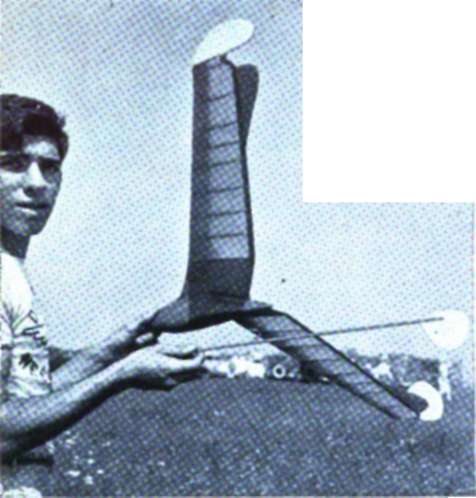
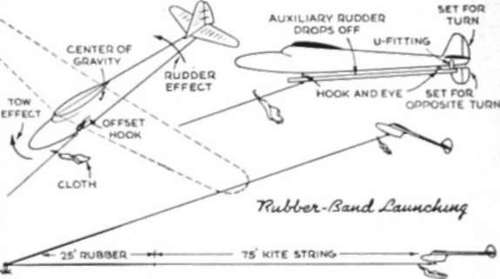
With a fourth of the towline of rubber, a glider is launched at gradually increasing speed, often adding surprising altitudes.
One should also remember that the life of a battery depends on its weight. Use the largest possible. Voltage drops appreciably after cells have been in service a short time, so use boosters as much as practicable.
The rules once permitted a maximum flight duration of only four minutes. Any time over that was subtracted from four, and if the flight was six minutes or more, no time was taken. The reason for this unusual rule was that gas models had to be kept within the flying area so as not to interfere with the spotting of military aircraft.
Gliders
Using only a minimum of materials, you'll find there is still fun in building towline gliders. These can be made from domestic woods and paper without consideration of weight. One needs only a long string to get them up as high as may be desired, although contest rules allow only 100' of line.
The design of a towline glider is not very different from that of a rubber-powered model. Its fuselage is usually one half the wing span. The aspect ratio of the wing may vary from 8 to 12, the former being more efficient in the case of small wings.
The chief thing to be watched is spiral stability, so that the glider will not spin under tow or in a thermal current. Use about lV of dihedral under each wing tip for every foot of span, and use polydihedral when possible. Careful adjustment of the rudder area must be made by observing the model in flight or glide. If it persists in facing the wind, the rudder is too large. If it tends to glide with the wind, the area is too small. The action is almost exactly like that of a weather vane.
If the rudder and dihedral are correctly proportioned, it is possible to tow the model upward with the rudder set for a circular glide. To do this, some fliers attach the towline to one side of the model, thus offsetting the effect of the turned rudder, as shown in the drawings. Others use a lever arrangement between the tow hook and the rudder so that the latter will remain straight under tow, but turn when towing is over.
One glider builder, Henry Struck, of New York, N. Y., designed an auxiliary rudder that is attached to the towline and drops off with it when the glider is released. Most fliers tie a bit of cloth to the towline near the glider. Wind drag on the cloth helps the line free itself from the hook.
An excellent launching method shown in the drawings makes use of both rubber and towline. About one fourth rubber to three fourths line is a good proportion, and a single strand is adequate for 4-oz. to 6-oz. gliders. This launches the model at gradually increasing speed; surprisingly high flights can be made in this way.
Glider flying affords great satisfaction. It is particularly exciting since a flight may be prolonged astonishingly if the model encounters a thermal.
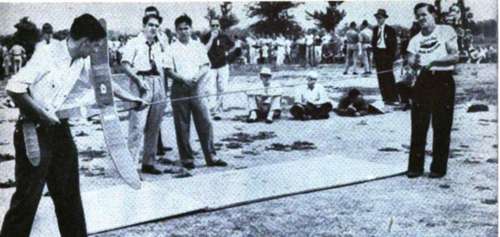
Dick Korda, recent Wakefield winner, winding model that set world's record of 43 min., 29 sec. John Zaic, who holds the plane, will testify that this is no job for a flimsy winder.
Continue to:


My Books

