


Gas Models And Towline
Description
This section is from the book "Boy's Fun Book Of Things To Make And Do", by Grosset & Dunlap Publishers. Also see: The Pocket Dangerous Book for Boys: Things to Do.
Gas Models And Towline
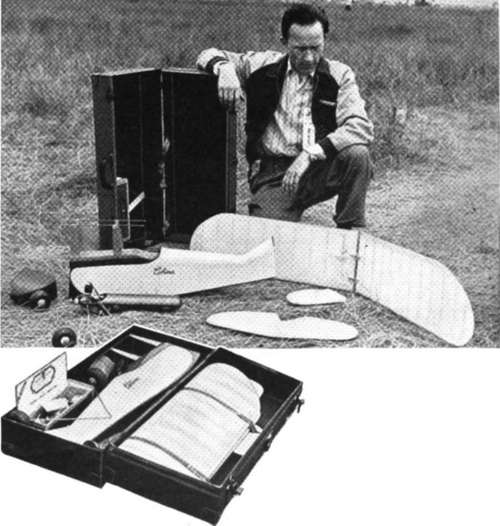
Demountable model planes find favor when fliers travel or have limited storage space. This one, built by Ralph Rapien, of Chicago, packs into a case and can be assembled quickly with pegs, rubber bands, and hinges.
MODEL-AIRPLANE making is entering a new era. Shortages of many materials previously imported may reduce the number of construction kits on the market, and more builders may be inclined to design their own ships.
Gas Models
Whether a gas model is made from a kit or built to an original design, too much stress cannot be laid upon the need for aligning all parts perfectly. Once you have a true line-up, any basic faults may be more easily checked. If some structures seem to be weak, replace them with stronger ones. As a rule, the high-powered, high-wing model is one that will call for critical adjustments. Its natural flying characteristics are a right spiral climb under power and almost anything in the glide. Use low power on the initial flights to learn the eccentricities of such a model and correct them before it cracks up. In designing a gas model yourself, count on having the wing slightly above and behind the motor. The reason for this is to bring the center of gravity closer to the trailing edge, or about 60 per cent of the wing chord back from the leading edge, and still have the motor accessible and the heavy ignition system near the wing.
Wing design and construction may be much the same as for rubber models. The stabilizer need not be larger than 25 percent of the wing area, and the rudder may be made 10 percent to start with and altered if test flights show it necessary.
Continue to:


My Books

