


Model-Airplane Short Cuts
Description
This section is from the book "Boy's Fun Book Of Things To Make And Do", by Grosset & Dunlap Publishers. Also see: The Pocket Dangerous Book for Boys: Things to Do.
Model-Airplane Short Cuts
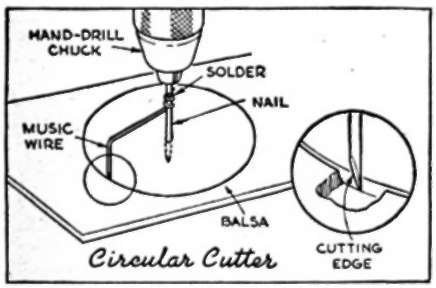
Circular Cutter
This tool will be found useful for making balsa wheels or bulkheads quickly. For cutting thin balsa or wheels 2" or less in diameter, steel music wire 0.040" thick will be satisfactory. If thicker balsa or larger disks are to be cut, thicker wire should be used. Grind the cutting edge sharp as shown, and cut gradually, using a hand drill. Do not force the tool or try to use it in a power drill, as the soldered joint will probably fail if this is done.
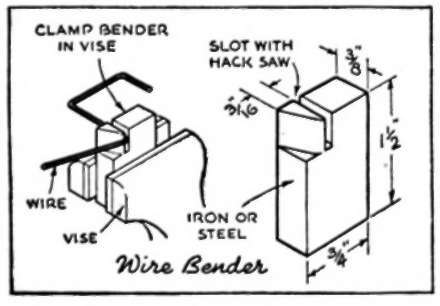
Wire Bender
You can make this jig from a scrap piece of mild steel or even cast iron. The latter is not difficult to work if the surface is not too heavily covered with hard scale, which can often be removed by grinding. With a hack saw and a file, shape the jig as shown. The slot should be slightly oversize for easy removal of the bent wire, but the dimensions given need not be followed exactly. This simple jig is especially useful for shaping thick music wire when making parts for gas models.
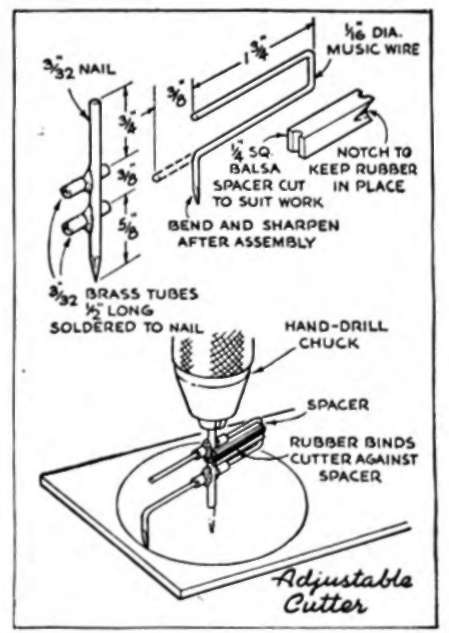
Adjustable Circle Cutter
The dimensions indicated are for a heavy-duty tool that may be used at slow speed in a power drill press.
If the feed is gradual, the soldered joints will withstand the strain. A jig made of small nails will hold the parts in their relative positions for soldering. Use balsa spacers and a strong rubber band to hold the cutter arm at various radii.
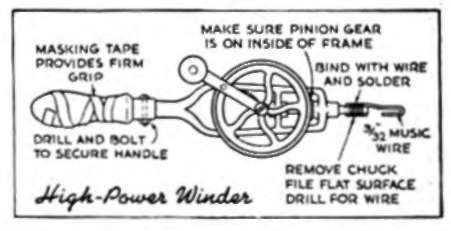
High-Power Winder
At the moment there seem to be no available winders that will safely handle the high-power rubber motors now in use. The winder shown, however, can be made easily from a suitable high-grade hand drill. Although such drills cost about $1.50, the investment pays dividends in security. It is dangerous to use winders consisting of a hook clamped in a hand-drill chuck. See that the hook runs true on the shaft and that the handle is securely bolted to the drill frame.
Wheel Retainer
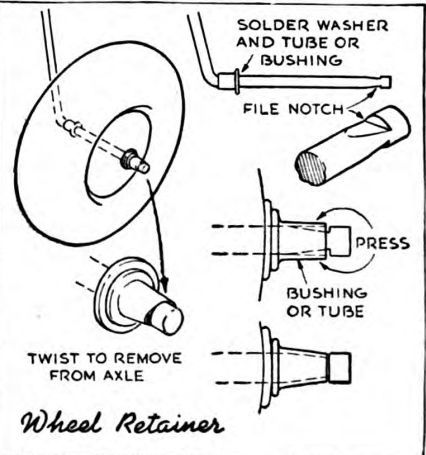
Music wire, from which landing-gear axles are usually made, is difficult to solder or to thread for a retaining nut. The method shown holds the wheels of even big gas models securely, yet permits them to be removed at any time. Use small eyelets, thin-walled bushings, or short pieces of tubing as shown. This idea was originated by a clever New York model maker.
Light Hinge
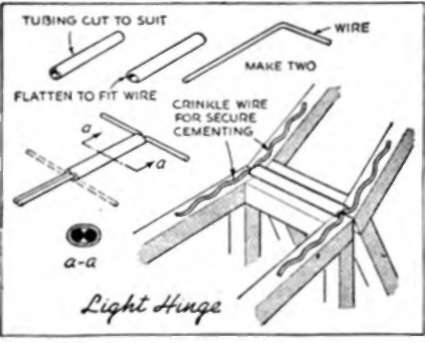
There are a number of places, especially on large planes, where a light, strong hinge can be used to advantage. Here one is shown joining the tail end of a fuselage that is hinged to allow access to the rubber motor. It is best to use aluminum tubing for light models, and brass tubing for heavier duty. If the wire is carefully selected and of the right size, there need be little looseness in the completed hinge. Cut the tubing to correct length, flatten it carefully, and insert the wire pins as shown. The stem ends of the latter are kinked slightly, and the cemented joint should be firmly bound with thread.
Continue to:


My Books

