


We Visit A Bee Farm. Part 2
Description
This section is from the book "Queendom Of The Honey Bees", by Phillip C. Lance. Also available from Amazon: Queendom Of The Honey Bees.
We Visit A Bee Farm. Part 2
"The best hive is made so a beekeeper can get into it easily when he wishes to work among the honey combs. It should have plenty of space where the bees may store the honey and ample room for a brood chamber. Movable frames enable the beekeepers to remove the honey. Of course, they should be strong and built to protect the bees from unfavorable weather. "
"This hive, " continues Ted, motioning us to gather around a clean new hive on a low carpenter's bench, "is a very fine modern one. It is of course, a movable frame hive, which means that the frames upon which the honey combs are built by the bees can be removed and replaced whenever the beekeeper desires to move them. This is a great advantage over the plain, old box hives, because the beekeeper can control the condition of his colony in many ways. He can remove the combs, one at a time, to find the queen and see if she is healthy and producing eggs. He can add several combs of fresh honey to supply a hungry colony. He can give several combs of brood cells to a weak colony that is not growing in size. He can remove diseased comb and by replacing it with new combs, save a colony from destruction. He can remove filled surplus combs and, by using a machine called an extractor, take the honey from the cell, then return the empty comb intact for the bees to refill. "
"Is a hive very difficult to make? "
"No. On the contrary, a hive is a very simple piece of construction work. See, this is the cover. " Ted removes the top of the hive, which is just a wooden box-like cap about six inches deep. Then he removes a second section, about half as high as the main part of the hive and says, "This is called a super. It is really an added section for storing the extra honey. A keeper can add as many supers as are needed to care for the honey crop. Now, here is the body or brood chamber. It has ten long frames suspended from stringers across the ends of the box and held in place by small pieces projecting from the end of each frame at the top. You see there is room on all sides of the frame for the bees to pass along but not enough to build extra combs. "
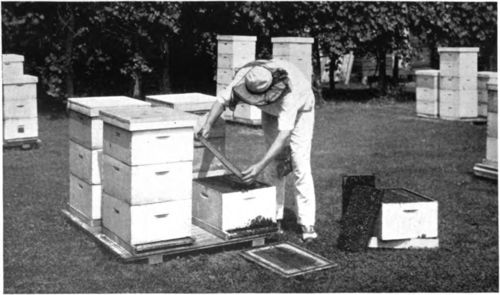
Ted picks up the brood chamber, and underneath it we see a plain board floor which is the bottom or base of the hive.
"Now, " Ted goes on, "we have seen what a hive looks like and I am going to tell you an important thing to remember. If you start an apiary, always have all hives and parts of the hive the same size. By doing this, each part of a hive may be exchanged with that of another at any time. This is really an important detail of successful beekeeping. Would you like to see the frames removed from the hives and some of the interesting things going on inside? "
"Yes, " we eagerly answer.
We follow Ted into another room where he instructs us to pull on white cotton overalls. He says, "Bees do not like dark clothing, especially if it is woolen. They prefer light colors and the vegetable fiber of cotton to dark colors and the animal fiber of wool. "
We then put on regulation bee-veils which are merely fine nets placed over our hats and tucked under our coats. They form a fine protection for our faces if, perchance, a bee may want to sting us. We draw on rubber gloves to protect our hands and fasten our trouser legs tightly near the ankle. Now we feel safe to venture into bee land. Ted does not wear these things for he has no fear of the bees because his work keeps him around them all the time and he is used to them, and the bees know him. We follow our guide's instructions closely.
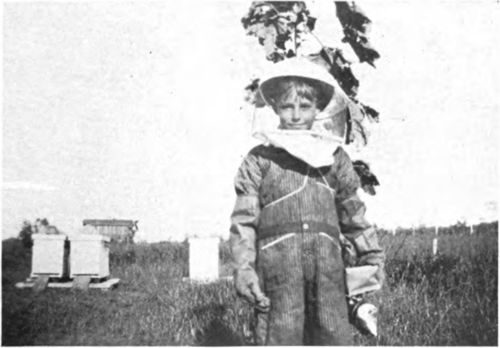
Prepared To Visit The Bees
Ted says, "Remember to move quietly and slowly. There is nothing to fear. I have several hives to check for new queen cells. You see, that is one way to tell when a colony is about to divide and a portion of the colony swarm away to a new home. The workers always build queen cells before the swarming time, so the group remaining in the hive after the swarm has left will be provided with a queen because the old queen goes with the swarm. Notice these cards that are attached to each hive. We have accurate records of the hives containing queen cells and are often able to prevent a swarm by moving the queen and part of the workers before they start to some hollow tree. "
We walk carefully along behind a row of hives. Ted looks at the little white record cards attached to each one. Presently he looks at the card on a hive and says, "Here we are; this one was inspected last week but we'll check it again today. Ordinarily I could open this hive without using smoke to frighten the bees. However, with strangers about, it is better to use the smoke. "
Ted lowers his bee-smoker near the entrance of the hive and, with the aid of a small bellows attached to the can, blows a few light whiffs of smoke inside.
This disorganizes the guards at the door and sends all the bees rushing to fill up on honey, which is the first thing bees do when threatened with fire. They get a supply of food in their stomachs so they will be ready to abandon the hive.
Continue to:


My Books

