


Chapter Seven. We Visit A Bee Farm
Description
This section is from the book "Queendom Of The Honey Bees", by Phillip C. Lance. Also available from Amazon: Queendom Of The Honey Bees.
Chapter Seven. We Visit A Bee Farm
We are on our way to visit the Fern County Apiary or bee farm. Driving through the fragrant fields in the country with the glorious sun shining on us is very pleasant. We arrive at the farm where everything is green and white. Rows and rows of pretty white hives stretch away over the closely cropped grass, under the spreading shade of many leafy trees. Acres and acres of white clover blossoms cover the countryside. The air is alive with the buzzing roar of a million honey bees.
Fern County Apiary is a public owned bee farm where people are employed by the county to care for it and to experiment with the bees. Here trained workers do the work. They know what to do in any emergency.
Many visitors come to the farm. For this reason, men are hired to act as guides around the farm and to answer any questions that may be asked about the bees. A pleasant young man comes toward us.
He will show us about and will answer our eager questions. We expect to ask a great many questions because some of us may raise bees as a future business.
One of our boys asks the guide, whose name is Ted, "How can a beginner get a good start in the bee business? " Ted suggests, "Let's take a stroll around the farm first and I'll answer your questions as we go. "
We agree and, as we walk along at a respectful distance from the hives, Ted answers the question asked him just a few minutes ago. He says, "Most anyone can keep bees if be learns to handle them without fear. You see, you must get along well with your bees if you are to work successfully with them. You must he neat, patient, and good at caring for details. Many people keep bees as a hobby and work with them in their spare time. You can't do this well unless you try to care for a few hives only and not a great many of them.
"Then, you must find a good location for the apiary. This isn't so important unless you plan to keep bees on a fairly large scale. If you do plan to have a big apiary, you must find a place where good crops of sweet clover, sage, or other blossoms can be found in the fields; or where fruit trees and fall flowers grow. Apiaries near rivers and creeks have a distinct advantage because many bushes and shrubs grow along the banks. These furnish a supply of sweets. Trees also supply sweets. " Ted points to a nearby stream and a little woods near the farm to illustrate his words.
Our guide pauses before a row of hives and remarks, "Notice how these hives are placed in rows facing the south. Thus, the entrances get the full benefits from the warm sun and light breezes. " "Bees must have a sheltered place to alight with their heavy loads of pollen and nectar. Often a gust of wind will blow the little workers to the ground or against stalks of grass and cripple them. "
"Our hives are all set on concrete foundations. No grass or weeds are allowed to grow around the hive entrances which are kept free of dead leaves, twigs, and other obstructions. Thus there are no hindrances to the honey gatherers when they come in heavily laden from the fields. "
"Each hive has an overhanging roof which protects its entrance from the sun and rain. They are like porches which are built in front of doorways. These fruit trees, under which the hives are placed, not only afford protection to the bees hut also furnish a source of honey supply near their home. "
Ted is very enthusiastic in his description of the bee farm, and we feel free to question him further. We ask, "What kind of hive is the best for beginners to use, and what kind of bees are best for new beekeepers to buy? "
Before Ted answers, he steps behind a nearby hive, quietly reaches out his hand and encircles a heavily laden bee which has just alighted at the door of the hive. When Ted comes back to us, he says,
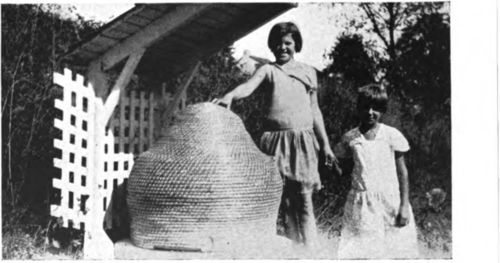
A Straw Hive, Or Skep
"Bees won't harm you when they are filled with honey. Of course, I'm not crushing this little worker in my hand; I'm just holding her loosely. " He opens his hand just a bit so that we can see the bee imprisoned there; then, he continues his remarks. "This is a tan colored bee, called an Italian Bee. It is the best type of honey producer known. The ordinary black bees are not so easily handled and are more savage. I recommend these bees to anyone going into the business. "
We view the little captive with interest as Ted continues his explanation.
"Of course, some beginners prefer to experiment with several colonies of the black bees to learn the business. These black bees are less expensive than the tan ones. "
Ted steps quietly back to the hive and releases his prisoner, saying, "Always move quietly when you are near a hive. Never make any sudden motions. It is best to approach a hive from the side or the rear. A direct approach often interferes with the bees' flight. This annoys them and they may sting you. "
"Before I tell you about the kind of hive you ought to use, let's go to the work room. There are several unused hives there and we can look at them, " says Ted.
As we enter the work room Ted explains:
Continue to:


My Books

