


Out In The Open Where The Honey Flows The Bee At Work. Part 3
Description
This section is from the book "Queendom Of The Honey Bees", by Phillip C. Lance. Also available from Amazon: Queendom Of The Honey Bees.
Out In The Open Where The Honey Flows The Bee At Work. Part 3
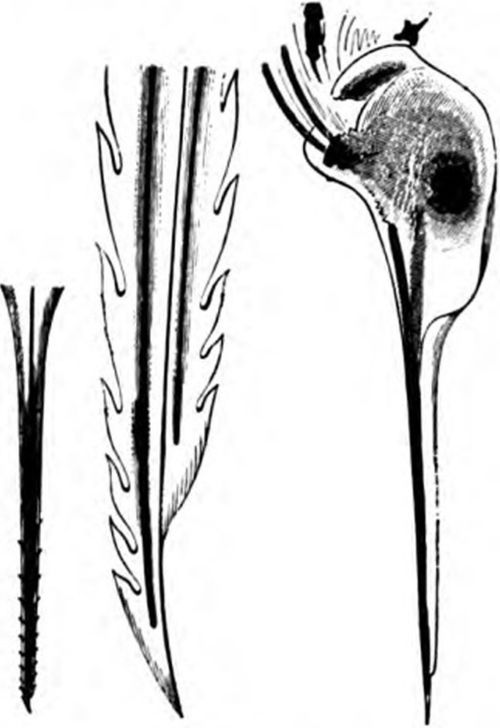
Magnified Sting
When we look at the little sting closely, we see that it is in three parts. It has a hollow groove through the center, in which two little barbed spears move up and down. When Miss Bee stings, she puts the first barbs into the flesh, then, by moving the little spears up and down, she forces in all ten of the barbs.
This is not all. Next to her body is a poison sac. From this sac, poison is forced down the groove of the sting, then through the five lower barbs, into the wound.
We may think Miss Honey Bee is very cruel. This is not so. She uses her sting only when in danger, and she frequently kills herself when she fights with it. When the bee stings anything as tough as our skin, the ten barbs on the sting hold it tightly in place. The bee is unable to pull it out. She pulls so hard to get away that the intestines, to which the sting is attached, are pulled from her body. This usually brings death to the bee. A man should feel sorry for the honey bee, not angry toward her, when she stings him because she acts in self defense and very frequently dies afterward.
What should a man do if a bee stings him? First, he should press the flat side of a knife blade gently against the skin, close to the sting. He should not press down on the poison sac and sting because that will force more poison into the wound, but he should pry or cut off the poison sac from below. Then a little mud and cool water applied to the wound will soon relieve the pain.
The Legs
We see that Miss Honey Bee has three pairs of legs. These legs grow from the middle part of her body called the thorax. Miss Honey Bee uses all six of her legs when she runs and walks.
The bee's legs are peculiar ones. Each leg has ten joints. Two parts of the leg are small and close to the body. The third, fourth, and fifth joints are the largest. The sixth, seventh, eighth and ninth joints form the foot and the tenth is a claw. The joints of the foot permit the bee to curl it about anything or to grasp anything, as we do with our fingers.
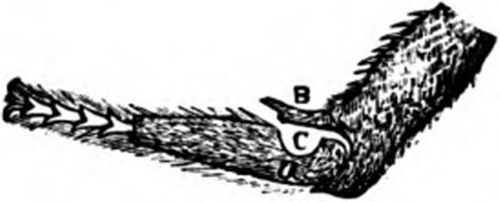
Anterior leg of Worker (magnified)
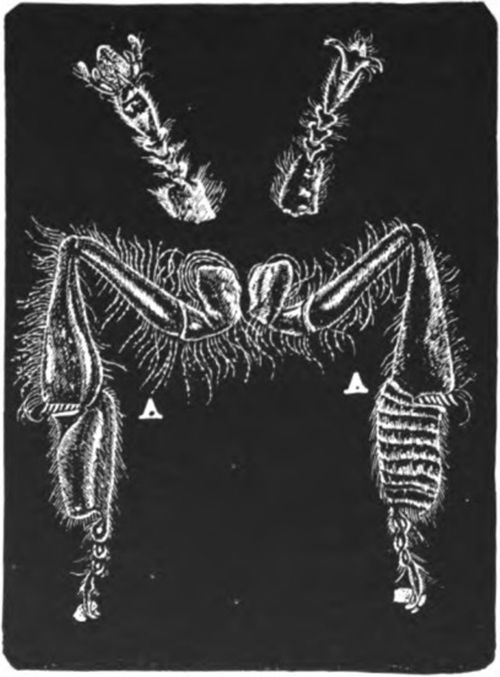
Legs Of The Honey Bees
Posterior Legs Of Worker (Magnified. ) A A Pollen-Baskets
The claw of the bee is at the end of the leg. Each one is made of four sharp prongs, two of which are short ones and two long ones. A pad between the claws of each foot is covered with a sticky substance to help her to walk on slippery places. Miss Bee can use her claws as hooks and hang herself up with them as a coat is hung on a hanger. Her claws are much more useful to her than hands and fingers would be.
Some of Miss Honey Bee's legs are used for things other than walking or running. Pollen baskets are found on the fourth joint of the hind legs. They are out of the way there. Miss Bee can easily reach them with her other legs. These pollen baskets are formed by a little hollow in the hone of the fourth joint. The pollen is held securely in baskets by stiff hairs which grow around them and point toward the middle parts of them. Miss Honey Bee fills her baskets by using her two front sets of legs which are made for this work. Each pair has stiff hairs on them. With these legs and hairs she brushes off the pollen which sticks to her body and stores it in the pollen baskets. The middle set of legs has long prongs or spurs on the fourth joint of each leg. The prongs are used only to scrape the wax cells from the bee's abdomen.
Miss Bee is a very neat and clean insect. Her front legs are made for her to use as cleaning brushes. We learned that on the fourth joint of the front legs were a neat pair of combs and brushes with which she kept her antennae or feelers clean. She keeps her body clean by using all her legs. With the nicely made brushes and combs which are on her legs, she can clean herself neatly and quickly until she becomes as free from dirt or stains as any boy or girl after a refreshing hath.
Conclusion of our Field Trip
We have learned much about the bodies and interesting work of our little friends the bees while we have been out here in the open fields, but much remains for us to learn. Even now, a little worker is placing her long tongue in a large cut at the base of that flower over there. She has not entered at the top as usual. Why? Because the cut was made by a big bumble bee whose tongue is much stronger than that of a honey bee. Instead of entering some deep blossomed flower the bumble bee merely slashes a hole near the base and drinks the nectar from it. The honey bees know this and usually follow her and drinks what is left after the humble bee finishes. That little worker there is drinking nectar through the hole cut in the flower by the larger bumble bee.
All summer, the worker bees buzz and hum merrily among the flowers as they gather the rich harvest of honey from them. Often they keep on until they have stored away more than they need. Their sole duty in life is gathering honey for other bees to use. They give all their energy for the good of the colony and for the benefit of those unborn bees who follow them.
Let us leave our friends in the midst of their sunlit fields. We shall not worry about them when the cold winter comes. Within the bee city they will rest in a great cluster. The bees in the center will generate heat to keep the temperature of the city about the same in any weather. In the hive they move occasionally to keep near the food storage.
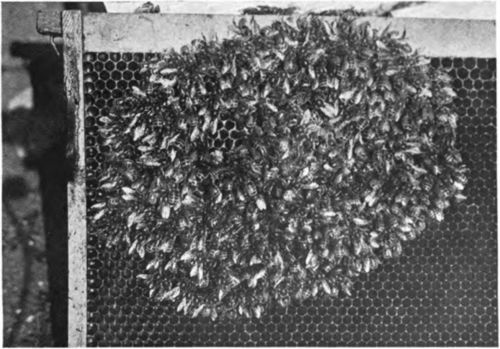
Winter Cluster Of Bees
Deep down in the bottom of the cluster rests the queen, symbol of life, mother of the city, and heart of the hive. If many bees in the main cluster die of hunger and cold, we shall probably find the queen and a few workers warm and safe beneath the rest. She will awake when the Springtime comes to lay thousands of eggs and to raise a new generation of bees to populate its empty halls.
In a few days we shall visit a modern bee farm or apiary. Here, we can get some first hand knowledge of how man helps the bees to produce large crops of honey.
I sing a song to the lilac,
Another to the rose,
But to the honeysuckle My finest music goes.
The morning glory holds me In her cup of sky,
And the dandelion golds me With her pollen covered eye.
But red and blue and yellow, What are those colors all Compared to the sweet, sweet odor In the honeysuckle's call?
Continue to:


My Books

