


Chapter Ten. What The Bees Produce
Description
This section is from the book "Queendom Of The Honey Bees", by Phillip C. Lance. Also available from Amazon: Queendom Of The Honey Bees.
Chapter Ten. What The Bees Produce
The busy bees have entertained us with their stories and their actions. We have enjoyed our trips through their homes, at the bee farm, and in the fields; and yet many things which we have seen leave us curious to learn more about them. How is nectar changed into honey? Why does honey keep sweet and fresh? What is Royal Jelly? What is bee food? What is beeswax? What is propolis? These are a few of many questions which we want answered.
This afternoon of late summer, when a dreamy haze fights with a lazy sun, will he a good time to wander slowly down the paths which lead to the city of bees. Let us he on our way.
The green of the opening year is changing to the brown of summer's close. Instead of the lively flowers of spring, we find the more sedate ones of harvest's end. The love call of the birds is missing now. Even the bees seem to work with a gentler hum. We fit our walk to the mood of the day and slowly plod along. Stop, here is a drone resting on a bloom. Let us ask him to tell us what we want to know. We greet him with a "Good afternoon, Mr. Drone. "
He makes a respectful bow and answers, "Good afternoon to you. "
Mr. Drone has been carefully brushing his fat body. His helmet sparkles in the sun. His silky jacket of yellow glistens like gold. The plumes on his head lift and wave in the air. However, his manners are as fine as his dress because he asks, "Can I help you? "
We are pleased because now we can tell him more easily why we are here. We say, "Yes, thank you. You can aid us. We visited the bees in their homes and learned many things from them, and so we want to learn much more about their work. Will you answer our questions? "
The drone assumes a superior air hut replies, "I shall be happy to do so. What do you wish to know? "
At our first question, "How do the bees change nectar into honey? " we notice that Mr. Drone looks a little puzzled. Finally he says, "I am not certain that I know all about that. I am too finely clothed to work. However, I shall tell you as much as I do know. "
We feel a little disappointed to learn that this courteous dandy is too proud to work; however, we do not let him know our feelings because we are too anxious to hear what he will tell us. After a thoughtful pause, he begins to speak in a deep, rich voice.
"The workers gather the nectar from the flowers. They place it in honey sacs which are inside of them. Here it is acted upon by several elements from the bees' bodies. Certain chemicals are added to it. Most of these are minerals. These added substances preserve the flavors of the flowers from which the nectar is gathered. So, they make many different kinds of honey. Each kind is flavored as the flowers from which it is gathered. "
We interrupt him to say, "Don't the bees gather nectar from many different kinds of flowers? Why isn't the flavor of the honey a mixed one? "
The drone's eyes seem to twinkle as though he is amused at our ignorance. However, he does not say so. He answers our question before he continues his story about honey making.
"The worker bees gather the nectar from only one kind of flower all day long if that flower is plentiful. When at work a bee always flies from one flower to another of the same kind. When she is working on clover, she always goes to another clover plant. At another time she may gather nectar from apple blossoms. Then she will fly from one apple blossom to another apple blossom. The bees make clover honey at one time in the year and apple bloom honey at another time. The same is true when any other kind of honey is made. However, if enough of one flower is not present, the honey may be mixed. " Then he goes on with his explanation of honey making.
"The bees change nectar to honey by adding certain elements to it when it is in the honey sacs then expel it from the honey sacs for the helper bees to put into the cells. "
"Most sweets ferment or spoil. Why doesn't honey do so? " we ask.
"Honey is a strongly concentrated sweet with little moisture in it. The bees place a very small amount of strong acid in all of their honey. This concentration and acid keeps it sweet. I can't tell you more about honey. Perhaps your chemists can explain what occurs when the bees change nectar into honey. At least, they have names for the sweets of the flowers and for the sweets of honey. "
We next ask him, "What is bee food? "
"That is honey mixed with the pollen of the flowers, " he answers.
Our next question is, "What is the difference between Royal Jelly and honey? "
The drone replies, "Royal Jelly differs from honey in the way it is made and in the way it is used.
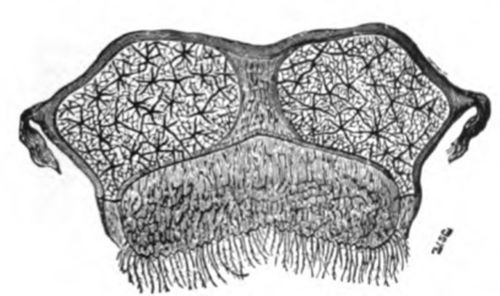
Wax Producing Organ
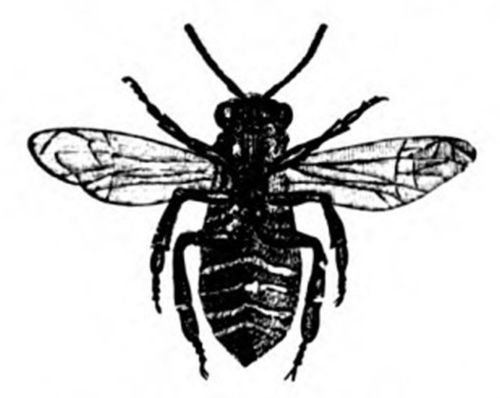
Under Surface Of Worker, Showing Wax In Segments (magnified)
The nectar from which the Royal Jelly is made is taken into the honey sac and kept there until it is worked over a second time. It is made stronger than simple honey and, because it is digested, is more easily absorbed by the bee to which it is fed. Royal Jelly is fed to all the young bees for a short time and is fed to the queen bee all of her life. If any worker bee is fed Royal Jelly and nothing else, it will grow up to he a queen bee. "
Continue to:


My Books

