


Chapter One. A Queen Is Born
Description
This section is from the book "Queendom Of The Honey Bees", by Phillip C. Lance. Also available from Amazon: Queendom Of The Honey Bees.
Chapter One. A Queen Is Born
Honey bees sail across the summer skies. They visit the fragrant flowers to gather the golden pollen and the sweet nectars from them. They load themselves with the precious wealth of meadows and trees, then, like galleons of old which carried costly cargoes from far off places, they sail to the Royal Hive. The hive is their little home port to which they bring the sweet products of the meadows and forests.
Let us enter the port of the bees. They will not mind if we behave ourselves and do not harm them. All is dark when we enter their home because no windows are in it. We soon become used to the gloom and can see about us. Near the door are a number of worker bees. They are beating their wings as fast as they can. The buzz of their efforts fills our ears. The swift motion of their wings fans the air through the hive. This is their ventilating system. Isn't it a queer one?
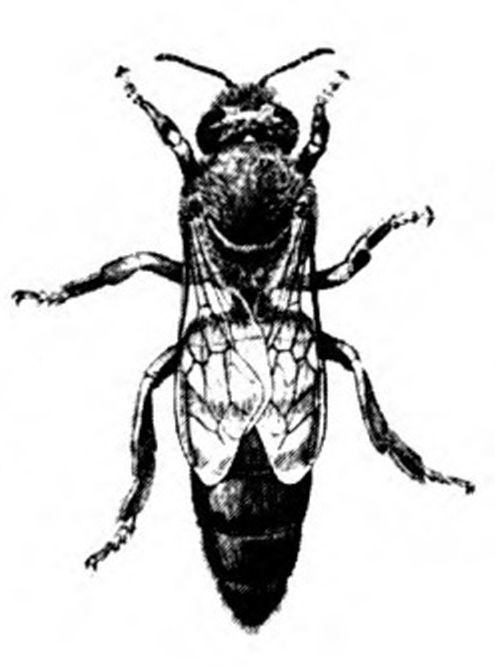
Worker
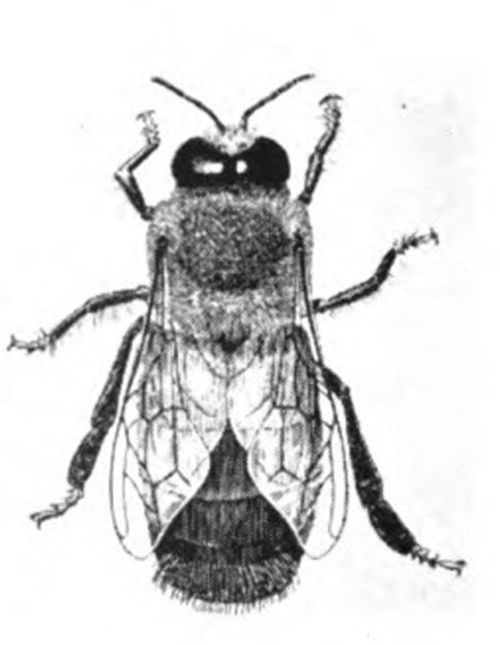
Queen
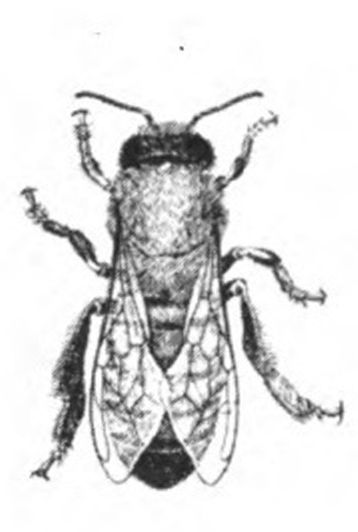
We notice that the hive has different kinds of bees in it. About ninety per cent of them or ninety of each hundred of them, are worker bees. Some of the worker bees are the honey gatherers. Other bees care for the young, guard and attend to the needs of the queen, ventilate the hive, make wax, build combs, and drive away the enemies of the colony.
The remaining ten per cent of the bees, except the queen, are called "drones. " The drones are big, lazy, male bees who do not work but merely eat and sleep until after the mating season when they are destroyed by the workers.
Each hive of bees has a queen mother who lays all the eggs from which the young bees are hatched.
We are in one of the most interesting places in the world. It is the home of sixty thousand fuzzy, buzzy, little bee people. Each bee, including the queen, works for the good of all and not for self alone or pays the death penalty. No useless member of the bee family is allowed to live and enjoy the things produced by those who work.
Long lines of bees are moving in single files down the narrow corridors. They obey traffic rides the same as we do. Honey combs tower high on either side of the corridors, like skyscrapers along a city street. Many thousands of cells are in the combs.
Some cells contain honey for the bees to eat later when the long winter months will come and others are brood cells where the baby bees are horn.
Throngs of bees move toward the center of the hive. We follow closely. In the center of the hive, three great straw colored cells hang suspended from the face of the honey comb. The largest cell looks very much like the outside of a peanut shell. Special groups of workers are always watching over them with loving care. We have a strange feeling that these cells are very important.
The bees are excited about something. What can it be? Notice how the buzzing noise in the hive has increased. Let us ask one of these brightly colored drones to give us some information about the commotion. The first drone we ask yawns and stretches lazily before he answers, but he is a friendly fellow and tells us what we wish to know.
We learn that the old queen is dead and that a new queen will he born from one of these large cells at any moment. This is why the bees are so happy.
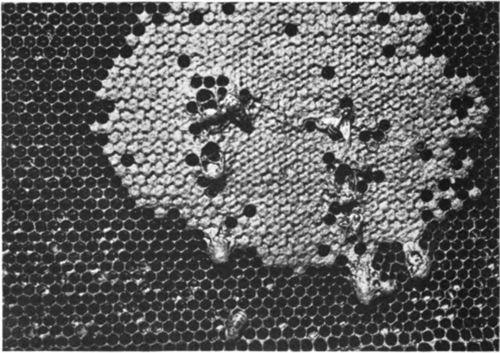
Bee cells with queen cells projecting from the comb
Without a queen the whole city of bees will die out. The very life of the hive depends on her because she only can lay the eggs in the thousands of brood cells. If it was not for her, no young bees would be hatched to take the place of those who die.
Our colorful friend, like all drones, is a vain fellow. He carefully brushes his furry brown and yellow body with his legs as he talks. He continues to tell us about the great event that we shall witness.
"If you care to stay for a time, I am sure you will see the birth of our new queen. Fifteen days ago the workers completed the queen cells you see here. They placed in each cell a worker bee egg and a small amount of royal jelly, which is a food made from pollen and twice digested honey. Your men who study bees do not know the origin of the royal jelly. Some think it comes from the salivary glands which are in the bee's head. Others think it comes from the stomach and can be used when it is needed. This is one of the secrets of the bees. "
We are very much interested.
"Why should a worker bee egg be placed in the cell to make a queen bee? " we ask.
"That too, is a secret of the bees, " says the drone, "but I shall tell you how it is done. Royal jelly is a very rich food. When the correct amount is eaten, it completely changes the body of the worker larva into that of a queen. "
"You call the small white worm or grub which hatches from the bee's egg, larva, but it is just a baby bee because it changes into a bee. The larva hatches from the egg three days after the queen lays it.
"What is the difference between the body of a queen and that of a worker? " we ask.
"Oh, there is a great difference, " replies the drone.
Continue to:


My Books

