


Chapter Eight. Bee Enemies
Description
This section is from the book "Queendom Of The Honey Bees", by Phillip C. Lance. Also available from Amazon: Queendom Of The Honey Bees.
Chapter Eight. Bee Enemies
Throughout the earth, from the frozen wastes of the Arctic to the steaming jungles of the tropics, countless millions of insects live and die in a never-ending struggle for food, shelter, and an opportunity to bear their young.
The weak are clawed, bitten, and stung to death by the strong. This may seem horrible at first. However, if insects were not destroyed by each other and by the birds and animals, in a very short time, the millions of these little creatures would increase and cover the earth. They would destroy everything. Not a bird, wild animal, human being, or even a growing blade of grass would be left. Yet, many insects do good work in the world, and without them the world would become a dreary waste.
Honey bees are really one of the gentlest kinds of insects. They seldom kill other creatures except to defend their own lives and their homes. However, the bees have many enemies. Practically all insects, bugs, birds, and other animals are fond of honey. The store of liquid gold in the treasure house of the bees is tempting to all the animals of the world. Just as men struggle for gold these other creatures fight for honey. Some of the treasure seekers eat the bees to get the tiny drops of honey which are carried in the fuzzy little bodies.
In warmer parts of our country, an army of little ants have been known to destroy a whole hive of healthy bees. The ants, hunting for the sweet honey, enter the hive at night when the bees are fast asleep. They may come in through a crack in the floor or in the walls of the hive when the guards are asleep. They may chew their way through the bee-glue which covers the inside of the hive. The bees can defend themselves if they awake before too many ants get into the hive. However, hundreds of thousands of ants frequently get into the hive before the bees know it. When the ants get inside they bite and claw the legs and wings of the bees until the little honey-makers lie helpless in defeat. The bees fight bravely, rolling, kicking and throwing the ants about with great force; but the bard shelled ants can stand a great deal of battering and always keep tearing away at the legs and wings of the little defenders. Deep in the heart of the hive, the noble queen mother is protected by her guards who fight bravely until the last one is killed. The thousands of marauding ants finally make their way to her and quickly kill her. With the last despairing cry of the (lying queen, the battle is over. The hive of bees is without a soul, without life, now that the mother is dead. The once busy colony of bees becomes a wasted city.
Several kinds of birds prey on the bees. Among these the King bird is the most common one. The King bird will watch and wait patiently on a tree limb, roof-top, or other vantage point until he chooses his prey. Then he swoops down upon it with unerring aim, catches it in his beak, and returns to his perch with his helpless victim. He crushes the honey from the little insect and drops the dead body to the ground.
The King bird and other bee-killing birds do very little damage to large colonies of bees and the losses from their attacks do not greatly trouble beekeepers. However, when birds attack a queen-rearing farm, they can do much damage for the specially-bred queens are valuable and the death of even a few of them means a great loss to the keeper.
In warm parts of the country, the Devil's Darning Needle, often called a Bee Hawk, is very destructive. These large insects, at certain times of the year, cover the sky like a blanket. Bee Hawks will attack any insects they meet. Whole apiaries sometimes are weakened or destroyed by these marauders.
Toads and frogs are fond of the liquid gold of the bees and will catch the little workers whenever they can.
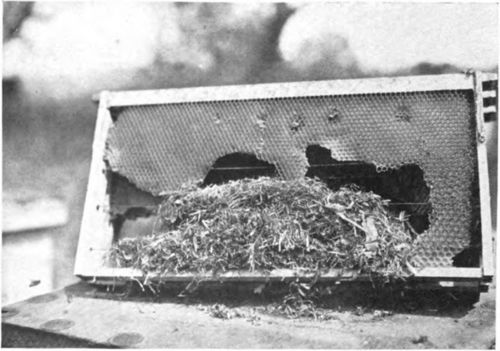
A mouse's nest in a bee hive
Mice are very dangerous enemies of bees if they can get inside the hive. They are great lovers of honey and will gnaw and ruin large amounts of stored honey combs in the storage houses if they are not made mouse-proof.
The common skunk is another enemy of the bees. These striped animals eat a great many bees and will stir up and frighten colonies by scratching on the outside of the hives.
Skunks multiply rapidly and are protected by law in many states, so some means must be devised to protect the bees from them. To fence in the apiary with a wire net fence is one of the best ways to protect bees from skunks. The wire net for the fence should be three or four feet wide. A strip of the wire one foot wide should be folded outward at right angles to the bottom of the fence. This part should be staked down. The skunks will not dig under it.
Continue to:


My Books

