


We Visit A Bee Farm. Part 5
Description
This section is from the book "Queendom Of The Honey Bees", by Phillip C. Lance. Also available from Amazon: Queendom Of The Honey Bees.
We Visit A Bee Farm. Part 5
During lunch in the pleasant dining room, we listen to many interesting stories of beekeeping. The men at the table begin to talk about robber bees. We listen closely and learn many things about them.
Robber bees are a constant menace to healthy hives, especially in a poor season when honey is scarce. Beekeepers must use care to keep robber bees from their hives because these thieves are attracted not only by the honey stores of a healthy hive but also by the sugar or syrup which is fed to the weaker colonies during a slack season.
Robber bees may be distinguished from those in a hive by their darting motions as they fly about the entrances of the hives, seeking admission. These bees will leave quickly if molested. The guards of the hive, however, become very active when robber bees are about and may sting anyone near them.
To stop this robbing a beekeeper must cease to open any of his hives. He should close the entrances as far as the weather will permit. This helps the guards to defend their home because fewer robbers can gain an entry at one time. Very often brush is thrown in front of the hive to make it harder to intruders to get near the hive. Finally, no honey stores should he left about the apiary to attract the robbers.
We learn that in hard times the bees themselves become their own worst enemies. Just as men turn on their fellows to obtain food when that necessity is scarce in the human world, the bees begin to steal from other bees when they are hungry for food.
After lunch we witness the transfer of bees from one hive to another. The colonies to be transferred are in the plain box hives in which they were purchased. The bees are not valuable producers when they live in these old-fashioned hives because the combs are fixed in position and the honey is very difficult to remove without destroying the bees. The box hives are removed from their stands and new movable framed hives are set in their places. Next the box hives are turned bottom side up and a small inverted box is placed over each one. Then the workmen drum on the sides of the box hives for some time. This causes the bees to rush upward into the inverted boxes. When most of the bees have ascended into the upper boxes, the boxes are removed and the bees are dumped in front of the new hives. If the queen does not go into the new hive with the worker bees more drumming with the sticks finally forces her from the old hive into the new one.
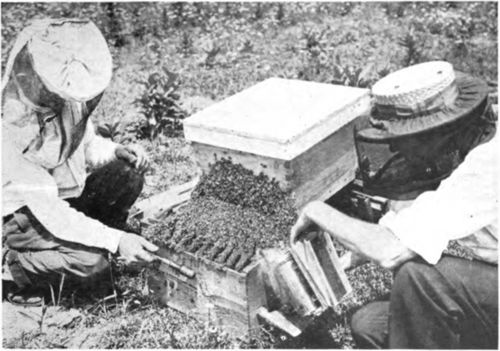
Driving The Bees Into A New Hive
"Is the wax in the old box hives wasted? " we ask. "No. This wax will he scraped out and separated from the honey. Both honey and wax may he used here, or they may he marketed. "
We suddenly become aware of the time and find that we must leave the bees and journey homeward. We thank Ted for his kind and interesting explanations to us.
Ted says, "If a person likes bees and considers them his friends and helpers, it is a pleasure to work with them and to tell others about their life and habits. I've enjoyed showing you through Fern County Apiary and wish we had time to talk over bee pasturage, bee enemies, honey marketing, and many other interesting things about the bees. "
We wish Ted good luck and, as we reluctantly drive away, resolve to investigate more thoroughly these other phases of beekeeping. We hope that some later day we may come again into the busy world of the honey makers at Fern County Apiary.
Continue to:


My Books

