


What The Bees Produce. Continued
Description
This section is from the book "Queendom Of The Honey Bees", by Phillip C. Lance. Also available from Amazon: Queendom Of The Honey Bees.
What The Bees Produce. Continued
The drone pauses then he settles himself like some great judge, to await our next question.
We ask, "Where do the bees get the wax to make their cells? "
He explains, "Beeswax is made in the bodies of the worker bees. They swallow a great amount of honey. Then they cluster in great masses. One bee hangs to another until they form a curtain. They hang there for hours. The close clinging bees, in an effort to make the wax, cause a stifling heat. The wax finally comes out upon the plates which are on their abdomens, almost as perspiration comes out on your skin when you are in a hot place. However, beeswax is different from perspiration because it is a fatty substance with a pleasant odor and you can see through it. "
We do not ask any more questions about the wax because it is nearing mid-afternoon. We know Mr. Drone will go back to his home about three o'clock and we want to question him about other interesting things.
"What is bee-glue or propolis? " we ask.
The drone looks a little bored but keeps his mannerly way.
"Propolis or bee-glue is a sticky substance which is used by the workers to stop any opening in their home so storms will not spoil the honey or kill the queen. Their store houses are sealed from robbers by propolis and any unsightly object which is too heavy for the housekeepers to carry away from their home is covered with it. "
"Where do the bees find the bee-glue? "
"They gather it from the trees, " answers the drone.
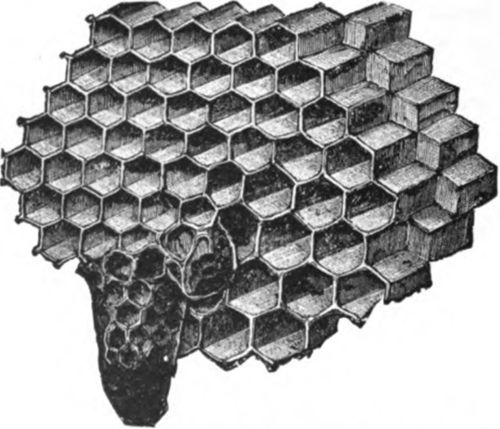
We remember the rows and rows of the beautiful same-sized and same-shaped cells which we saw in the hive and ask the drone to tell us why they were six-sided and why the caps on them slant to a center like a roof on some houses.
For the first time since we spoke to the drone, he shows a little pride in his story.
He exclaims, "They are wonderful. I, myself, ad-mire them, when I see them tower above me like many steeples of glass. Did you notice how many kinds of cells there were in each hive? " he asks.
"Yes, " we answered. "There were four kinds of cells. "
"That is right, " said the drone. "Each kind of cell has a different use. The large ones which project from the others are the queen cells. You may find in a hive as few as three of these cells or as many as twenty-four of them. Sometimes the workers tear the partitions from two or more cells and build them into the shape of a queen cell which is different from the shape of the honey cell. The cells next in size are the ones from which finely colored bees like me, are hatched. The cells next in size are the ones from which the worker bees are hatched or in which honey is stored. Then all along the sides of the combs and between them are passage ways made of connecting cells. "
Mr. Drone looks at the sun's rays on the flower, then says, "I must go soon to my home. What other questions do you wish to ask? "
We ask, "Why are all the cells six-sided with each side the same size? "
HOney-Comb. Drone-Comb. Intermediate Cells, Worker-Comb, Queen-Cell
Mr. Drone settles himself like a college professor who has an important fact to explain to a class. Then he says, "The forms of honey cells are the strongest that can he built and at the same time fill all the space in the comb. If the cells were round, vacant spaces would be between them when they are placed together. The worker bees wish to occupy all the possible space and leave nothing vacant. Now three forms of cells will do this. A three sided cell or a triangular one will fill all space if each side is as long as the other side of it. A four sided figure if it is a square, will fill all space. Cells of six sides, or a hexagon, will fill all the space if the sides are all of the same length. Any of these three figures will leave no vacant space in the comb when they are arranged in rows. Not only must the cells fill all space but they must be strong too. They must withstand the battering of the bees when they work about them or tear the tops from them to obtain honey. Then, too, the cells must be strong enough to withstand the storms which often shake the hives. A six-sided cell is stronger than a three-sided one or a four-sided one. The bees build the cells in six-sided structures because that form is the strongest one that will fill all the space in the comb. "
The drone pauses to let us think about bis explanation, then continues.
"The cells are capped in the way they are, because the form and slant of the cap gives the greatest possible strength to it. It will hold up a much greater weight without breaking than will a flat cap. The slant is just the right one to stand the greatest pressure on its sides before it will dent. If the cap were flat or less of a slant than it is, it would sag quicker when the bees crawl over it than it will at its regular slant. The cap, if it were steeper than it is, would dent more readily when the bees press against it than it will at its regular slant. One of your great mathematicians proved by figures that the bees' cells have the greatest strength in their caps that it is possible for them to have. "
"I must go now, " says the drone.
We thank him for his kindly answers to our many questions. He waves good-bye then flies away. His wings make a deep hum quite different from the sharper sound of the worker bees' wings. We turn homeward, thinking of the great skill which these little creatures exhibit.
Continue to:


My Books

