


We Visit A Bee Farm. Part 3
Description
This section is from the book "Queendom Of The Honey Bees", by Phillip C. Lance. Also available from Amazon: Queendom Of The Honey Bees.
We Visit A Bee Farm. Part 3
Ted inserts a sharp hive tool, which is somewhat like a knife, under the edge of the cover and lifts it free. We stand quietly, very careful not to jar any of the nearby hives. Hive covers and frames are often stuck tight with bee glue but this one comes off easily.
Looking down into the body of the hive, we see the ten frames of brood and storage comb. They are covered with thousands of bees all filled with honey and harmless to us now. We can see how the frames hang suspended from each end on stringers nailed to the ends of the hive.
"Now I am going to find the queen, " Ted remarks as he gently lifts out the center frame which looks like a wall of bees because both sides are covered with them. There is a steady buzz from the little creatures. We are glad that we have ample protection for the sight of so many stinging insects, so close at hand, is a new experience to us.
Ted carefully scans the bees on the comb but he does not find the queen until he has removed the frames. Then he shows her to us. She is easily distinguished from the rest. A group of workers which are much smaller than she is, surround her. Ted takes the queen in his hand to examine her closely. We can see that one of her wings has been clipped. Ted explains that they did this to prevent swarming. If the queen cannot fly away, the other bees will not leave the hive because they always remain with her.
Ted examines the brood comb and finds that there are too few brood cells in the hive to make it a strong one. He notes this fact, writes it on the hive record, and explains, "A frame of brood bees will be taken from a stronger colony and placed in this one to build up its strength. You see all of our frames are the same size so this can be done very easily. This queen seems to be losing her laying ability. We will either replace her with a queen hatched from another colony or send to a queen rearing apiary for a fine new Italian Queen. "
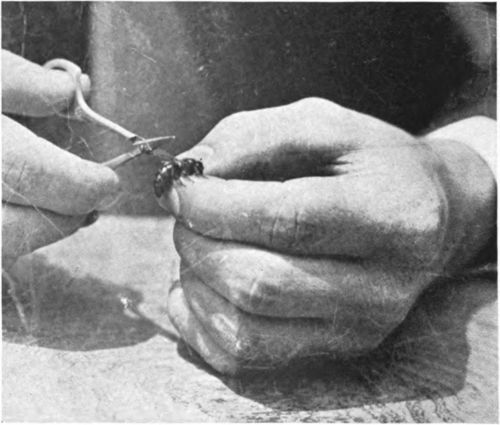
Clipping The Queen's Wings
"Will the bees accept a new strange queen? " We ask.
"We have a way to make them accept a new one. " Ted replies. "When a new queen is added to a hive she is placed in a cage made of wire which has the entrance plugged with candy. The cage is placed in the hive. The bees smell the strange queen and are angry and excited at first. Nevertheless, they feed her with their tongues, through the wire cage because she is a queen. After a few days the bees get used to the smell of the new queen and are ready to accept her. The bees eat their way through the candy plugged entrance to the cage and set her free. In this way she is accepted as their queen. "
Ted replaces the cover on the hive, and after examining several more, suggests that we visit the north end of the farm where hives are being opened and honey extracted for storage, curing, and sale. He leads the way to a section where the hives look much taller. These hives are taller because they have additional storage boxes called supers added to them. Some have as many as four supers. The supers in these hives are full of surplus honey. The completely filled supers will he removed from the hives and the honey extracted from them.
Ted explains, "The supers on these hives were raised slightly last evening, and boards containing bee escapes were inserted between the supers and the main hive below. A bee escape is a small metal piece containing outlets for the bees through which they can pass down to the main hive, but through which they are unable to return to the honey stored above. So today the storage rooms or supers are empty of bees and can be removed. "
We notice several men carrying supers of honey to a large building close by. This building is the main work roof of the apiary. It is here that the crop is cared for and the supplies are kept.
As we enter, we notice that the wide windows which can be opened sideways are screened so the bees cannot get in from the outside. Ted calls our attention particularly to the window screens. "Notice that these screens have an opening at the top about a quarter of an inch wide, all the way across the windows. These openings allow any bees who may get into the work room to escape outside again. You see, the first thing a bee does, when it is indoors, is to fly towards the light. She will crawl upward when she lands upon the window screen, then she can escape through the opening when she reaches the top of the window. However, the bees never enter such an opening. "
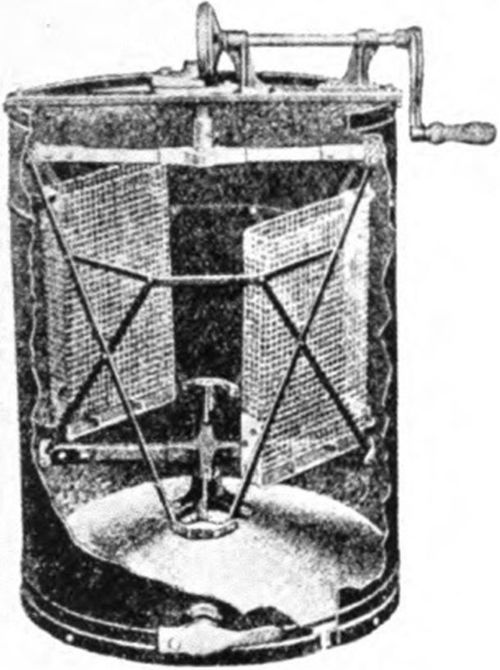
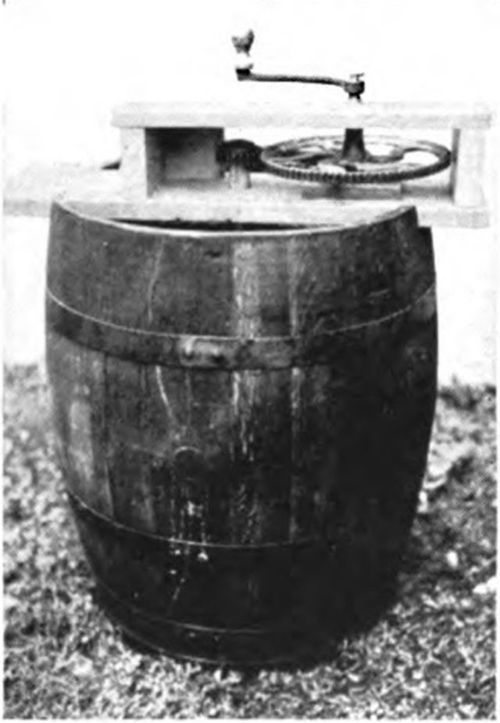
Interior Of An Extractor
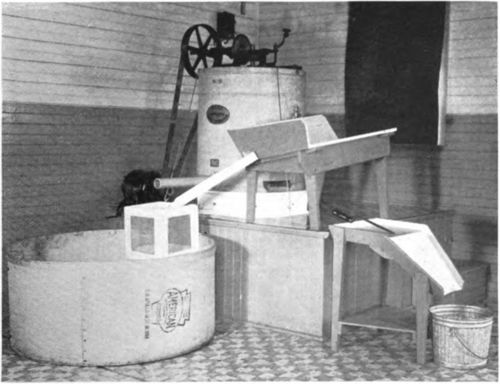
Home Made Extractor
"Now we shall watch the job of extracting honey from the comb-filled frames which have been taken from the supers. Frames are placed on the rim of what is called a capping can. Here, workmen slice the wax caps from the comb, using special knives for this purpose. Next, the uncapped combs are placed, frame and all, in the extracting machine. "
The extracting machine looks like an old fashioned ice cream freezer, only it is larger, and works on somewhat the same principle as a cream separator. The container, which is whirled about by turning a handle at the top, is a round metal tank with a basket inside.
Continue to:


My Books

