


Spring Management Of The Overwintered Colony. Early Spring Management. Continued
Description
This section is from the book "Beekeeping for Beginners", by G. H. Cale, Jr.. Also available from Amazon: Beekeeping for Beginners.
Spring Management Of The Overwintered Colony. Early Spring Management. Continued
A very good practice which will maintain a supply of extra queens is to take a frame of brood and bees from each of your strongest colonies at the beginning of fruit bloom, replacing with a frame of foundation or drawn comb Place two frames of brood with adhering bees, along with an empty comb, in a nucleus box and introduce a queen. This queen nucleus is allowed to build up and whenever you have a colony that is weak or has a failing queen, you may kill the old queen and place the nucleus with the new queen in with the old colony. This serves a dual purpose - bolstering the strength of a weak colony and at the same time giving the colony a young laying queen.
This method is good practice for the beekeeper with ten or more colonies, but should not be attempted by one having only two or three colonies.
If one of your colonies seems to have a good queen but is weak in worker population, it may be helped by exchanging an empty comb from the weak colony with a good comb of emerging brood and bees from a strong colony that can spare the loss of a few bees. When doing this, check the comb closely to make sure that you are not taking the queen from the colony. Combs of brood added in this manner should be placed on one side of the brood nest so there will be little danger of the strange bees killing the queen.
The worker bees of a colony which leave the hive to gather nectar, pollen, or water are called field bees. They are accustomed to the position of their own hive in an apiary and should the hive be moved to a different location they would return to the old location rather than to the hive itself. This habit of the field bees gives us still another method of building up a weak colony-which is called "switching. " In this method a weak colony is exchanged in apiary location with one which is strong. Since the field bees will return to their old location, the weak colony will gain considerable strength in numbers. This should be done when bees are gathering nectar.
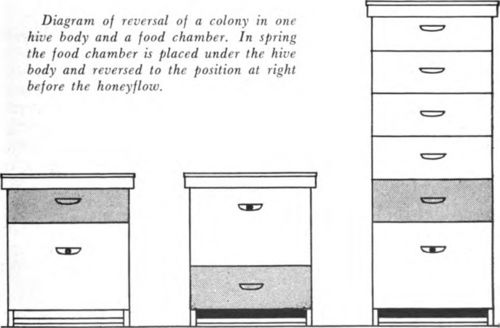
As the fruit bloom period progresses you will probably find that many colonies have brood in the super which was left on for winter stores, while the hive body of combs below will be only partially used and in some cases may be deserted entirely. If this is the case you should reverse the position of the body and the super - placing the super below the body. This will cause the queen and bees to move up into the partially deserted hive body where there is plenty of room for the queen to lay her eggs. If there is honey left in the super, the worker bees will move it up into the body and in so doing will stimulate the colony to faster growth.
An occasional colony will be found in which the queen confines her egg laying efforts to the center combs even though there may be side combs which are completely empty. This is especially true if there are frames of honey or pollen blocking the expansion of the brood nest and effectively preventing the queen from laying in all of the combs. In such a case the empty side combs should be moved up to the brood nest and the combs of honey or pollen moved toward the sides of the hive. Do not, however, separate the frames of the brood area. Remember that word of caution-always put frames of combs up to and not into the brood nest.
Continue to:


My Books

