


Spring Management Of The Overwintered Colony. Early Spring Management. Part 2
Description
This section is from the book "Beekeeping for Beginners", by G. H. Cale, Jr.. Also available from Amazon: Beekeeping for Beginners.
Spring Management Of The Overwintered Colony. Early Spring Management. Part 2
Late Spring Management
From the end of the fruit bloom period until the beginning of the major honeyflow there is usually a period of dearth, often between the blossoming of dandelion and clover, when there is little or no nectar gathered by the bees. Many colonies which did not need additional feed during the early spring or midspring, may need sirup during this period. Some colonies may need only one feeding of sirup to carry them through, while others may require as many as three ten-pound feedings of sirup. Here again it is advisable to add 1/4 teaspoon of sulfa-thiazole sodium to each ten pounds of sirup given to a colony.
This period is truly called the danger period since many cases of colony starvation and swarming occur at this time. Starvation is easy to prevent and the wise beekeeper will make sure that his colonies have plenty of natural stores or sugar sirup during this period.
Swarming presents a number of different problems, all of which may be overcome by the beekeeper. The urge to swarm is probably inherent and instinctive and is stimulated by environmental conditions. Swarming usually occurs when the brood nest of the colony is crowded with worker bees and the queen is forced to slow down in her laying, although bees are known to swarm out of their hive for other reasons; for example, bees will swarm from their hive when they have reached the point of actual starvation, or a large, populous colony, approaching the honeyflow, but having a failing queen, may very quickly develop the urge to swarm.
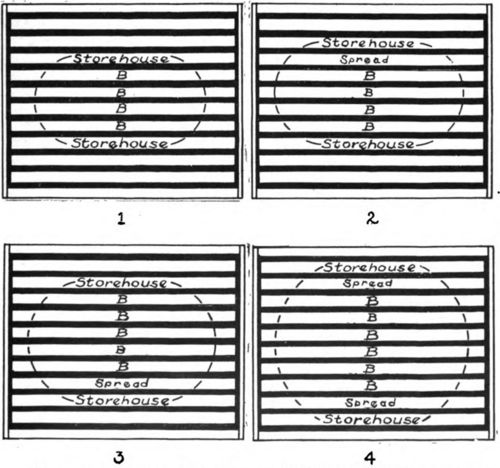
Diagram of expanding the brood nest. With four fairly well-filled brood combs flanked by stores in fruit bloom, one empty comb is moved in; a week later another is moved in, and about 10 days later two empty combs are moved in as diagramed.
Although some beekeepers talk proudly about having all of their equipment full of bees, the good beekeeper will have some extra equipment which is available at all times. It would indeed be poor management to allow a colony to swarm simply because you did not happen to have the bottom board, body, frames, cover, and a few pounds of comb foundation that are necessary to divide the colony. By the time the equipment could be ordered and arrive at its destination the swarm would have long since departed.
Swarm Control Methods-Clearing. The Brood Nest
Since a crowded condition of the brood nest is one of the prime factors in swarming, the beekeeper should watch his bees carefully during the late spring period and make sure that the queen has plenty of room to lay. At this time of the year the super, which earlier was reversed beneath the body, should be placed back on the hive body. In addition to this the deep brood combs should be inspected and side combs containing pollen or honey should be removed and empty combs or frames of foundation placed in the hive. This will give the queen room to expand her egg laying into combs which would otherwise not have been available to her. The placing of the super back on top of the colonies will allow the worker bees to move excess stores from the brood chamber and again will make more room for the queen to lay. No matter what style of hives is used, the same system of reversal should be followed.
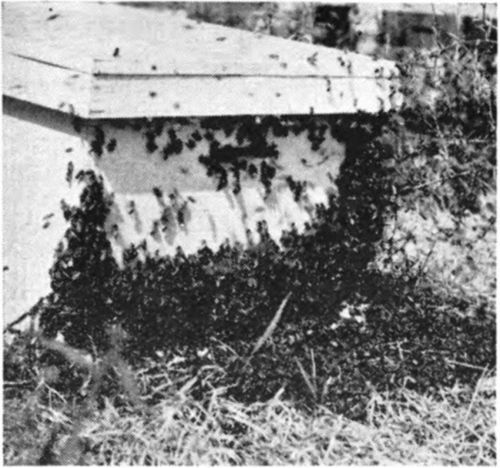
Notice the crowded condition of the bees. This hive should have at least two supers on at this time and one of them should be a foundation super to help relieve the crowding in the brood nest.
Adding A Foundation Super
Worker bees between the ages of twelve and eighteen days supply the beeswax for the colony. It is at that age that beeswax is secreted most freely by the glands on the undersurface of the abdomen. This habit of the bee gives the beekeeper another method for swarm control. A colony which is going through a rapid build-up will have many worker bees of the right age for wax secretion. A strong, crowded colony may be given a shallow super of foundation. The super of foundation is "baited" by taking out two or three drawn combs from another super and placing them in the foundation super and placing the foundation frames in the lower super. This gives the wax secreters a useful task to perform and at the same time removes them from the brood nest which, of course, reduces the amount of crowding in the brood area.
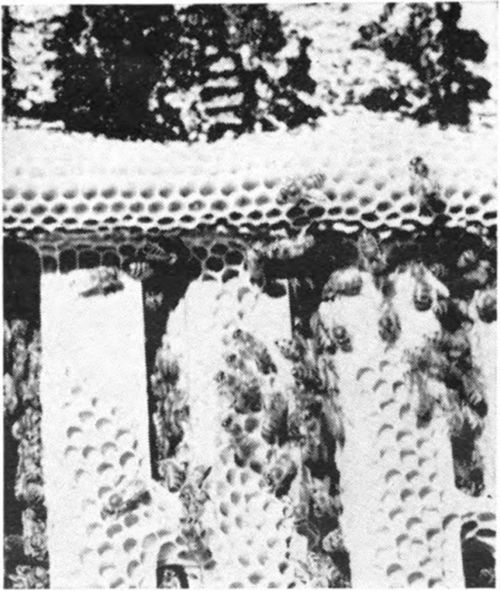
Burr comb placed on the top bars of frames. A foundation super should have been given this colony so that this wax could have served some useful purpose.
Relocation
An easy and very effective measure of swarm control is the practice of relocating or switching colonies. As described previously, the weak colonies exchange places with the strong. Not only does this cut down the field force of the crowded strong colony, and hence help to eliminate swarming, but it also helps to build up weak colonies that would otherwise not be able to make much of a honey crop. If no weak colony is available, the strong colony is simply relocated in a new spot so that the field bees will drift away from it.
Continue to:


My Books

