


Chapter IV. The Honey Bee Colony
Description
This section is from the book "Beekeeping for Beginners", by G. H. Cale, Jr.. Also available from Amazon: Beekeeping for Beginners.
Chapter IV. The Honey Bee Colony
THE honey bee colony is made up of three individual types of bee-the worker, the queen, and the drone. These three carry on the functions of the colony, but before we look into the colony itself, let us first examine each of these types of the honey bee.
The Worker Bee
As its name implies, the worker bee is the laborer of the bee colony. The worker is an undeveloped female that is adapted for nectar and pollen gathering but is not capable of reproduction. When you see a bee on a flower it is the worker bee which you see.
Like all other insects, the worker bee follows a complete metamorphosis in its development. It starts as an egg, which hatches into a larva. The larva grows and matures, spins a cocoon around itself within its waxen cell, and then changes into a pupa. The pupa spends its allotted time maturing and finally emerges from its cell as a full-grown adult.
The function of the worker bee is clear from the name. All the work of the colony, with the exception of laying eggs, is carried on by these worker bees. They protect and warm the eggs, larvae and pupae; feed the young larvae; build comb; bring water to the hive; gather pollen and nectar from the flowers; transform the nectar into honey; and countless other tasks.
Because of this tremendous amount of work, their lifetime is short, and in the heart of the summer honeyflow worker bees seldom live longer than six weeks.
Such a variety of tasks as is assigned to the worker bee is reflected in her anatomical make-up. The head, or front segment of the bee has two compound and three simple eyes so the bee can be equally proficient in seeing within the hive and on the wing while in search of honey or returning with it to the hive. In addition there are located in the head, glands which secrete a substance used in feeding the larvae of the colony, particularly the young embryo queens which require a specially rich food called royal jelly.
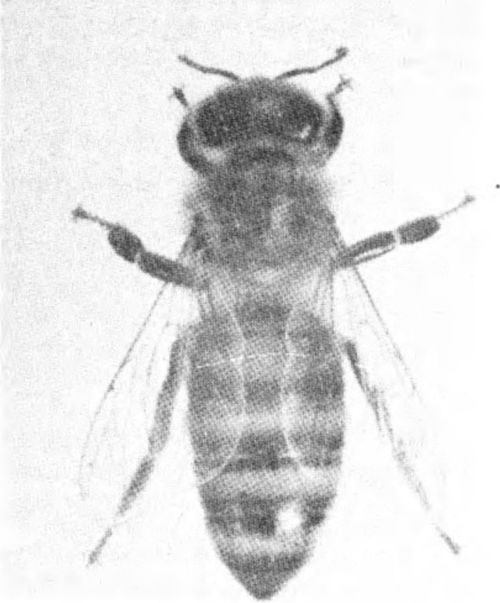
The worker bee
Here in the head are also located the feelers or antennae which apparently have the senses of smell, touch and hearing; also the mouthparts with muscular pump arrangement which allows the honey bee to sip with equal ease, the nectar from the flowers or the water from the watering trough, or pump the nectar back into the comb within the hive.
The sense of direction of the bee must be remarkable. Once she has located her hive by her first play flight, she leaves ever after without apparently looking back, only to return with uncanny accuracy to the home entrance. In fact, if the hive be moved only a few inches, the bee will be cognizant of it, and a move of several feet loses her almost completely. The honey bees of a colony usually forage little beyond a two-mile radius from the hive; in broken, hilly country, probaby less; on a flat plain possibly several miles, though their economic honey gathering ability is lessened on account of the time factor on the longer trips. We have all heard the remark "a bee line" as if it were the shortest distance between two points. Yet seldom is the bee line a straight line. More often it is the line of least resistance to get from hive to forage and back, taking advantage of wind protection, land contour, tree openings, creek bottoms, etc.
In the thorax or second part of the bee's body are located the muscles which operate the wings and legs, all of which are attached to this part of the body.
The honey bee is also remarkable in its appendages. Its two pair of wings, hooked together on each side, can carry tremendous loads, while its three pair of legs have sticky pads to facilitate crawling on a smooth wall, hairy baskets to collect and carry the pollen to the hive; a short spike to help in scraping the pollen from the pollen baskets into the cells of the hive and even a small notch in one of its pair of legs enabling it to clean its antennae and perform its personal toilet.
The third part of the body is the abdomen. Immediately in the forward part lies the honey stomach, the container for the nectar as it is gathered and from which it may be pumped out into the cells for nectar and honey storage within the hive, or may go on down into the stomach proper to serve as the bee's food or be transformed chemically into beeswax to serve in building the bee's comb.
In the abdomen is located the stomach; the wax secreting glands; the intestines; rudimentary sexual organs which at times allow a worker bee to lay a few eggs which hatch only drones; and the sting with its barbed point and its little sac of poison. The worker bee loses her sting in the act of stinging, the bee sting remaining in the flesh of the individual, and the muscles of the sting pushing the sting itself more deeply into the wound. If a person is stung, the sting should be removed by rubbing it off the flesh, rather than trying to pinch it out of the wound since in the latter case, the poison in the sac is squeezed out into the flesh, thus increasing the danger of swelling.
Every colony is always on the alert for marauders, be it the human, the straying animal, or the worker bees of another colony, for honey bees are arrant robbers, especially when there is nothing in the fields for them to gather. Weak colonies are apt to be overpowered in times of dearth, even though wary guards are stationed at the entrance of the hive to ward off intruders.
From the time the tiny egg is attached to the bottom of the cell until the mature, downy, hairy young bee emerges from the cell by cutting the waxy capping away, a period of twenty-one days has elapsed.
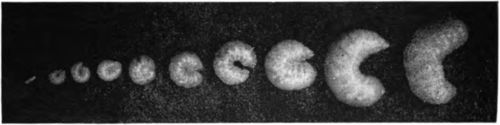
From left to right-the egg which hatches into the larva and the stages in growth of the bee larva.
(Photo courtesy U. S. D. A. )
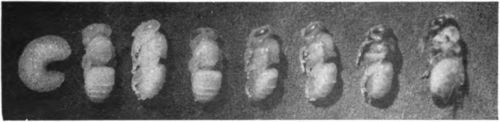
From left to right-the stages in development from the larva through the pupal changes.
(Photo courtesy U. S. D. A. )
The following table gives the duration of development of the brood from the egg to the perfect insect:
Queen Worker Drone
In the egg............................ | days | 3 | 3 | 3 |
Growth of larva | .....days | 5 | 6 | 6 1/2 |
Spinning of cocoon............... | .....days | 1 | 2 | 1 1/2 |
Period of rest....................... | .....days | 2 | 2 | 3 |
Change to pupa................... | days | 1 | 1 | i |
Change to winged insect..... | days | 3 | 7 | 9 |
Av. duration of changes | .....days | 15 | 21 | 24 |
These figures represent the time required in summer weather; in cool or cold temperatures the time is somewhat lengthened.
Continue to:


My Books

