


Chapter X. The Honey Bee And Pollination
Description
This section is from the book "Beekeeping for Beginners", by G. H. Cale, Jr.. Also available from Amazon: Beekeeping for Beginners.
Chapter X. The Honey Bee And Pollination
ALTHOUGH the honey bee has been famous for centuries for her labor in the production of honey and beeswax, she is of far greater service to mankind in the distribution of pollen.
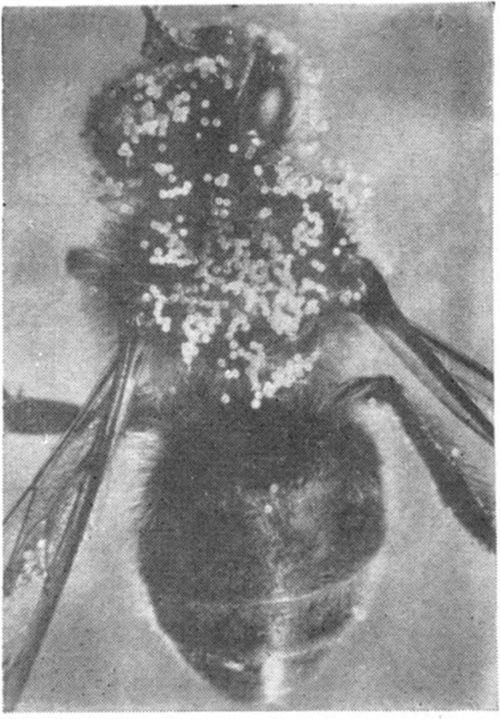
A pollen covered bee
A large number of plants are fruitful only when pollen from the flowers of one plant is brought to the flowers of another to insure fertilization. Under present day conditions the honey bee is by far the most efficient agent in this pollen distribution, commonly spoken of as pollination.
Many of our most important food plants are dependent upon the bees for this service. The grains are largely wind pollinated and do not depend upon insects; but most of the fruits, many of the legumes, including the clovers and alfalfa, and such garden vegetables as cucumbers, melons, and cabbage require the help of insects to insure that fruit will be formed or seed set.
In a recent publication of the United States Department of Agriculture, Circular E-584, is given a list of fifty plants which are important in present day agriculture, all of which either depend upon the honey bee for pollination or are helped by her visits.
In the days of the self-sufficient farm we knew little of the problems which have developed along with the present day specialization. Every farm raised a little of a great many different things and the family provided a home market for about sixty per cent of the farm output. Now a farmer will devote himself to the production of two or three crops and often to only one. The large areas devoted to special crops provide ideal conditions for the spread of insect pests with the necessity of heavy expense of time and money in the effort to control them. The poisons used in their control often destroy the wild insects which serve a useful purpose in the distribution of pollen. With the disappearance of the many wild bees, ranging in size from smaller than a housefly to the bumblebee, we have come to be dependent upon the honey bee which is the only insect whose numbers can be controlled and which can be moved to the spot where her services are most needed.
In neighborhoods where there are large areas of wasteland and where little spraying is done, there may be plenty of wild insects still present to serve the need of small acreages. However, it is common practice at present to grow special crops in such a large acreage as to require a far greater number of insects than are present in the wild.
Loss For Lack Of Pollination
It often happens that unprofitable crops will result from lack of pollination when growing conditions are favorable and the grower is at a loss to understand his failure. In many localities where farmers once harvested five to eight bushels of red clover seed per acre, they now get less than one bushel, and seed production is no longer profitable. This change came with the disappearance of the bumblebees which were once plentiful in the area.
The honey bee is not as efficient in the pollination of red clover as the bumblebee but when enough honey bees are present they do provide the necessary service. Since the corolla tubes of the red clover are so deep that it is difficult for the honey bees to get the nectar, they are likely to visit other flowers in preference if any are open. The remedy is to bring in so many honey bees that other pasture will not be sufficient and they must visit the red clover to provide their needs.
It would be difficult to estimate the extent of losses to agriculture from lack of pollination. The difference in yields in fields or orchards after the honey bees have been brought in, has shown that such losses run into hundreds of millions of dollars. The loss of soil fertility through continuous stirring of fields that should be sown to meadow or pasture is even greater and this loss is permanent and cannot be replaced.
Competition For Attention Of Bees
In any program of pollination it is necessary to bear in mind that the bees are likely to show preference for flowers with nectar of the highest sugar content. Thus, we cannot be sure when we bring bees to our orchards or gardens that they will visit the flowers which we are so anxious for them to serve.
The nectar from some flowers is rich in sugar while others may have a low sugar content. Since the bees are constant to one kind of flower while it is in bloom and visit only that species while its flowers are open, it is important for the grower that they start visiting the crop to be pollinated when its flowers open. This constancy greatly increases their value as pollination agents since they carry only pollen from apples when they are gathering from apples or from dandelions when that is the source of their nectar.
Some red clover seed growers have decided that the honey bee is a poor pollinator for red clover when the insects flew over their fields to visit sweet clover over the hill. Likewise, the owners of pear orchards are often disappointed when the bees fail to notice their fruit trees and seek apple orchards farther away. In turn the apple grower may be disappointed when the bees find dandelions in nearby pastures more attractive.
The remedy, as already stated, is to make sure there are enough honey bees in the neighborhood to insure visits to the flowers with low sugar content when that is necessary.
There is great variation in the number of bees necessary to insure pollination of the various crops. Much will depend upon the acreage within flying range, the length of the flowering period of the plants to be visited and the number of wild bees already in the neighborhood. The weather at flowering time is also important. At times when weather is chilly and cloudy with brief periods of time suitable for bee flight, far more bees will be needed than when weather is balmy and bees can fly from early to late.
Under favorable conditions one strong colony of bees per acre may be sufficient where five would be needed if the weather is bad at time of bloom. There are so many unpredictable factors that it is good policy to bring in more bees than are thought to be necessary. Extra bees bring added assurance that the crop will be pollinated.
Every crop offers problems peculiar to itself and every neighborhood has a different set of conditions. It should be borne in mind however, as stated earlier, that only strong colonies offer efficient pollination service. The beekeeper who rents bees for pollination should be prepared to give service on this basis to insure that his customer will get the value of his money.
Continue to:


My Books

