


Chapter XI. Transferring Bees - Moving Bees
Description
This section is from the book "Beekeeping for Beginners", by G. H. Cale, Jr.. Also available from Amazon: Beekeeping for Beginners.
Chapter XI. Transferring Bees - Moving Bees
THE term transferring means the changing of bees from one hive to another. It may be only changing the frames and bees from an old worn-out hive to a new one placed in the same location. Usually, however, the word "transferring" means getting the bees out of an old hollow log gum or an old box in which the bees have built criss-cross combs. Such box hives or "gums" are practically useless since neither can they be looked into to determine the condition of the colony, nor do they usually produce much more than enough honey to sustain the colony.
Purchasing such box hives or gums should, therefore, be at a conservative price, since new hives and equipment must be bought and assembled; plus the additional work of transferring these colonies to their new and modern abode. However, the beekeeper may have box hives available which he wishes to transfer, or he may wish to buy bees which are in boxes in his neighborhood.
When To Transfer
The best time to transfer bees is about fruit bloom time in early spring. At that time the box hives will be as light as they will ever be in honey, and the comb transfer will be most readily made. Also, there will be a light nectar flow so there should be a minimum of trouble from robber bees. In addition, early transferring will allow the colony to repair the transferred combs during the honeyflow, build new ones and perhaps make a crop of honey for its owner before the season ends.
How To Transfer
The first step is to move your box hives to the exact locality where you will want your new transferred hive to be permanently. After they have been there a few days, the bees will have become cognizant of their location and transferring may proceed. Your next step is to remove the box hive several yards or more away, and put in its place the new hive, facing the same way and with its entrance as near to where the old entrance was as possible. A few frames with foundation for the returning bees to cluster upon should be left in the new hive. Turn the box hive upside down, smoking the bees thoroughly as you do so. Tear off the bottom of the box hive and in its place invert over the exposed combs of the colony, an ordinary box of about the same size as the box hive, making everything as tight as possible between the two.
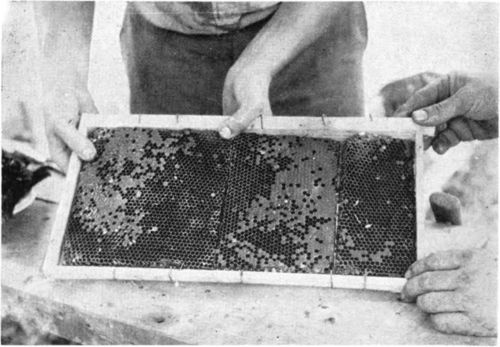
The worker comb is cut to fit the inside of the frame and tied in place with string or other means.
You now have your box hive without a bottom, and immediately above it an empty box into which the bees of the hive may run when they are driven into it. With a stick, hammer, or chisel rap vigorously on the bottom box hive, smoking the bees a little if necessary to keep them from getting angry. In a very few minutes, most of the bees and the queen will have forsaken their combs and run into the upper box. This box may be provided with a couple of cross sticks, making it easier for the combless bees to cluster. The box with the bees is then taken to your already prepared modern hive and dumped either directly into the hive or upon a sheet immediately in front of it, just as you would do with a new swarm.
Your old box hive is now minus its bottom and minus the bees and the queen. Take it inside where there will be no danger of possible robbers and proceed to cut out all the combs in the box. All combs with brood may be saved and combined into frames, properly fastened with wires. In spring, especially, the colony needs all the help it can get from freshly emerging bees, so all sizable patches of worker brood should be saved. It is also wise to make up a comb or two of dry or partly filled worker comb, as to build out comb at this early date may delay the egg laying of the queen. Oftentimes, twine is used instead of wires to wrap around the newly made up combs of brood, though the wires are stronger.
These frames of comb and brood are now given to the transferred colony, filling out the rest of the space with frames of bee comb foundation. The cover is replaced, entrance reduced to keep down chances of robbing, and feed supplied if there was no honey in the transferred combs. The colony can now be left to shift for itself for a few days. Eventually it will have all its combs filled out and will need surplus room. Also, in due course of time you will have opportunity to gradually work these transferred combs to the edge of the hive, whence they can be removed the following spring or whenever convenient, to be replaced by other drawn combs or by frames with full sheets of foundation.
Continue to:


My Books

