


Chapter VIII. Spring Management Of The Overwintered Colony. Early Spring Management
Description
This section is from the book "Beekeeping for Beginners", by G. H. Cale, Jr.. Also available from Amazon: Beekeeping for Beginners.
Chapter VIII. Spring Management Of The Overwintered Colony. Early Spring Management
If your bees were packed for the winter, the first thing to do in the early spring (late March or early April*) is to remove the packing and dispose of it. Next, whether the bees were packed or not, you should tilt the hive back, remove the bottom board and scrape it clean of debris or dead bees. Replace the hive on the bottom board and be sure to replace the entrance reducer. Bees will rob readily in the spring and examination of colonies should be conducted with the use of robber cloths.
During the first spring examination of the overwintered colony you should check for evidence of a laying queen, supply of honey, and pollen stores. If the colony has a laying queen you will find that brood rearing will start comparatively early -usually sometime in February or March. If an examination shows the colony to be strong in worker population, but queenless, you should order a new queen at once so that she will arrive in time to place in the colony during the first of the fruit blossoming period. As both pollen and honey are necessary for brood rearing, adequate supplies of both must be available if the colony is to build up in strength for the main honeyflow. If wintering instructions were followed carefully there should be plenty of honey for the colony at the time of this first examination. It is easy to tell when a colony of bees is short of food. A safe rule is to make sure that there is some sealed honey in the comb at all times. When there is no sealed honey to be seen, the bees are approaching starvation. If the colony is short of honey it should be fed sugar sirup. (Sugar sirup is prepared by mixing one part of sugar to one part of hot water, allowing the mixture to cool before using. ) With no honeyflow on and brood rearing increasing, a colony will consume approximately ten pounds of sugar sirup during a one* All references to seasonal dates refer to central Illinois. Spring moves northward at a rate of approximately ten miles per day. If you use this figure you will be able to change the dates mentioned in this text to conform with your own particular locality.
week period. Continue feeding sugar sirup until the natural supply of available nectar is sufficient for colony needs.
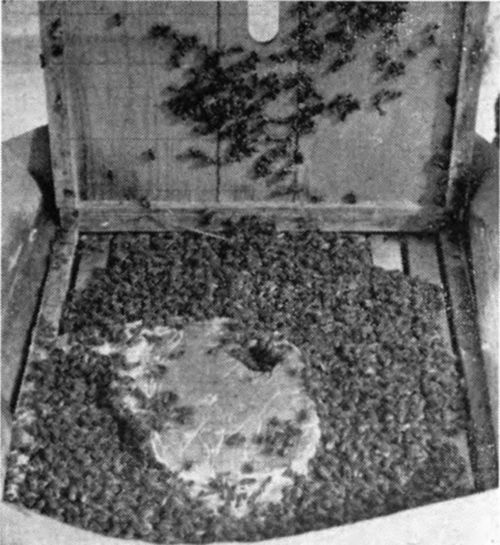
Pollen cake on colony in early March (Photo courtesy U. S. D. A. )
Considering that pollen is essential for brood rearing, the early spring period, when natural pollen either is not available or inclement weather prevents the bees from gathering it, is a critical time in the build-up of your colony. Check each comb carefully for pollen reserves. If the supply of pollen is low, feed a pollen substitute. Pollen substitute is made by mixing one part animal type brewer's yeast with two parts of ex-peller - processed soybean flour by weight. One-to-one sugar sirup is then added to the dry mixture until it is of a paste-like consistency, just short of being runny. Spread about three pounds of this mixture over the tops of the frames directly above where the bees are clustered, and cover with wax paper to keep the pollen substitute from drying and becoming hard. Continue to feed freshly prepared pollen substitute in this manner until natural pollen becomes available.
It is recommended that 1/4 teaspoon of sulfathiazole sodium powder be added to each pollen substitute cake and each pail of sirup given your bees during the spring period. The use of this drug serves as a very effective preventive for American foulbrood.
Midspring Management
The period of fruit bloom-starting with the apricot and pear, and ending with the last of the apple blossoms-bringing with it an abundance of natural pollen and nectar, is a period of great increase in colony strength. Stronger colonies may be given a full entrance at this time, although it would still be advisable to keep the entrances of weak colonies somewhat reduced. It is during this period that the results of a queen's egg laying should be full combs of solid brood. You should, therefore, watch closely for poor queens-distinguished by their spotty or small amount of egg laying. Such a queen should be replaced at once so that the new queen will have a chance to build up the colony during fruit bloom. It is always wise to have a few extra queens on hand at this time of the year.
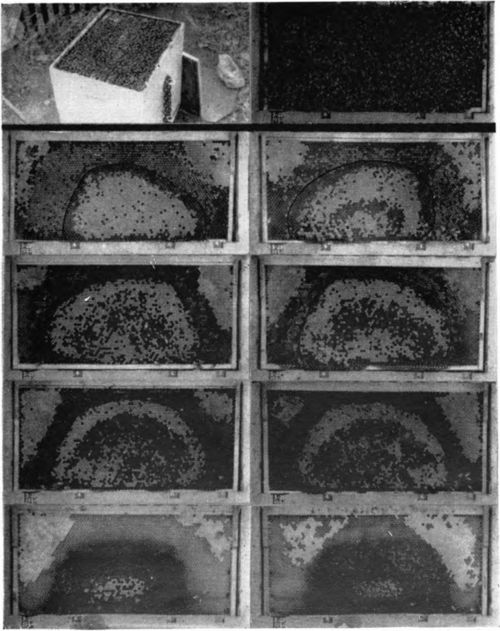
Brook nest of a colony on March 28, central west location. This colony had a fall pollen reserve of 632 square inches. Plenty of stored honey and an abundance of pollen reserves are responsible for this large, early brood rearing.
(Photo courtesy U. S. D. A. )
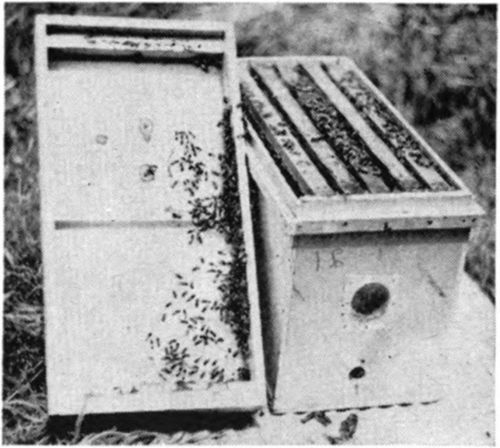
A transport or nucleus hive made from quarter inch lumber. The hive has screened holes in both ends as well as a false screened top and bottom to allow for ventilation. When being moved about, the entrance is closed and the bees still receive air through the screened portions of the hive. Such a hive allows a queen nucleus room to grow until you are ready to use it.
Continue to:


My Books

