


When, Where, And How To Decorate. Part 2
Description
This section is from the book "Interior Decoration: Its Principles And Practice", by Frank Alvah Parsons. Also available from Amazon: Interior Decoration: Its Principles and Practice.
When, Where, And How To Decorate. Part 2
In the same way, the living-room is meant to live in. We associate with this room objects which one needs to have about him for comfort, use, companionship, and personal enjoyment.
The drawing-room offers rather a problem of general use. It is the room in which not only friends but acquaintances and other guests make brief stays for purposes of formal social intercourse. Such things as stimulate conversation, arouse wit, and express one's general good taste belong in this room.
It will be clearly seen that the problems of the diningroom, hotel corridor, the general reception room, etc., are individual ones. The dominating idea of function separates one from the other, and renders each case a problem for special consideration before taking up the question of decorative arrangement.
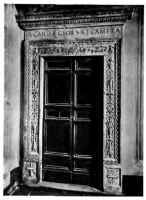
DOORWAY WHICH ILLUSTRATES STRUCTURAL EMPHASIS BY ORNAMENT, CONSISTENTLY APPLIED.
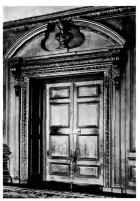
DOORWAY ILLUSTRATING OVER-EMPHASIS OK THE TOP BY TOO MUCH ORNAMENT, INCONSISTENTLY APPLIED.
In eliminating from rooms already furnished a sufficient number of articles to make a beginning possible, it is necessary to discuss one universal quality. Every one normally made has what he calls a sentiment for certain things. This sentiment is primarily, of course, supposed to apply to persons or their characteristics, but unfortunately it has been allowed to extend to all sorts of material objects, wedding gifts, family heirlooms, Christmas presents, bargain-sale effects, and other things with which nearly every home is filled.
The first error to combat in this field is the one through which the object bequeathed by a relative is confused with the relative himself. Because one's uncle possessed a crayon portrait of himself, or a mahogany table ugly in line, bad in proportion, and disagreeable in colour, is no reason why these inartistic objects should be perpetuated in each generation until the family line is extinct. This same uncle - be he ever so perfect in moral, spiritual, and even aesthetic qualities - could not and would not wish to transfer the qualities of these objects to the consciousness of his descendants simply because, for some unknown reason, he used them while he was alive. The mahogany table and its qualities are quite apart from the qualities of the individual, and a person who connects these two or makes them one is not a man of sentiment, but one of sentimentality - which is quite another matter. The same thing is true where gifts and other ugly acquired objects are indiscriminately cherished. The only possible excuse for keeping such things about is the lack of money to buy new ones and, even in that case, better nothing at all than bad things where good ones ought to be.
Probably the most difficult thing for any person who truly desires an artistic home, is to acquire the courage to put forever out of sight those things which absolutely prevent the realization of his ideal.
The attributes of beauty are perhaps difficult to understand at first, but in subsequent chapters we shall see that the merest novice can be helped to produce this quality if he can grasp the element of function and eliminate sentimentality from his consciousness at the out-
To return now to the question of decoration itself, some very elementary yet vital statements may be made here. Since every applied art object involves two elements - use and beauty - it is essential that we see these in their relation to each other and in their relation to the decorative idea.
As has been stated before, with a useful thing, use is paramount. One of the old masters of the Renaissance said: "Decoration must never be applied where use is sacrificed in its application." To appreciate this is probably the first step in grasping the meaning of the decorative idea. How often do we see fruits and flowers painted in the centre of a plate upon which we must eat anything ranging from soup to dessert. If these do not appear, fish do, and this complicates the situation considerably. The sofa pillow - that much-abused decorative article - is not decorative to most people if it is a solid colour or the colour of their divan. They must display prominently in its centre objects human, animal, vegetable, and sometimes mineral. The carpet and rug, with roses and lilies natural enough to demand respect, are trodden on without the slightest feeling as to the fitness of things in materials. Flowers appear upon our walls, and into them we drive nails, on them we hang pictures, and as they glaringly intrude themselves we are forever prevented from using hangings or other fittings decoratively upon them.
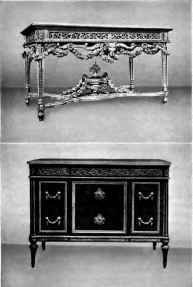
A CONSOLE TABLE, GOOD IN PROPORTION, BUT WITH ORNAMENT EXPLOITED FOR ITSELF IN A "CHRISTMAS TREE" ARRANGEMENT DISREGARDING STRUCTURE AND FUNCTIONAL CONSIDERATIONS, A COMMODE, BEAUTIFUL IN PROPORTION, WITH ORNAMENT APPLIED IN A TRULY DECORATIVE MANNER, EMPHASIZING STRUCTURE AND FUNCTIONAL APPOINTMENTS, HANDLES AND KEYHOLES.
This question of applying decoration, it will be seen, is not only concerned with the objects mentioned, but with furniture and other art objects when they are intended for use, and the decorative idea interferes in the least with that use. The same authority has given us help by a statement like this: "Decoration exists to emphasize and make structure stronger, and also to add beauty to the object decorated." The first consideration here, it will be seen, is not the decoration, but the structure of the object to be decorated. Take for example the door and its trim. The casing is bordered on each of its edges by mouldings more or less distinct. They are greater or fewer in number, according to the scale of the door, but always extend in the same direction as the structure of the door; that is, each parallel to the other, with their angles always right angles. These mouldings, following exactly the structure of the opening, as well as the door itself, not only call attention by their lines to the opening, but serve to strengthen or make more emphatic the outline of this opening. At the same time they perform the second function of breaking up the surface of the woodwork casing. This breaking up relieves the monotony of the flat surface, making the casing more interesting and, consequently, more beautiful in most instances than a perfectly flat surface could be made to appear.
Continue to:


My Books

