


When, Where, And How To Decorate. Part 3
Description
This section is from the book "Interior Decoration: Its Principles And Practice", by Frank Alvah Parsons. Also available from Amazon: Interior Decoration: Its Principles and Practice.
When, Where, And How To Decorate. Part 3
The chimney piece with its mantel shelf frequently has classic mouldings or simple lines bordering and bounding it. In this case the moulding becomes a decorative idea because it has followed and strengthened the structural appearance, and has, through a modest display of variation in surface and arrangement, expressed beauty or the decorative idea. One may readily see how this can be applied to a rug. A plain border, two or three bands, a few simple lines following the edge of the rug conforms to this law and also to the first principle stated, since there is no reason why one should not step upon an abstract decorative line.
At this point further illustration is unnecessary, but one should test not only these articles each in itself, but their arrangement as decorative effects in the room.
A helpful suggestion may be given here. An English writer has said that the confusion between decoration and ornamentation has led to many abuses of historic ornament. This is just as true of any other ornament seen in its true relation to the subject under treatment. "Decoration," he says, "exists to strengthen structure and make more beautiful the object on which it appears. Ornamentation, on the other hand, exists to exploit itself at the expense of the thing upon which it is applied." This is food for thought. If the ornament becomes the end instead of the means, or in other words, if it becomes apparent as an addition,' with the purpose of showing itself, it loses the decorative quality and savours of ostentation and, of course, proportionately, of vulgarity. It is well to remember this - that in any decorative question, decoration does not exist for itself, but for the thing upon which, or with which, it is used.
Another point must be discussed in order that we may begin at once to see material in its relation to decoration. Pattern or ornament must be adapted to the material in which it is rendered. For example, perfectly natural flowers cannot be expressed in woollen carpets nor in printed wall papers at so much a roll. Neither can vegetables, birds, and flowers be painted on china, glazed and baked, and still be real. Nor is this desirable. It is misapplied effort to attempt to copy nature exactly, and to reproduce all its qualities in anything excepting its own material.
Modern art thought has been almost exclusively influenced by the decadent Renaissance of France. Naturalism is not art, it is imitation, and when these two are confused, successful decoration is well-nigh impossible. In order that decorative motives may perform their function, they must be so conventionalized that they seem to be adequately and rightly expressed in the material with which or in which they are used. Only the greatest artists of any time are fit to handle naturalism in a decorative way, and then the conventionalization or modification of them to suit the material is a criterion of their decorative excellence.
Pictures, ornaments, and other objects, each perhaps decorative, may be so arranged on a wall, a table, or a mantel, as to destroy, for example, the rest quality of a room. Its dignity, too, or formality, may be absolutely lost in the arrangement of the furniture or in the placing of objects of ornament about the room. When this is done the decorative object, still decorative in itself, not only fails to perform its decorative function, but it destroys the fundamental idea, the use for which it is intended. This is illustrated in the hanging of portfires at doors so that passage is well-nigh impossible, or placing window hangings in such a way that no light can come in or that persons outside are always able to look in. It will later be seen that there is a way to hang windows and doors decoratively. and still not interfere with their function. This way is. of course, the right way, bom the standpoint of function, as well as of art and common sense.
It will be seen then that the problem of decorating a room takes into account its function and the function of each object used in its furnishing. It also includes such a choice and arrangement of these objects as will result in a decorative unit adequately expressed. It is really a question of seeing structure clearly in relation to its need for decorative treatment, and then seeing backgrounds in their relation to the decorative objects used. In our discussion of colour this matter of backgrounds will be considered.
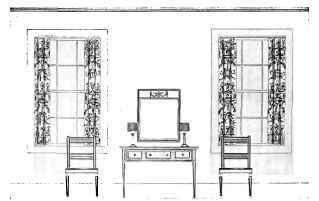
ELEVATION SKETCH OF SIMPLE ROOM IN WHICH THE DECORATIVE IDEA 1S CORRECTLY EXPRESSED IN CHINTZ HANGINGS, PLACING AND SPACING OF FURNITURE ON WALL, AND IN FURNITURE TREATMENT. DECORATIVE MATERIALS FOLLOWS STRUCTURE AND ADDS BEAUTY.
tion it may not be amiss to consider this term in its relation to life.
I have said that man intuitively desires to create and to possess beauty. This desire is equivalent in man's higher self to the appetite for food or drink or rest in the realm of physical existence. It is just as general, just as clearly defined, and just as important to man's realization of himself. This is shown by an investigation of the savage, the barbarian, or the so-called civilized communities in their building of shelter and in its decorative treatment, their making of implements and utensils more or less ornamented, their use and misuse of paint, metals, and textiles in matters of attire and in all ways by which man expresses naturally his life activities.
Art is then, first of all, a state of mind, a condition of consciousness growing out of a desire for beauty; or one might define it as an appetite for aesthetic things. The atrocities committed in any of the fields I mentioned are but sincere attempts to create the natural stimulus which the aesthetic sense of man demands. The reasons for these inartistic things are ignorance and over-zealous desire for beauty - not a wish to badly express the idea. Since art is a state of mind or of consciousness, it may be described as harmony between the idea and its expression and between all parts of the elements through which idea is expressed.
Continue to:


My Books

