


How To Use The Scroll-Saw
Description
This section is from the book "Our Homes And Their Adornments", by Almon C. Varney. Also available from Amazon: Our Homes and Their Adornments.
How To Use The Scroll-Saw
Amateurs should first learn to operate treadle, so they can run machine and talk at same time; even write and run saw. Having accomplished this, take a piece of cigar box or other thin board, make straight and curved lines upon it (do not at first turn round). When you have made the marks, place the board close to the saw, as near the mark as possible, with your hands on top of the board; press down gently - not hard, but always down and forward at an even speed, not by fits and starts. Keep the hands as near the saw as possible. Always use thin lumber first, and saw slowly; as you learn to saw you can learn to use machine to fullest capacity. To saw a bracket or any other piece of work, always place the pattern on the wood so that the grain will run lengthwise of the weaker parts.
Lesson I
Commence at one end and saw up to a sharp point; now, without stopping the motion of the saw, you want to swing the piece of wood around, using the saw blade as a fulcrum for the center; when you get so you can successfully do this you will find it of great value in executing work rapidly and nicely. At first you will find it a little difficult, for the reason that you do not turn on the actual center of the saw blade; this is caused by your pressing the wood forward slightly while you are turning it; now it should not be pressed in any direction, but if any way it should be held back a little, for the reason that it would then hit the back of the saw blade, which cannot cut; but this will be overcome by practice.

Fig. 79.
Lesson II
This is a different practice, but it will require no special instruction. Carefully follow the lines.
Do not crowd or hurry your work. In case the saw works hard, occasionally apply a little soap or bees-wax to the back of the blade.

Fig. 80.
Lesson III
This is a combination of the line, curve, and angle, but differing from previous lessons in this respect: In the preceding figures our object was to preserve the outside line, in this we preserve the inside. First, drill a small hole at a, unscrew the upper saw fastener, and insert the blade through the hole. Now proceed to cut out the design as already described.

Fig. 81.
Having practiced on these lessons until you can saw true, either on a line, curve, or angle, you will be ready to advance another step in this fascinating art.
Lesson IV
Making A Bracket
Having selected a good piece of black-walnut about three-sixteenths of an inch thick, apply to it the design. There are several methods for doing this. The simplest is to paste the design directly upon the wood, using flour paste. After the sawing is done, the paper can be removed by moistening with water, but it is much better to be careful in putting the paste on, and only put it on the part you throw away. You can also secure the design to the wood with small tacks, driven into the parts of the wood to come away. Another good way: Procure a sheet of "impression paper, ".lay the paper on the wood, place the design over it; take an instrument with a fine, hard point, and trace around the design. On removing the impression paper, the design will be seen neatly copied on the wood.
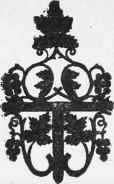
Fig. 82.
It is better to cut away inside work first. Drill holes in every part which requires cutting away; this done, place the wood, with the design upward, on the saw table. The inside of the design being complete, remove the outside in the same manner. Having finished the various parts of the bracket, it is ready for finishing.
Continue to:


My Books

