


Loss Of Head In Straight Pipes
Description
This section is from the book "Principles And Practice Of Plumbing", by John Joseph Cosgrove. Also available from Amazon: Principles and Practice of Plumbing.
Loss Of Head In Straight Pipes
Loss of head in straight pipes is caused entirely by the frictional resistance of the walls of the pipes; the rougher the walls, the greater the amount of frictional resistance offered to the flow. Frictional resistance in pipes may be summed up in three general laws, viz. :
Law 1
Frictional resistance in a pipe varies directly as the length of the pipe. That is, the total amount of friction offered in a pipe 100 feet long is twice as much as in a pipe 50 feet long, of equal diameter and smoothness, and one-half as much as in a pipe 200 feet long.
Law II
Friction varies inversely as the diameter of the pipes. That is, in a pipe 2 inches in diameter the frictional resistance is proportionately less by one-half than in a pipe 1 inch in diameter. The reason is that frictional resistance is in direct proportion to the area of the surface of water and walls of pipe in contact. This surface is known as the wetted perimeter, and in a pipe 2 inches in diameter is but twice as great as the surface in a 1-inch pipe, while the cross sectional area of the 2-inch pipe, it will be remembered, is 4 times as great as that of a 1-inch pipe.
This is well illustrated in Fig. 67. In the four 1-inch pipes, a, b, c, d, the length of the wetted perimeter is just 13.16 inches. If the four 1-inch pipes be now converted into one 2-inch pipe by removing the sections marked with dotted lines and rolling the heavy lined sections back to e, the wetted perimeter will be reduced to 6.49 inches, or about one-half the length of the combined perimeters of the four 1-inch pipes, while the sectional area remains unchanged.
Law III
Friction varies almost as the square of the velocity and is entirely independent of pressure. That is, if the velocity of flow of water in a pipe is doubled, the frictional resistance will be quadrupled, while if the initial velocity is reduced to one-half, the frictional resistance will be decreased to one quarter, regardless of the intensity of pressure in the pipe. Loss of head due to friction in pipes can be determined by the formula: h=f lv2 d2g
In which h=loss of head in feet; f=coefficient for size and roughness of pipe l=length of pipe in feet v=velocity in feet per second d=diameter of pipe in feet g=32.16 acceleration due to gravity
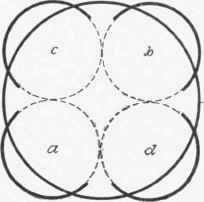
Fig. 67
Table XXVI - Values Of Coefficient f (Merriman)
Diameter of Pipe in | Velocity of Feet per Second | |||||||
Ft. | In. | 1 | 2 | 3 | 4 | 6 | 10 | 15 |
.05 | 5/8 | .047 | .041 | .037 | .034 | .031 | .029 | .028 |
.1 | 1 1/4 | .038 | .032 | .030 | .028 | .026 | .024 | .023 |
.25 | 3 | .032 | .028 | .026 | .025 | .024 | .022 | .021 |
.5 | 6 | .028 | .026 | .025 | .023 | .022 | .021 | .019 |
.75 | 9 | .026 | .025 | .024 | .022 | .021 | .019 | .018 |
1. | 12 | .025 | .024 | .023 | .022 | .020 | .018 | .017 |
The value of coefficient for different sizes of pipes and with different velocities of flow can be found in Table XXVI.
Example
What is the loss of head due to friction in a 3-inch pipe 600 feet long, if the mean velocity of flow is 4 feet per second?
Solution
From the table it is found that the value of f for a 3-inch pipe with a velocity of 4 feet per second is .025; then, substituting given values in the formula: h=.025 X 600X16 =15 feet. - Answer. .25X64.32
Table XXVII gives the loss of head in pounds per square inch for each 100 feet of length in different sizes of clean pipes discharging given quantities of water per minute.
Table XXVII - Loss Of Head In Pounds (G. A. Ellis, C. E.)
Gallons Discharged per Minute | 1/2-inch | 3/4-inch | 1-inch | l 1/4inch | 1 1/2-inch | 2-inch | 2 1/2-inch | 3-inch | 4-inch | 6-inch | Gallons Discharged per Minute | ||||||||||
Velocity in Pipe per Second | Friction Loss in Pounds | Velocity in Pipe per Second | Friction Loss in Pounds | Velocity in Pipe per Second | Friction Loss in Pounds | Velocity in Pipe per Second | Friction Loss in Pounds | Velocity in Pipe per Second | Friction Loss in Pounds | Velocity in Pipe per Second | Friction Loss in Pounds | Velocity in Pipe per Second | Friction Loss in Pounds | Velocity in Pipe per Second | Friction Loss in Pounds | Velocity in Pipe per Second | Friction Loss in Pounds | Velocity in Pipe per Second | Friction Loss in Pounds | ||
5 10 15 20 25 30 35 40 45 50 75 100. 125 150 175 200 250 300 350 400 450 500 | 8.17 16.3 | 24.6 96.0 | 3.63 7.25 10.9 14.5 18.1 | 3.3 13.0 28.7 50.4 78.0 | 2.04 4.08 6.13 8.17 10.2 12.3 14.3 16.3 | 0.84 3.16 6.98 12.3 19.0 27.5 37.0 48.0 | 1.31 2.61 3.92 5.22 6.53 7.84 9.14 10.4 11.7 13.1 19.6 | 0.31 1.05 2.38 4.07 6.40 9.15 12.4 16.1 20.2 24.9 56.1 | 0.91 1.82 2.73 3.63 4.54 5.45 6.36 7.26 8.17 9.08 13.6 18.2 | 0.18 0.47 0.97 1.66 2.62 3.75 5.05 6.52 8.15 10.0 22.4 390 | 5 10 15 20 25 30 35 40 45 50 75 100 125 150 175 200 250 300 350 400 450 500 | ||||||||||
1.02 | 0.12 | ||||||||||||||||||||
2.04 | 0.42 | ||||||||||||||||||||
1.63 | 0.21 | 1.13 | 0.10 | ||||||||||||||||||
3.08 | 0.91 | ||||||||||||||||||||
4.09 | 1.60 | ||||||||||||||||||||
5.11 7.66 10.2 12.8 15.3 17.1 20.4 | 2.44 5.32 9.46 14.9 21.2 37.5 | 3.26 4.90 6.53 8.16 9.80 11.4 13.1 16.3 19.6 | 0.81 1.80 3.20 4.89 7.00 9.46 12.48 19.66 28.06 | 2.27 3.40 4.54 5.67 6.81 7.94 9.08 11.3 13.6 15.9 18.2 20.4 22.7 | 0.35 0.74 1.31 1.99 2.85 3.85 5.02 7.76 11.2 15.2 19.5 25.0 30.8 | 1.28 | 0.09 | ||||||||||||||
2.55 | 0.33 | 1.13 | 0.03 | ||||||||||||||||||
■ | 3.83 | 0.69 | 1.70 | 0.10 | |||||||||||||||||
5.11 6.39 7.66 8.94 10.2 11.5 12.8 | 1.22 1.89 2.66 3.65 4.73 6.01 7.43 | 2.27 2.84 3.40 3.97 4.54 5.11 5.67 | 0.17 0.26 0.37 0.50 0.65 0.81 0.96 | ||||||||||||||||||
If the loss of head is desired for the same diameters of pipe but for different lengths than those given in the table, when discharging the given quantities of water, they can be found by multiplying the loss of head by the ratio of the length of pipe. For instance, according to the table there is a loss of head of 13 pounds in a 3/4-inch pipe when discharging 10 gallons of water per minute, and, as friction, hence loss of head, is in direct proportion to the length of a pipe, velocity and diameter remaining the same, it follows that in a 24-inch pipe 200 feet long, discharging 10 gallons of water per minute, the loss of head would be 26 pounds or double that in 100 feet of pipe. Likewise, in a pipe of equal diameter but only 50 feet long, discharging 10 gallons of water per minute, the loss of head would be 6.5 pounds or one-half that of 100 feet of pipe.
If the loss of head expressed in pounds in Table XXVII is desired in feet, it can be found by multiplying the loss of head in pounds by 2.3. The size of pipes and quantity of discharge being given in this table, the velocity of flow can be found by dividing the quantity by the area of the pipe.
Friction loss in pounds pressure per square inch for each 100 feet of length in different size clean iron pipes, discharging given quantities of water per minute, also velocity of flow in pipe in feet per second, can be found in Table XXVII.
Continue to:


My Books

