


Hydraulics Flow Of Water Through Pipes - Friction In Pipes
Description
This section is from the book "Principles And Practice Of Plumbing", by John Joseph Cosgrove. Also available from Amazon: Principles and Practice of Plumbing.
Hydraulics Flow Of Water Through Pipes - Friction In Pipes
The flow of water through pipes is accelerated by gravity and retarded by friction. If it were not for the frictional resistance in pipes water would flow through them with a velocity equal to eight times the square root of the head. As it is, the roughness of the interior walls, the bends and branch fittings in a system of piping offer so much frictional resistance that the actual mean velocity is but a fraction of the theoretical velocity.
The pressure head at any point is less than that due to the hydrostatic head. This difference between the hydrostatic head and the pressure head is known as loss of head, and is greater the smaller the pipe or the greater the velocity of flow. The loss of head is due to three causes - loss of head due to entry, loss of head due to bends, and loss of head due to the length and area of the pipe.
Loss Of Head Due To Entry
The Contracted Vein
The flow of water through a circular aperture in a thin plate, Fig. 61, is contracted in size a short distance outside of the plate to .615 the area of the aperture, but expands again to the full size of the opening. The point of greatest contraction is at a distance from the plate equal to about one-half the diameter of the aperture. In consequence of this contraction, the velocity of flow is slightly reduced from the theoretical velocity and the quantity discharged is greatly reduced. This contraction is known as the contracted vein.
When the aperture is through a plate of considerable thickness or through a tube the length of which is not less than twice the diameter of the pipe, the contraction is still found to occur but to a lesser extent than in the former case; the vein being contracted, as shown in Fig.
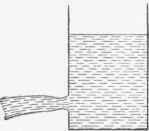
Fig. 61
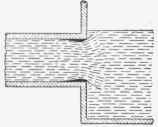
Fig. 62
62, to only .8 of the theoretical area due to head and aperture.
Loss due to the contracted entrance of water from a tank or cylinder into the end of a pipe, as commonly found in practice, must be taken then as .2 the quantity that should pass. This loss is known as loss of head due to entry and is considered separate from the loss due to friction in long pipes, loss for bends, branches, etc., and should be added thereto.
The actual loss of head due to entry can be reduced to a quantity too small to be considered by enlarging the entrance to the pipe and making it cone shaped as in Fig.
63. The cone should have a length a, equal to one-half the diameter of the pipe, and a radius b equal to 1.22 diameters of the pipe. Any greater enlargement of the opening will deduct but little from the loss of head. If the ends of thick pipes or pipes of small diameter which are relatively thick are reamed with a reamer, the length of which is just twice the base, enough metal will be removed to give almost the best form of contracted vein.
When an unreamed pipe projects a short distance inside of a tank the loss of head due to entry is greater than when the pipe finishes flush with the inside of the tank. This loss of head has been found by experiment to be over .3 of the whole flow, thus decreasing it one-tenth more than a pipe that finishes flush with the inside of a tank.
Loss of head due to entry can be determined by the formula: l=c v2.
2g
When l=loss of head in feet; v=velocity of flow in feet per second g=32.16, acceleration due to gravity c=coefficient depending on shape of the pipe inlet.
For ordinary calculations the value of c may be taken as .5.
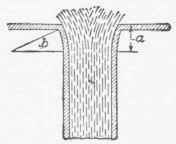
Fig. 63
Example
What is the loss of head due to entry in a pipe when the velocity of flow is 8 feet per second?
Solution
1 =.5 = .497 feet. Answer. 64.32
Continue to:


My Books

