


Of The Mechanical Division Of Bodies. Part 3
Description
This section is from the book "The London Dispensatory", by Anthony Todd Thomson. Also available from Amazon: PDR: Physicians Desk Reference.
Of The Mechanical Division Of Bodies. Part 3
The concentrated acids and alkaline solutions act too powerfully on the materials commonly employed for filters, to be filtered in the ordinary way; and therefore, when it is required that they should be filtered, which is not often the case, they are passed through strata of siliceous matter, arranged in a glass funnel, in the following manner:-An irregularlyshaped pebble is first dropped into the throat of the funnel; then a layer of pieces of quartz, or broken flint glass, is placed over it; and, lastly, a thick stratum of coarsely-powdered glass, or of well washed white sand, covers the whole. The substance to be filtered is poured gently on the surface of the sand, and soon passes through it and the substrata, leaving the impurities behind.

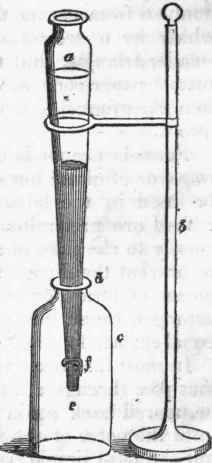
4. Percolation is a species of filtration which might be most beneficially employed for making tinctures. It is performed by means of an oblong funnel, a, which may be made of glass or of block tin; and it may be incased with another terminating a few inches from the top, and as many from the bottom, for holding hot water in operations in which the aid of heat is required. For ordinary purposes, the percolator, a, made of glass, may be supported by a brass stand, b, and the smaller extremity inserted into a wide-mouthed bottle, c, which it should only loosely fit, to enable the air to escape. The materials to be acted upon are to be rubbed up with an equal bulk of pure siliceous sand, then put into the percolator, over the lower orifice of which, e, a piece of calico,f, should be tied: lastly, the fluid, whether spirit or alcohol, must be poured over the materials, and the superior opening slightly stopped with a cork. By this method of operating, as a particle of sand is interposed between each particle of the materials, the spirit, in passing through, acts upon every side of it; and thus carries downwards all the soluble matter which it contains.
Tinctures which, in the ordinary mode of maceration, require from seven to fourteen days to be perfected, are made by the percolator in as many hours. The whole of the tincture is obtained by pouring over the materials some water, towards the conclusion of the process; since the water drives before it the spirit, and remains in the percolator.
5. Expression is employed for obtaining the juice of fresh vegetables, and the unctuous vegetable oils. The subject is first bruised or coarsely ground, then enclosed in a hair-cloth bag, and subjected to violent pressure between the plates of a screw press. The bags should be nearly filled; and the pressure should be gentle at first, and gradually increased.
Vegetables, in general, intended to be expressed, should be perfectly fresh, and cleansed from all impurities; and should be submitted to the press as soon as they are bruised, as the bruising disposes them more readily to ferment; but subacid fruits yield more juice, and of a finer quality, when the bruised fruit is allowed to stand for some days in an earthen or a wooden vessel. It is necessary to peel oranges and lemons before pressing them, to prevent the essential oil which their rind contains from mixing with the juice: and to some vegetables, which are not very juicy, the addition of a little water is requisite.
For expressing the unctuous seeds, in order to obtain the oil which they contain, iron plates are employed; and the bruised seeds should be previously exposed in a bag to the steam of boiling water.
6. Despumation is employed to clarify fluids which are so thick and clammy as not to be able to penetrate through the substances of which filters are made, without some previous preparation. For this purpose it is sometimes required only to heat the liquor, which then throws up a scum that is to be carefully removed; but more frequently it is necessary to clarify it with the white of egg. When the substance is not spirituous, as syrup for example, the albumen which is mixed with the fluid coagulates when it is boiled, and, entangling the impurities of the fluid, rises with them to its surface in the form of scum; but spirituous liquors may be clarified with isinglass without the assistance of heat, the alcohol coagulating the isinglass, which forms a scum, and descending to the bottom of the vessel, carries with it all the impurities. Some expressed juices are clarified by the simple addition of any vegetable acid.
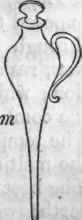
Besides the above methods of mechanically separating the parts of substances from one another, fluids of different specific gravities, mixed together, are separated by means of the separatory funnel, m. It is chiefly used for separating the essential oils from the water with which they are entangled during their distillation. The funnel is first stopped at the bottom, and then filled with the mixed fluids, the heaviest of which gradually subsides into the narrow part below; and when the cork at the bottom is taken out, and the stopper above a little loosened, it flows out; by which means the lighter is easily obtained in a separate state. Some of the essential oils are heavier, others lighter than water, but both can be thus separated with equal facility.
Continue to:


My Books

