


Of The Mechanical Division Of Bodies. Part 2. Mechanical Separation
Description
This section is from the book "The London Dispensatory", by Anthony Todd Thomson. Also available from Amazon: PDR: Physicians Desk Reference.
Of The Mechanical Division Of Bodies. Part 2. Mechanical Separation
The parts of substances, under certain circumstances, may be separated from each other by different mechanical means; as sifting, washing, or elutriation, filtration, expression, and despumation.
1. Sifting, The particles of the powders obtained by the longest and most accurate pulverization and trituration are still of very unequal degrees of fineness, and therefore require to be separated, the finer from the coarser, by the operation* denominated sifting. For this purpose sieves are employed, made of iron-wire, or of hair-cloth, or of gauze. These permit the finer particles to pass through them, and leave the coarser to be again submitted to the pestle; and thus by degrees the whole assumes an uniform fin-ness. The simple sieve is a broad wooden hoop, with a cloth of one or other of the above textures stretched over it in the manner of the parchment of a drum. The compound sieve, which is more employed, consists of the simple sieve, b, with a deeper rim, a, a lid covered with leather, and d, a receiver, with leather stretched across one end, and made sufficiently wide to admit the lower portion of the sieve to enter and fit tightly within it. When these are put together, the finest powders may be separated by them without any loss or inconvenience to the operator.

2. Washing, or Elutriation, is intended for separating the finer parts of powders prepared by trituration or levigation, which are not acted upon by water. The powdered substance is mixed with a large quantity of water, and briskly stirred, so as to diffuse it pretty equally through the fluid, which retains the finer particles suspended for a short space of time, and permits the coarser to settle to the bottom. The liquor, still containing the finer particles suspended, is poured off from the sediment; and by allowing it to remain at rest for a sufficient length of time, it deposits the fine powder, from which the clear water is separated, either by carefully decanting it, or, if the sediment be very light, so as to be easily disturbed, by drawing it off through the glass syphon, g, the longer limb of which being plunged into the vessel containing the fluid till it nearly touches the subsided powder, where it is supported by the board, f, placed on the mouth of the vessel, e, and the air sucked from it by means of the arm, h, the whole of the supernatant fluid is drawn off into the vessel, i, and the powder left in a fit state to be dried.1 The coarser particles first separated may be again levigated, and the elutriation repeated.
Chalk and some metallic matters are thus prepared; and the process may likewise be employed for separating substances of different degrees of specific gravity, although of the same degree of fineness.
3. Filtration is intended for separating fluids from solid bodies suspended in them. Filters may be regarded as kinds of sieves; and are generally made either of very fine and close flannel, or of linen, or of unsized paper formed into a conical shape, through which the liquid percolates clear, while the solid is collected at the apex of the cone, which is inverted. When the quantity of materials is large, and the solid suspended in the fluid is not in the state of very fine powder, flannel or linen bags are to be preferred, as performing the process more quickly than paper. These are generally made in a conical shape, with the mouth stretched on a hoop or frame supported upon a wooden stand. When the solid residue is the part to be preserved, flannel filters may be used; but when the filtered liquor is the valuable product, linen is preferable, as it absorbs less of the fluid, which is obtaiued, also, in a more limpid state. The cloth must be well cleaned after every time that it is used, to prevent any thing from remaining to injure subsequent operations. For small processes, unsized paper is the best material for forming filters.
A square piece of this paper, of a size proportionate to the quantity of the substance to be filtered, is taken, and first doubled from corner to corner into a triangle, which by a second doubling forms again a smaller triangle, and this when opened constitutes a paper cone, k, which is to be supported in a glass funnel, l, before the liquor is poured into it.
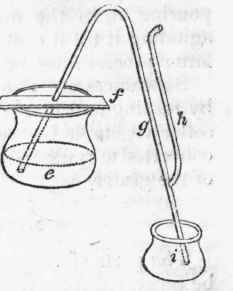
1 The fluid may also be drawn off by means of wet cotton or worsted threads, having one end in the fluid, nearly touching the precipitate from which it is to be separated, and the other hanging over the side of the vessel, below the plane of the fluid in it.
Funnels are made of tin, or of Wedgewood's ware, or of glass; but only the two latter should be used in the laboratory. Those which are ribbed are preferable, as the paper adheres so closely to the sides of smooth funnels as nearly to prevent the filtration from proceeding, unless pieces of straw, or quills, or thin glass rods, be arranged round the inside, so as to form an unequal surface for the paper to rest upon.
In most instances, the first portions of fluid that pass through a filter are turbid, and therefore require to be poured back again into the filter, sometimes repeatedly, until the pores of the filter are sufficiently obstructed to permit the most limpid part only of the liquor to pass. In cases where the solid residue is small, and it is requisite to collect the whole of it, it is useful to have a small glass tube, drawn out to a fine capillary point at one extremity, and blown to a globe in the centre; by filling which with distilled water, and putting the larger end into the mouth, the force of the breath can direct a small but strong stream of water round the sides of the paper in the funnel, which will wash down to its bottom all the minute particles of solid matter lodged on its sides.
Continue to:


My Books

