


B. Of The Mechanical Division Of Bodies
Description
This section is from the book "The London Dispensatory", by Anthony Todd Thomson. Also available from Amazon: PDR: Physicians Desk Reference.
B. Of The Mechanical Division Of Bodies
The cohesion of solid bodies often opposes an obstacle to their immediate chymical combination with other substances, and their medicinal action in the stomach; and therefore the following preliminary mechanical operations are instituted for overcoming to a certain degree that power, and separating the integrant particles of bodies, or reducing them to the state of powder. These are denominated pulverization, trituration, levigation, and granulation.
1. Pulverization is that process by which friable and brittle solid bodies are reduced to powder. It is generally performed in mortars, by means of pestles. These are made of various materials; of brass, iron, marble, granite, glass, agate, and porcelain, or of Wedgewood's ware, according to the nature of the substances for the pulverization of which they are intended to be used: it being requisite that the materials of which pestles and mortars are made be such as to resist both mechanical force and the chymical action of the substances they contain. Thus, a mixture containing any astringent matter is turned black, if rubbed in an iron mortar; and acid substances act upon one made of marble.
Mortars are required to be of various sizes. The largest size is usually made of cast iron, a, fitted with a wooden cover, b, perforated to admit the pestle, but close enough to prevent the finer and lighter parts of the substances from flying off, and to defend the operator from disagreeable and noxious matters, such as aloes, ipecacuanha, etc. This may be more completely attained by tying closely round the mouth of the mortar, and round the stalk of the pestle, c, a large piece of leather, so pliable as to admit the free motion of the pestle. But notwithstanding these guards, it is sometimes necessary for the operator to cover his mouth and nostrils with a wet cloth, and to stand with his back to a current of air, that the particles which arise may be carried from him, when very acrid friable matters, as Euphorbium or Spanish flies, for instance, are to be powdered. To lessen the labour, the pestle is often attached by a cord to the end of a flexible wooden beam, placed horizontally over the mortar, the elasticity of which elevates the pestle to the proper height after each stroke is made.
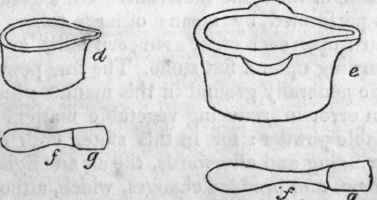
For lighter purposes, brass and bell-metal mortars are sometimes used: but as, in the pulverization of every hard body, the mortar also is worn by the operation, these mortars are improper for pharmaceutical purposes. The most useful mortars for smaller articles are those of porcelain and Wedgewood's ware, d, e, as they are smooth, hard, and resist the action of any chy-mical re-agent. The handles, f, of the pestles are made of wood, and the heads, g, of the same material as the mortar.
Of whatever materials mortars are made, they should be internally, at bottom, of the form of a hollow hemisphere, and their sides should have such a degree of inclination as to make the substances fall back to the bottom every time the pestle is lifted. The operation, however, is retarded when too great a portion of the ingredients falls under the pestle; hence a large quantity of any substance should not be put into the mortar at a time, and the finer parts should be from time to time removed.

Vegetable matters require to be dried before they can be pulverized; and wood, roots, and barks should be previously cut, chipped, or rasped. When roots are very fibrous, as those of ginger, for example, it is advisable to cut them diagonally, which prevents the powder from being full of hairlike filaments. Resins and gum resins, which soften in a moderate temperature, or in warm weather, should be powdered in cold weather, and only gently beaten to prevent them from running into a paste instead of forming a powder; and when the powdered substance is intended to be dissolved in any menstruum except a pure alkali, the pulverization is much facilitated by mixing them with a portion of clean, well washed, white sand. The pulverization of camphor is assisted by the addition of a few drops of alcohol; sugar is the best addition to aromatic oily substances, as nutmegs, mace, etc.; and to the emulsive seeds some dry powder must be added, without which they cannot be reduced to powder. Metals which are scarcely brittle enough to be powdered, and yet are too soft to be filed, as zinc, for instance, "may be powdered while hot in a heated iron mortar; or metals may be rendered brittle by alloying them with a small quantity of mercury1;" but as metals are not required to be reduced to the state of very fine powder for pharmaceutical purposes, these processes are seldom performed.
2. Trituration is intended to produce the same effect as pulverization, but in a greater degree. It is performed by a rotatory motion of the pestle, either in the common mortars of glass, agate, or Wedgewood's ware, or in flatter mortars made of the same materials. On a great scale this operation is performed by means of large rollers of hard stone, which turn upon each other as in corn mills, or by one vertical roller, turning upon a flat stone. The fine powders kept in the shops are generally ground in this manner; but there appears to be an error in reducing vegetable matters to the state of impalpable powder: for in this state, both during the process of grinding and afterwards, the air and light act powerfully upon them, and produce changes, which, although they be not well understood, yet appear to alter the medicinal virtues of the substances.
3. Levigation is a process similar to trituration, except that the rubbing is assisted by the addition of a liquid in which the solid under operation is not soluble. Water or spirit of wine is usually employed, and occasionally viscid and fatty matters, as honey and lard. The substance to be levigated is spread on a flat table of porphyry, or some other hard stone, b, and is then bruised and rubbed with a muller of the same materials, either of a cylindrical shape, as a, a, or a portion of a large sphere. A thin spatula of ivory, horn, wood, or iron, is employed to bring back the materials from the edges of the table, to which the operation of the muller continually drives them. Earths and some metallic substances are thus prepared.
Lavoisier's Chymistry-Trans. 437.
4. Granulation is employed only for the mechanical division of metals and of phosphorus. It is performed by melting the substance, and either stirring it briskly until it is cold, or pouring it, in the melted state, into water, and stirring or agitating it till it cool. For the granulation of phosphorus, the latter process must be employed.
Substances are also reduced to the state of coarse powder by rasping and filing; and softer vegetable bodies are converted to a pulp by means of the grater, c.


Continue to:


My Books

