


Of The Mechanical Division Of Bodies. Part 4. II. Chymical Operations
Description
This section is from the book "The London Dispensatory", by Anthony Todd Thomson. Also available from Amazon: PDR: Physicians Desk Reference.
Of The Mechanical Division Of Bodies. Part 4. II. Chymical Operations
The operations of Pharmacy, which are strictly chymical, may be arranged in three classes.
a. Operations which produce changes in bodies, separating the constituents, without any obvious decomposition.
b. Operations in which changes are produced by the chy-mical action of one set of bodies upon another, or attended with obvious decomposition.
c. Operations in which the oxidizement and the deoxidize-ment of bodies are effected by means of a very high temperature.
a. Of the operations which produce changes in bodies, separating the constituents, without any obvious decomposition.
These changes are effected-
1. | By Caloric-inducing - | Liquefaction. |
Fusion. | ||
Evaporation. | ||
Exsiccation. | ||
Distillation. | ||
Rectification. | ||
Dephlegmation. | ||
Sublimation. | ||
2. | By water and other fluids - | Solution. |
Lixiviation. | ||
Maceration. | ||
Digestion. | ||
Extraction. | ||
3 | By other chymical agents - | Coagulation. |
1. Operations in which the changes are effected by caloric.
Liquefaction is that operation by which certain bodies, when exposed to a moderate heat, are rendered fluid, after passing through several intermediate states of softness. Fat, lard, wax, resin, and many other similar bodies, undergo liquefaction; which is, therefore, employed in pharmacy to facilitate the combination of these bodies in the formation of ointments. The temperature at which liquefaction takes place is termed the melting point. It is always the same, in the same body. The best vessels for conducting the process of liquefaction are earthenware pans.
Fusion is a modification of liquefaction, but differs from it in the sudden change from the solid to the fluid state which those bodies, which are liable to it, suffer on exposure to heat. There are no intermediate states of softness; but the fusible body, when heated to a certain point, immediately assumes the fluid form. This point differs very considerably in different solids; but, in general, simple substances are less fusible than compounds; and some of the simple earths cannot be fused without the addition of some other substances to promote their fusion. These are generally saline bodies, and are denominated fluxes.
Fusion, which may take place without changing the nature of the fused matter, is intended as a mean of promoting chymical action, and of decomposing bodies. It is, however, generally confined to the metals, which are extracted from their ores, and afterwards smelted and alloyed by it. It is a species of operation occasionally employed in pharmaceutical processes.
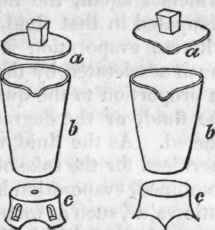
Fusion is usually performed in crucibles1, the best of which are made of very pure clay, or potter's earth. Those formed of common clay, with calcareous or siliceous earth, are easily vitrified, and then melt. The Hessian crucibles are composed of better clay and sand, and when good, stand the fire very well; as do also Wedgewood's crucibles; but they are apt to crack when suddenly heated or cooled,- a circumstance, however, which may be remedied by using a double crucible, and filling the interstice with sand, or by coating the crucible with a paste of clay and sand. Crucibles formed of black lead resist very sudden changes of temperature; but they are destroyed if nitre be melted in them; and even a current of air acting upon them whilst they are hot destroys them. Crucibles are made of various forms,, three-cornered or round, b, b, and fitted with covers, a, a. The lids may be luted on, if necessary, with a mixture of clay and borax. Those crucibles which are of uniform thickness, which have a reddish brown colour, without black spots, and a clear sound when struck, are to be preferred. •
In order to expose the lower part of a crucible to the utmost intensity of heat, and to prevent it from cracking by the draught of cold air which would be directed upon it, were it to be placed directly upon the grate of the furnace, it is usually raised upon a small stand, c, c, either solid or hollow, an inch above it, which, according to Dr. Kennedy, is the hottest part of the furnace.
Crucibles are also made of cast-iron, of fine silver, and of platinum. The, first, however, are destroyed when saline substances are melted in them; and, when made red-hot in a current of air, are apt to suffer oxidation; but in other respects they are durable, and can sustain sudden alternations of heat and cold without cracking. Some of the metallic crucibles combine many of the best qualities necessary for this set of instruments; particularly those of platinum, which, however, are too expensive for ordinary use.
1 The name crucible was derived from the alchemists having stamped upon the vessel the figure of the cross.
Evaporation is the dissipation of a liquid by means of heat, and is employed in pharmacy, generally with the view of obtaining, in a separate state, any fixed substance which may be combined with water, or some other evaporable fluid. Thus by exposing an aqueous solution of a salt to a certain degree of heat, the caloric which combines with the water renders it volatile, and disperses it in the form of an elastic aeriform fluid; while the particles of the salt, being brought nearer to each other, and within the sphere of their mutual attraction, reunite, and the salt is obtained in its concrete state. This process differs from spontaneous evaporation, in which air is the principal agent, the liquid being diminished in quantity and dissipated in that fluid, independent of the action of caloric; whereas evaporation is not carried on by the air, nor even much accelerated by the exposure of a large surface, but only in proportion to the quantity of caloric which combines with the fluid, or the degree of heat at which the process is conducted.
As the fluid which is dissipated is entirely lost, and sacrificed for the sake of the fixed substance with which it was combined, evaporation is only employed where the liquid is of little value, such as water; but where a solid is to be recovered from a more valuable liquid, as alcohol, for instance, the process of distillation is employed.
Continue to:


My Books

